How to Tell if an Alexandrite Is Real
Real alexandrite is so rare that most 'alexandrite' jewelry — especially vintage pieces — is actually synthetic color-change sapphire. The test that matters is the quality of the color change: true alexandrite swings green-to-red, while the common fakes swing blue-to-purple. Price is the other tell: genuine alexandrite has no bargains.
The 60-Second Alexandrite Checklist
Run these quick checks first — most fakes fail at least one before you ever reach for a loupe.
- Green/teal in daylight → red/raspberry under incandescent light
- Blue-to-purple change = synthetic color-change sapphire
- Strong pleochroism: green, orange, purple-red down different axes
- Real alexandrite over 1 ct starts at five figures — cheap means fake
- Most 'grandma's alexandrite' from 1900–1980 is synthetic sapphire
5 At-Home Tests for Real Alexandrite
Work through these in order — each one is safe for genuine alexandrite unless noted, and together they expose nearly every common fake.
The two-lamp color-change test
View the stone under cool daylight/LED (5000K+), then under a warm incandescent or candle-type bulb. Phone flashlights are too white — use a genuinely warm source like a halogen or candle-type bulb.
Real alexandrite
Alexandrite shifts from green/bluish-green to red/purplish-red — the famous 'emerald by day, ruby by night'. Fine stones shift 80–100% of their body color.
Fake
Synthetic color-change sapphire (the classic impostor) shifts grayish-blue to purple/mauve — never a true green-to-red swing.
Daylight hue inspection
Judge the daylight color carefully against known references.
Real alexandrite
Bluish-green to teal-green body color in daylight.
Fake
If the 'daylight' color is blue-gray or violet-blue, you're looking at sapphire chemistry, not chrysoberyl.
Pleochroism check
Rotate the stone down different axes in daylight.
Real alexandrite
Alexandrite is strongly trichroic: green, orange-yellow, and purple-red appear down different directions.
Fake
Color-change glass shows nothing; synthetic sapphire shows weaker two-color shifts.
Loupe for curved striae and bubbles
Examine the interior at 10× under side light.
Real alexandrite
Natural alexandrite may show fine needles, fingerprints, or step-like growth zoning.
Fake
Curved growth lines and tiny gas bubbles betray Verneuil synthetic sapphire; perfect emptiness in a large stone suggests lab-grown material of either kind.
Price and provenance sanity check
Compare the ask against the real market before believing any story.
Real alexandrite
Natural alexandrite with a good change runs $1,000–$70,000+ per carat; 1 ct+ fine stones are five-figure gems.
Fake
A '3-carat alexandrite' for $200 is synthetic — no exceptions, no estate-sale miracles.
Common Fake Alexandrites & How to Spot Them
These are the materials most often sold as alexandrite — and the giveaway that exposes each one.
| Imitation | How to spot it | The giveaway |
|---|---|---|
| Synthetic color-change sapphire | Blue-to-purple change, curved striae, often in vintage jewelry sold as 'alexandrite'. | Wrong colors in both lights — no true green, no true red. |
| Lab-grown alexandrite | Real chrysoberyl chemistry with excellent change, but too clean and 'too good' for the price. | Genuine material worth ~$100–500/ct — fine if disclosed, fraud if sold as natural. |
| Color-change garnet | Shifts bronze-green to raspberry; singly refractive, no trichroism. | A lovely natural gem, but the shift starts from brownish-green, not alexandrite's teal. |
| Andalusite (misidentification) | Shows green and red simultaneously from different facets rather than changing with light source. | Pleochroism mimicking color change — rotate it under one light to expose the difference. |
When to get professional testing
No colored stone needs lab paper more than alexandrite. Natural-vs-synthetic and Russia/Brazil/Sri Lanka origin calls can swing value by 100×, and the synthetic sapphire impostor fools most consumers. GIA, Gübelin, or AGL certification is mandatory at these prices — budget it into any purchase.
Photo-Check Your Alexandrite in Seconds
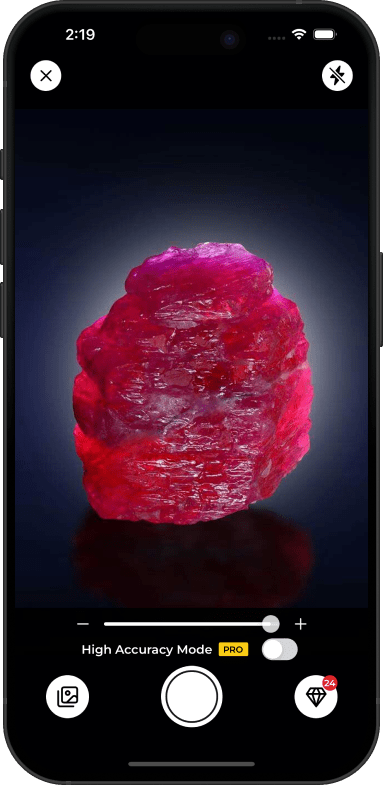
Upload a photo and Ruby Glint's AI compares your stone against thousands of verified alexandrite and lookalike references — free, no login required.
Or try the free online identifier

Real vs Fake Alexandrite: Your Questions
Get answers to common questions about rock identification, rockhounding, and using our platform.
Statistically, probably not. From roughly 1900–1980, enormous quantities of synthetic color-change sapphire were sold worldwide as 'alexandrite', especially in rings from Mexico, Egypt, and mail-order catalogs. If it shifts blue-to-purple rather than green-to-red, it's the sapphire impostor — still a nice stone, worth perhaps $50–100.
Teal-to-bluish-green under daylight swinging to red, raspberry, or purplish-red under incandescent light. Quality is graded by the completeness of the shift — fine stones change 80–100% of their face-up color. Weak, partial, or blue-purple shifts mean lesser stones or different materials.
Among the highest per-carat prices of any gem: roughly $1,000–$5,000/ct for small or weak-change stones, $5,000–$25,000/ct for fine 1 ct stones, and $30,000–$70,000+/ct for fine Russians and large gems with dramatic change. Lab-grown alexandrite, by contrast, runs a few hundred dollars per carat.
It's genuine chrysoberyl with a genuine color change — legitimate when disclosed and a defensible way to own the phenomenon for ~1% of natural prices. It becomes fraud only when sold as natural, which is why certification matters at every price point for this gem.
Keep Going: AlexandriteValue & Identification
Alexandrite Price Per Carat
Current 2026 price ranges by carat size and quality tier.
Gemstone Value Calculator
Get an instant market estimate for your alexandrite.
Alexandrite Identification Guide
Full encyclopedia entry: properties, colors, and lookalikes.
Free Gemstone Identifier
Upload a photo and identify any gemstone with AI.
Home tests are screening tools, not certification. For high-value purchases, insurance, or resale, confirm with an accredited gem lab (GIA, AGL, Gübelin, SSEF).