How to Tell if a Diamond Is Real
Most fake diamonds are cubic zirconia, moissanite, or glass — and each one fails at least one simple at-home test. A real diamond conducts heat almost instantly, refracts light so strongly you can't read through it, and never shows the rainbow 'disco-ball' fire of moissanite. Run the checks below before you pay for a lab report.
The 60-Second Diamond Checklist
Run these quick checks first — most fakes fail at least one before you ever reach for a loupe.
- Fog it: a real diamond clears in 1–2 seconds, fakes stay fogged
- You cannot read newsprint through a round brilliant diamond
- Sparkle is white brilliance with flashes of fire — not all-rainbow
- CZ of the same size feels noticeably heavier (about 1.7×)
- Check the girdle for laser inscription matching a GIA report
5 At-Home Tests for Real Diamond
Work through these in order — each one is safe for genuine diamond unless noted, and together they expose nearly every common fake.
The fog test
Breathe on the stone like you would on a mirror and count how long the fog lingers.
Real diamond
Diamond conducts heat so well the fog disperses in one to two seconds.
Fake
Cubic zirconia and glass stay fogged for several seconds because they hold heat.
The dot (read-through) test
Draw a small dot on white paper and place the stone table-down over it. Look straight down through the pavilion.
Real diamond
A well-cut round diamond bends light so sharply you cannot see the dot or any print through it.
Fake
Through CZ, glass, white sapphire, or quartz you can usually see the dot or a circular reflection of it.
Sparkle and fire check
Rock the stone under a single light source and watch the character of the flashes.
Real diamond
Diamonds return intense white brilliance with distinct, separate flashes of colored fire.
Fake
Moissanite throws exaggerated rainbow fire from every facet (a 'disco-ball' look); glass and quartz look glassy and dim.
Weight and heft comparison
If you can weigh the loose stone, compare carat weight against its millimeter diameter (a 6.5 mm round diamond ≈ 1.00 ct).
Real diamond
Diamond's density is 3.52 g/cm³ — size and weight line up with standard charts.
Fake
Cubic zirconia is about 70% heavier for the same size; a 6.5 mm CZ weighs roughly 1.7 ct.
Loupe the girdle and facets
Examine the stone at 10× magnification, especially the girdle and facet junctions.
Real diamond
Crisp, knife-sharp facet edges; possibly a microscopic laser inscription on the girdle; tiny natural inclusions.
Fake
Rounded or scuffed facet edges (glass and CZ are far softer), mold lines, or internal gas bubbles — bubbles mean glass, always.
Common Fake Diamonds & How to Spot Them
These are the materials most often sold as diamond — and the giveaway that exposes each one.
| Imitation | How to spot it | The giveaway |
|---|---|---|
| Cubic zirconia (CZ) | Fails the fog test, much heavier than diamond, facets wear dull over time. | Reads through on the dot test and weighs ~1.7× a diamond of the same size. |
| Moissanite | Look down through the table at 10×: facet edges appear doubled because moissanite is doubly refractive. | Excessive rainbow fire and doubled facets — diamond is singly refractive and never doubles. |
| White sapphire | Noticeably less brilliance and almost no fire; looks 'glassy gray' next to a diamond. | Passes a scratch test but fails the sparkle comparison badly. |
| Glass / rhinestone | Internal round gas bubbles at 10×, soft scratched facets, stays fogged. | Any visible bubble is conclusive — diamonds never contain gas bubbles. |
When to get professional testing
A thermal/electrical tester pen separates diamond from CZ in seconds but can be fooled by moissanite, so jewelers use a dual tester. For purchases over a few hundred dollars insist on a GIA or IGI report — it also tells you whether the diamond is natural or lab-grown, which home tests cannot.
Photo-Check Your Diamond in Seconds
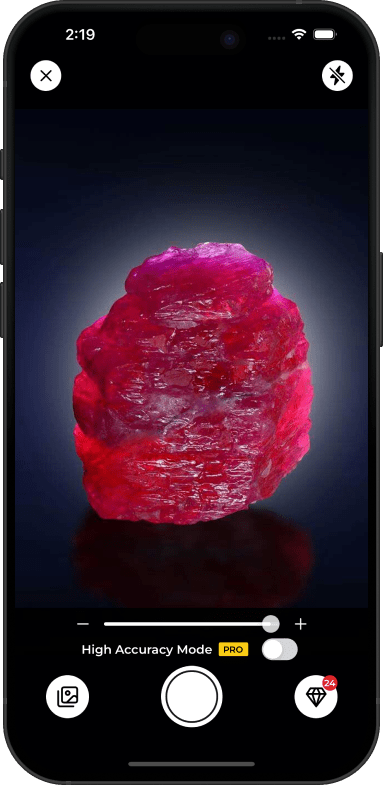
Upload a photo and Ruby Glint's AI compares your stone against thousands of verified diamond and lookalike references — free, no login required.
Or try the free online identifier

Real vs Fake Diamond: Your Questions
Get answers to common questions about rock identification, rockhounding, and using our platform.
Yes — this is why the old 'scratch glass' advice is unreliable. Moissanite (9.25), CZ (8.5), and white sapphire (9) all scratch glass easily. Use the fog, dot, and sparkle tests instead, or a dual diamond/moissanite tester.
Partly. A real diamond shows mostly white brilliance with occasional distinct flashes of colored fire. If every facet throws rainbow colors all the time, you are more likely looking at moissanite or cubic zirconia.
You can't at home — lab-grown diamonds are real diamonds chemically and pass every consumer test. Only gem labs can separate them, using spectroscopy and fluorescence patterns. Check the girdle inscription: lab-grown stones graded by GIA/IGI are inscribed as laboratory-grown.
It fogs momentarily but clears within about two seconds because diamond conducts heat extremely well. Simulants like CZ and glass hold the fog for noticeably longer.
Keep Going: DiamondValue & Identification
Diamond Price Per Carat
Current 2026 price ranges by carat size and quality tier.
Gemstone Value Calculator
Get an instant market estimate for your diamond.
Diamond Identification Guide
Full encyclopedia entry: properties, colors, and lookalikes.
Free Gemstone Identifier
Upload a photo and identify any gemstone with AI.
Home tests are screening tools, not certification. For high-value purchases, insurance, or resale, confirm with an accredited gem lab (GIA, AGL, Gübelin, SSEF).