How to Tell if an Emerald Is Real
Emerald is the easiest major gem to fake badly and the hardest to fake well. Real emeralds are almost never flawless — their internal 'jardin' of inclusions is the strongest authenticity signal you have. Glass, doublets, and hydrothermal synthetics all betray themselves under a 10× loupe if you know what to look for.
The 60-Second Emerald Checklist
Run these quick checks first — most fakes fail at least one before you ever reach for a loupe.
- A flawless 'emerald' at a low price is glass or synthetic
- Natural stones show a mossy garden (jardin) of inclusions
- Bubbles = glass; chevron/zigzag growth = hydrothermal synthetic
- Check the girdle under water for doublet join lines
- Real emerald shows weak fire — too much sparkle is a red flag
5 At-Home Tests for Real Emerald
Work through these in order — each one is safe for genuine emerald unless noted, and together they expose nearly every common fake.
The jardin check
Examine the interior at 10× with side lighting.
Real emerald
Wispy veils, mossy or feathery inclusions, tiny crystals and growth tubes — over 99% of natural emeralds are visibly included.
Fake
Glass shows round bubbles and swirls; hydrothermal synthetics show telltale chevron (zigzag) growth patterns; a perfectly clean green stone is almost never natural emerald.
Sparkle and dispersion test
Tilt the stone under a point light and watch for colored flashes.
Real emerald
Emerald has low dispersion — it glows a velvety green with very little rainbow fire.
Fake
Green CZ, YAG, and moissanite throw far more sparkle and fire than a real emerald ever could.
Doublet detection
Immerse the stone in water and view it from the side against white paper.
Real emerald
Uniform green body color from crown to pavilion.
Fake
Soudé doublets show a sandwich: colorless crown, thin green glue layer at the girdle, colorless pavilion. The join line jumps out under immersion.
Dichroism check
Rotate the stone and watch the green from different directions.
Real emerald
Natural emerald is dichroic: bluish-green from one direction, slightly yellowish-green from another.
Fake
Glass and garnet-topped doublets show one flat green from all angles.
Hardness and wear inspection
Inspect facet edges at 10× (do NOT scratch-test an emerald — they are brittle).
Real emerald
Beryl (7.5–8) keeps reasonably crisp facet edges, though corners may chip.
Fake
Glass imitations show rounded, scuffed facet junctions and surface scratches after any wear.
Common Fake Emeralds & How to Spot Them
These are the materials most often sold as emerald — and the giveaway that exposes each one.
| Imitation | How to spot it | The giveaway |
|---|---|---|
| Green glass (most common) | Gas bubbles, swirl lines, scratched soft surface, flat color with no dichroism. | Bubbles are conclusive — emeralds never contain round gas bubbles. |
| Hydrothermal synthetic emerald | Chevron/zigzag growth zoning, unnatural cleanliness, sometimes nail-head spicules. | Real beryl chemistry but lab-grown — worth 1–5% of a comparable natural stone. |
| Soudé doublet | Green concentrated in a glue line at the girdle; crown and pavilion colorless when immersed. | All the color lives in one thin layer. |
| Green CZ / YAG / peridot / tourmaline | CZ and YAG sparkle too much; peridot is yellowish with doubled facets; tourmaline shows strong pleochroism. | None reproduce emerald's soft velvet green with low fire. |
When to get professional testing
Nearly all natural emeralds are oiled — that's accepted — but the degree of enhancement (minor vs significant) moves price dramatically. For stones over $1,000, get a GIA or AGL report stating origin and oil grade; 'Colombia, minor oil' is the magic phrase that multiplies value.
Photo-Check Your Emerald in Seconds
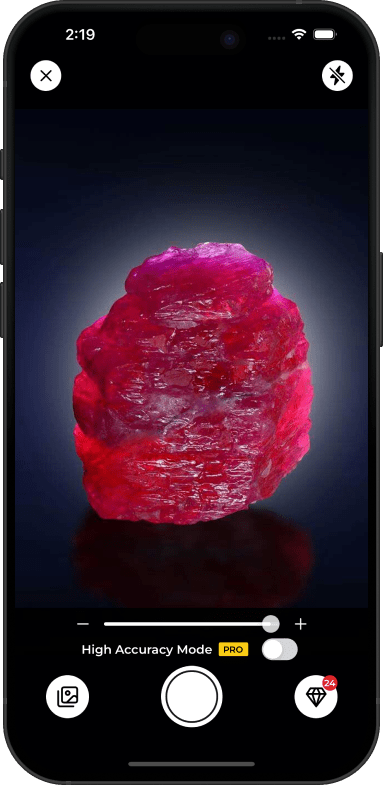
Upload a photo and Ruby Glint's AI compares your stone against thousands of verified emerald and lookalike references — free, no login required.
Or try the free online identifier

Real vs Fake Emerald: Your Questions
Get answers to common questions about rock identification, rockhounding, and using our platform.
Almost never. More than 99% of natural emeralds contain visible inclusions — the 'jardin' — and eye-clean natural emeralds command enormous premiums. A spotless green stone at a friendly price is glass or lab-grown.
Cedar oil or resin is drawn into surface-reaching fractures to improve clarity. It is standard practice and accepted in the trade as long as it is disclosed. Untreated or minor-oil emeralds with lab certificates carry large price premiums.
No — and that's a useful test. Emerald has low dispersion, so it glows rather than sparkles. If your green stone throws rainbow fire from every facet, it's more likely green cubic zirconia, YAG, or moissanite.
Under 10× magnification, hydrothermal synthetics show distinctive chevron or zigzag growth patterns and are suspiciously clean. Flux-grown synthetics show wispy flux 'fingerprints' but no natural mineral crystals. When in doubt, a gem lab separates them definitively.
Keep Going: EmeraldValue & Identification
Emerald Price Per Carat
Current 2026 price ranges by carat size and quality tier.
Emerald Value Calculator
Get an instant market estimate for your emerald.
Emerald Identification Guide
Full encyclopedia entry: properties, colors, and lookalikes.
Free Gemstone Identifier
Upload a photo and identify any gemstone with AI.
Home tests are screening tools, not certification. For high-value purchases, insurance, or resale, confirm with an accredited gem lab (GIA, AGL, Gübelin, SSEF).