How to Tell if a Garnet Is Real
Garnet's problem isn't synthetics — almost nobody fakes a $30 stone with a lab — it's glass imitations and misidentification in both directions (garnet sold as ruby, glass sold as garnet). Garnets also hide a superpower for testing: they're among the most magnetic of all gems. A $10 neodymium magnet outs most fakes.
The 60-Second Garnet Checklist
Run these quick checks first — most fakes fail at least one before you ever reach for a loupe.
- Strong neodymium magnet visibly attracts most garnets
- Singly refractive: one clean image, no doubled facets
- No UV glow (iron content kills fluorescence)
- Bubbles = glass
- Rare green garnets (tsavorite/demantoid) deserve lab checks
5 At-Home Tests for Real Garnet
Work through these in order — each one is safe for genuine garnet unless noted, and together they expose nearly every common fake.
The magnet test
Float the loose stone on a scrap of foam in water, or hang it from a thread, and bring a strong neodymium (N52) magnet close.
Real garnet
Most garnets — almandine, pyrope, rhodolite, spessartine — are paramagnetic enough to swing or drag toward the magnet.
Fake
Glass, CZ, and most other red gems show no response. This simple test is a garnet specialty.
Single-refraction check
Look through the table at the back facet edges with a 10× loupe.
Real garnet
Garnet is singly refractive: back facets appear as single crisp lines.
Fake
Doubled facet edges indicate zircon, moissanite, or other doubly-refractive stones often confused with garnet.
UV fluorescence (negative test)
Shine a UV torch on the stone in the dark.
Real garnet
Garnets stay dark — iron in their chemistry suppresses fluorescence.
Fake
A red stone glowing vivid red under UV is ruby or red spinel, not garnet. (Useful in both directions!)
Inclusion check at 10×
Examine the interior under side lighting.
Real garnet
Often quite clean; demantoid may show prized 'horsetail' fibers; rhodolite shows tiny needle silk.
Fake
Round gas bubbles and swirl marks mean glass — the most common garnet imitation in vintage jewelry.
Hardness test
Try a steel blade on an inconspicuous spot; try the stone against glass.
Real garnet
At Mohs 6.5–7.5, garnet resists a knife and scratches window glass.
Fake
Glass imitations scratch under steel and skate over a bottle without marking it.
Common Fake Garnets & How to Spot Them
These are the materials most often sold as garnet — and the giveaway that exposes each one.
| Imitation | How to spot it | The giveaway |
|---|---|---|
| Red glass ('garnet glass') | Bubbles, swirls, mold seams in beads, no magnetic response. | Ubiquitous in antique 'Bohemian garnet' jewelry — test the magnet. |
| Garnet-and-glass doublets | Thin garnet crown fused to glass pavilion; join line visible at girdle under immersion. | Surface tests pass, but the body is glass. |
| Synthetic color-change sapphire sold as 'alexandrite-like garnet' | Harder (Mohs 9), doubly refractive, curved striae inside. | Garnet never shows doubled facets. |
| Red CZ | Heavier per size, far more rainbow fire, no magnetism. | Garnet's brilliance is warm, not disco. |
When to get professional testing
For commercial red garnet, home tests are plenty. For green garnets — tsavorite over $500/ct and especially demantoid with horsetail inclusions — a lab report verifying species and origin protects real money, since fine demantoid can exceed $5,000 per carat.
Photo-Check Your Garnet in Seconds
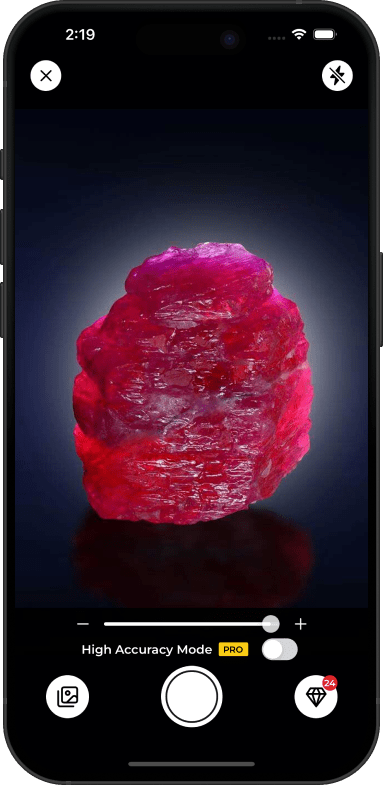
Upload a photo and Ruby Glint's AI compares your stone against thousands of verified garnet and lookalike references — free, no login required.
Or try the free online identifier

Real vs Fake Garnet: Your Questions
Get answers to common questions about rock identification, rockhounding, and using our platform.
Noticeably, yes — and it's the best home test for them. The iron and manganese in almandine, pyrope, rhodolite, and spessartine make them respond visibly to a strong neodymium magnet, while glass, CZ, ruby, and spinel do not.
Shine a UV light: ruby fluoresces red, garnet stays dead dark. Ruby is also dichroic (slight color shift on rotation) and harder (9 vs 7.5). Price is a clue too — a fine 'ruby' at garnet prices is usually garnet.
Green ones. Tsavorite runs $500–$8,000 per carat in fine qualities and Russian demantoid with horsetail inclusions is a collector's prize. Spessartine 'mandarin' orange and color-change garnets also carry premiums, while red almandine and pyrope stay affordable at $10–$50 per carat.
Lab garnets exist (YAG and GGG were grown for lasers and once used as diamond simulants), but nobody bothers faking inexpensive red garnet with them today. The realistic risks are glass imitations and garnet-topped doublets in antique jewelry.
Keep Going: GarnetValue & Identification
Garnet Price Per Carat
Current 2026 price ranges by carat size and quality tier.
Gemstone Value Calculator
Get an instant market estimate for your garnet.
Garnet Identification Guide
Full encyclopedia entry: properties, colors, and lookalikes.
Free Gemstone Identifier
Upload a photo and identify any gemstone with AI.
Home tests are screening tools, not certification. For high-value purchases, insurance, or resale, confirm with an accredited gem lab (GIA, AGL, Gübelin, SSEF).