How to Tell if a Peridot Is Real
Peridot is one of the few gems that comes in exactly one color, and its strong double refraction makes it surprisingly easy to authenticate: look inside and the back facets appear doubled, like mild double vision. Green glass is the common fake; green CZ and synthetic spinel cover the rest.
The 60-Second Peridot Checklist
Run these quick checks first — most fakes fail at least one before you ever reach for a loupe.
- Facet edges look doubled when you peer through the table
- Always olive-to-lime green — never blue-green or emerald green
- Color stays identical under every light source
- 'Lily pad' disc inclusions are a natural signature
- Bubbles = glass
5 At-Home Tests for Real Peridot
Work through these in order — each one is safe for genuine peridot unless noted, and together they expose nearly every common fake.
The double-vision test
Look through the table at the pavilion facets with a 10× loupe.
Real peridot
Peridot's high birefringence (0.036) visibly doubles the back facet edges — the classic peridot signature.
Fake
Glass, CZ, and spinel are singly refractive: crisp single facet lines mean it isn't peridot.
Color consistency check
View the stone under daylight, fluorescent, and warm incandescent light.
Real peridot
Peridot is idiochromatic — colored by the iron in its own formula — so its olive-green barely shifts between light sources.
Fake
Color-shifty green stones (some glass, synthetic color-change materials) and any 'peridot' leaning blue or pure emerald green fail this test.
Lily pad inclusion hunt
Examine the interior at 10× with side lighting.
Real peridot
Disc-shaped stress halos around tiny black chromite crystals — 'lily pads' — are diagnostic of natural peridot.
Fake
Round gas bubbles mean glass; sterile emptiness in larger stones suggests synthetic substitutes.
The oily luster check
Tilt the polished surface under a lamp and judge the shine.
Real peridot
Peridot shows a distinctive greasy/oily luster — softer than the hard glassy glint of CZ.
Fake
CZ sparkles with sharp fire; glass looks flat; neither has peridot's warm oily glow.
Hardness test
On loose stones only, test against a steel blade.
Real peridot
At Mohs 6.5–7, peridot resists a knife (though it's brittle — be gentle).
Fake
Soft green glass marks easily; fluorite fakes scratch with a fingernail file.
Common Fake Peridots & How to Spot Them
These are the materials most often sold as peridot — and the giveaway that exposes each one.
| Imitation | How to spot it | The giveaway |
|---|---|---|
| Green glass (incl. vintage 'evening emerald' paste) | Bubbles, single refraction, scratches under steel, warm to touch. | No facet doubling — instantly disqualifying. |
| Green cubic zirconia | Far too much fire and sparkle, heavier per size, single refraction. | Peridot glows oily-green; CZ flashes rainbows. |
| Synthetic green spinel | Singly refractive, often a bluer green than peridot can be. | Wrong hue family plus no doubling. |
| Green tourmaline (misidentification) | Strong pleochroism (olive to brownish on rotation) where peridot barely shifts. | It's a real gem, just not peridot — and prices differ. |
When to get professional testing
Peridot is rarely treated and rarely synthesized — your risk is imitation, not enhancement. Lab reports only earn their fee on large fine stones: 10 ct+ Burmese or Pakistani (Supat Valley) peridot in vivid grass green is collector territory at $400–900 per carat.
Photo-Check Your Peridot in Seconds
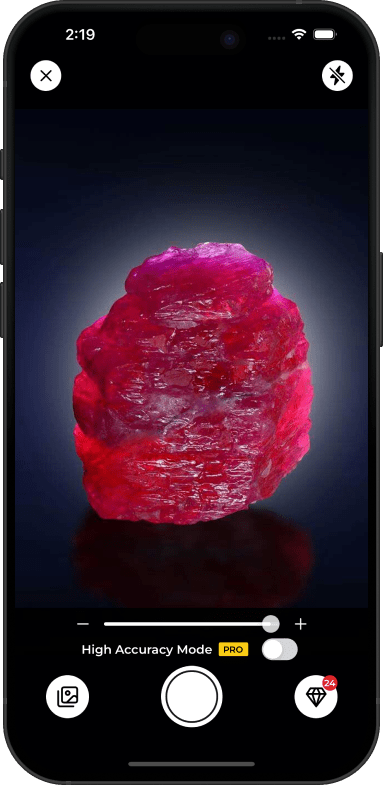
Upload a photo and Ruby Glint's AI compares your stone against thousands of verified peridot and lookalike references — free, no login required.
Or try the free online identifier

Real vs Fake Peridot: Your Questions
Get answers to common questions about rock identification, rockhounding, and using our platform.
That's the best possible sign. Peridot's strong double refraction makes back facets appear doubled when viewed through the table — a built-in authenticity feature that glass, CZ, and spinel imitations cannot reproduce.
No — and that's diagnostic. Iron is part of peridot's chemical formula, so it is always some shade of yellowish-green to olive. A 'blue peridot' or 'pink peridot' is a different stone or a fake by definition.
Large vivid 'grass green' stones from Myanmar and Pakistan's Supat Valley, where 10+ carat clean gems run $200–$900 per carat. Arizona supplies most commercial material at $15–$50 per carat. Historic 'evening emerald' stones in antique jewelry are often peridot — or glass, so test.
Synthetic forsterite exists (mainly grown as tanzanite imitation) but lab peridot is commercially rare because natural material is affordable. Practical concern ranks: green glass first, CZ second, misidentified tourmaline third.
Keep Going: PeridotValue & Identification
Peridot Price Per Carat
Current 2026 price ranges by carat size and quality tier.
Gemstone Value Calculator
Get an instant market estimate for your peridot.
Peridot Identification Guide
Full encyclopedia entry: properties, colors, and lookalikes.
Free Gemstone Identifier
Upload a photo and identify any gemstone with AI.
Home tests are screening tools, not certification. For high-value purchases, insurance, or resale, confirm with an accredited gem lab (GIA, AGL, Gübelin, SSEF).