How to Tell if a Ruby Is Real
The ruby market is flooded with glass-filled composites, flame-fusion synthetics, and red stones that aren't corundum at all. A genuine ruby is extremely hard (Mohs 9), glows red under UV light, and shows natural silk inclusions under magnification. Here is how to separate a real ruby from a fake without a lab.
The 60-Second Ruby Checklist
Run these quick checks first — most fakes fail at least one before you ever reach for a loupe.
- A real ruby scratches glass and cannot be scratched by a steel knife
- Strong red glow under UV (blacklight) — especially Burmese stones
- Look for blue flashes in cracks: the signature of lead-glass filling
- Perfectly clean + large + cheap = synthetic, every time
- Bubbles inside the stone mean glass, not ruby
5 At-Home Tests for Real Ruby
Work through these in order — each one is safe for genuine ruby unless noted, and together they expose nearly every common fake.
Hardness scratch test
Try to scratch an inconspicuous spot with a steel blade, then try the ruby against a piece of glass.
Real ruby
Ruby is corundum (Mohs 9): steel won't mark it, and it cuts a clean scratch into glass.
Fake
Glass imitations and garnet (6.5–7.5) can be scratched by hardened steel or a quartz crystal.
UV fluorescence
Shine a 365 nm UV torch on the stone in a dark room.
Real ruby
Chromium makes most rubies fluoresce a strong red — Burmese rubies almost glow like embers.
Fake
Red garnet stays inert (iron kills fluorescence), and most red glass shows weak or chalky reaction. Note: flame-fusion synthetic ruby also glows red, so pair this with the inclusion test.
Inclusion check at 10×
Use a loupe with the stone lit from the side and focus inside the stone.
Real ruby
Fine intersecting needles of rutile 'silk', angular color zoning, small crystals — natural growth fingerprints.
Fake
Curved growth lines (curved striae) mean flame-fusion synthetic; round gas bubbles mean glass; wispy blue/orange flashes inside fractures mean lead-glass-filled composite ruby.
The composite (glass-filled) check
Rotate the stone slowly under a strong point light and watch the surface-reaching fractures.
Real ruby
Untreated or heat-only rubies show no flash effect in cracks.
Fake
Lead-glass composite rubies flash blue or orange along fracture planes, and trapped flattened bubbles sit inside the filled cracks. These stones can sell for a few dollars a carat and dissolve in jeweler's pickle.
Price sanity check
Compare the asking price to the real market: clean natural rubies above 1 carat start in the thousands per carat.
Real ruby
Genuine fine ruby is one of the most expensive colored gems on earth — there are no bargains.
Fake
A 'natural ruby' of 2+ eye-clean carats for under a few hundred dollars is a synthetic or a composite, full stop.
Common Fake Rubys & How to Spot Them
These are the materials most often sold as ruby — and the giveaway that exposes each one.
| Imitation | How to spot it | The giveaway |
|---|---|---|
| Lead-glass composite ruby | Blue/orange flashes in fractures, flattened gas bubbles, very low price for size. | The most common 'real ruby' scam — it is low-grade corundum fused with up to 40% lead glass. |
| Flame-fusion synthetic ruby | Curved growth striae at magnification, unnaturally clean interior, strong fluorescence. | Chemically real corundum but lab-made and worth a tiny fraction of natural. |
| Red garnet | Softer (7–7.5), no UV glow, brownish secondary tones, singly refractive. | Completely inert under UV where ruby blazes red. |
| Red spinel & red glass | Spinel is singly refractive with octahedral inclusions; glass has bubbles and scratches easily. | Spinel fluoresces a weaker red; glass fails the hardness test instantly. |
When to get professional testing
Treatment, origin, and natural-vs-synthetic calls need a lab. For any ruby above about $1,000, ask for a GIA, AGL, Gübelin, or SSEF report — 'Burma, no heat' on paper can multiply the value of the same stone five-fold.
Photo-Check Your Ruby in Seconds
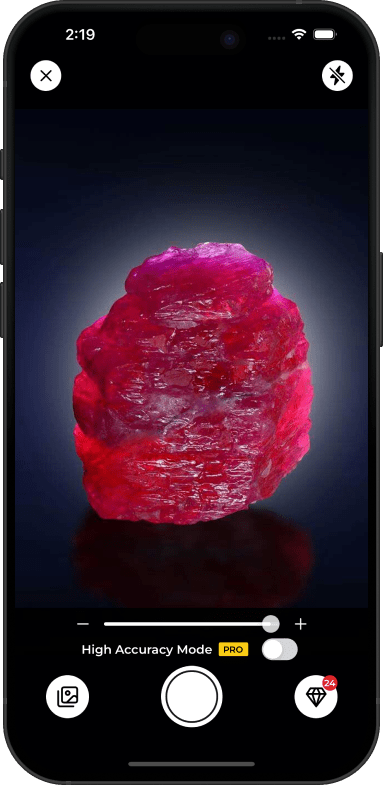
Upload a photo and Ruby Glint's AI compares your stone against thousands of verified ruby and lookalike references — free, no login required.
Or try the free online identifier

Real vs Fake Ruby: Your Questions
Get answers to common questions about rock identification, rockhounding, and using our platform.
Yes — chromium makes natural ruby fluoresce red under 365 nm UV, with Burmese stones glowing the strongest. But synthetic rubies glow too (often even brighter), so fluorescence proves it's corundum, not that it's natural. Combine it with the inclusion check.
Yes. Ruby is Mohs 9 — harder than anything in a typical home except diamond. If your stone won't scratch glass, or a steel knife marks it, it is not a ruby.
It's very low-grade corundum with fractures flooded by lead glass — sometimes 30–40% glass by volume. They sell for a few dollars per carat, can't survive a jeweler's torch or even lemon juice, and should never be sold as 'natural ruby' without disclosure.
No. Very dark, garnet-like red often signals garnet or low-grade material, while a 'too perfect' bright clean red signals synthetic. Natural ruby usually shows slight zoning and silk under a loupe — perfection is the red flag.
Keep Going: RubyValue & Identification
Ruby Price Per Carat
Current 2026 price ranges by carat size and quality tier.
Ruby Value Calculator
Get an instant market estimate for your ruby.
Ruby Identification Guide
Full encyclopedia entry: properties, colors, and lookalikes.
Free Gemstone Identifier
Upload a photo and identify any gemstone with AI.
Home tests are screening tools, not certification. For high-value purchases, insurance, or resale, confirm with an accredited gem lab (GIA, AGL, Gübelin, SSEF).