How to Tell if a Tanzanite Is Real
Tanzanite comes from exactly one place on earth — the Merelani Hills of Tanzania — and its scarcity invites fakes: synthetic forsterite, color-shifting glass, CZ blends, and cheaper blue stones. Real tanzanite's giveaway is trichroism: three distinct colors down three crystal axes. No imitation does it.
The 60-Second Tanzanite Checklist
Run these quick checks first — most fakes fail at least one before you ever reach for a loupe.
- Trichroism: blue, violet, and burgundy-red flashes as you rotate it
- Velvety violet-blue unlike sapphire's pure blue
- Too soft for a scratch test — never test hardness ON tanzanite
- Doubled facets at 10× = synthetic forsterite
- Eye-clean is normal; bubbles are glass
5 At-Home Tests for Real Tanzanite
Work through these in order — each one is safe for genuine tanzanite unless noted, and together they expose nearly every common fake.
The trichroism test
Rotate the stone in daylight and view down different axes, ideally with polarized sunglasses as a makeshift filter.
Real tanzanite
Genuine tanzanite flashes blue down one axis, violet down another, and burgundy/brownish-red down the third — visibly different colors, not just lighter and darker.
Fake
Glass, CZ, and synthetic spinel show one flat color; iolite shifts but to a washed-out yellow-gray.
Color character under two lights
View under daylight, then under a warm incandescent bulb.
Real tanzanite
Tanzanite leans blue in daylight and shifts toward violet-purple under warm light — a soft, velvety transition.
Fake
Sapphire stays stubbornly blue; synthetic color-change imitations often swing too theatrically.
Facet-doubling check
Loupe through the table at the back facets at 10×.
Real tanzanite
Tanzanite's birefringence is modest — facet edges look essentially single.
Fake
Synthetic forsterite — the most convincing modern tanzanite fake — shows clearly doubled back facets.
Inclusion and bubble check
Inspect the interior with side lighting at 10×.
Real tanzanite
Top tanzanite is typically eye-clean; natural inclusions look like fine feathers or needles.
Fake
Round gas bubbles mean glass; sweeping curved striae mean lab-grown imitation material.
Price and source sanity check
Compare the asking price and the seller's claims with the real market.
Real tanzanite
Fine 2–3 ct tanzanite retails around $300–$650 per carat — there's a floor below which real stones don't exist.
Fake
'Tanzanite' parcels at $10–20 per carat, or any claim of non-Tanzanian origin, are imitations by definition.
Common Fake Tanzanites & How to Spot Them
These are the materials most often sold as tanzanite — and the giveaway that exposes each one.
| Imitation | How to spot it | The giveaway |
|---|---|---|
| Synthetic forsterite | Doubled back facets at 10× — tanzanite never doubles visibly. | The most deceptive tanzanite fake; one loupe check defeats it. |
| 'Tanzanique'/coated CZ and blue glass | Single flat color, no trichroism, bubbles in glass, excess fire in CZ. | Rotation reveals nothing — real tanzanite is a three-color show. |
| Iolite | Strong pleochroism but to pale straw-gray, watery brilliance, much cheaper look. | The 'wrong' third color: tanzanite flashes burgundy, iolite goes colorless. |
| Synthetic blue spinel | Singly refractive, no pleochroism at all, slightly steely blue. | Zero color change on rotation. |
When to get professional testing
Virtually all tanzanite is gently heated to develop its blue — universal and accepted. What needs paper is rarity claims: unheated certificates, 'investment grade' D-block material, and fancy colors (pink, green tanzanite) all warrant a GIA or independent lab report before premium money changes hands.
Photo-Check Your Tanzanite in Seconds
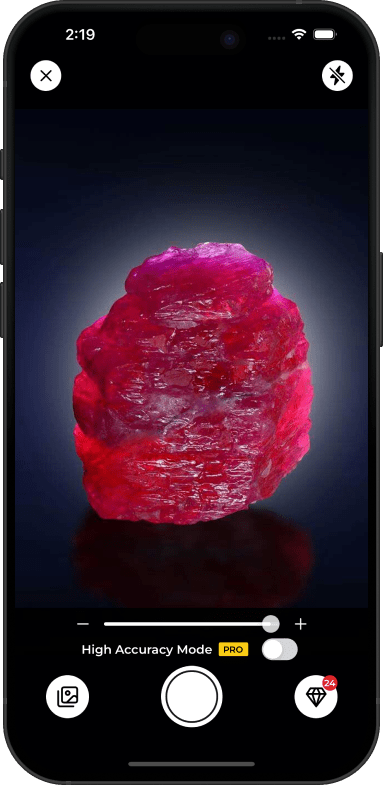
Upload a photo and Ruby Glint's AI compares your stone against thousands of verified tanzanite and lookalike references — free, no login required.
Or try the free online identifier

Real vs Fake Tanzanite: Your Questions
Get answers to common questions about rock identification, rockhounding, and using our platform.
That's authentic behavior. Tanzanite is strongly trichroic and shifts from blue in cool daylight toward violet-purple under warm indoor light. A stone that stays identically blue everywhere is more likely sapphire, spinel, or glass.
Almost all of it, yes — gentle heating around 600°C turns the brownish natural zoisite blue-violet, is permanent, and is fully accepted by the trade. Certified unheated blue tanzanite is a rarity that commands premiums.
Don't. At Mohs 6–7 with perfect cleavage, tanzanite is soft and brittle enough that scratch tests and ultrasonic cleaners can ruin it. Use the optical tests instead — trichroism and the facet-doubling check are safe and more diagnostic anyway.
The single-source story is true — Merelani is the world's only commercial deposit — but 'last generation' marketing has run for decades. Buy fine color (vivid violet-blue, 2 ct+) because you love it; treat any guaranteed-appreciation pitch as a sales tactic.
Keep Going: TanzaniteValue & Identification
Tanzanite Price Per Carat
Current 2026 price ranges by carat size and quality tier.
Gemstone Value Calculator
Get an instant market estimate for your tanzanite.
Tanzanite Identification Guide
Full encyclopedia entry: properties, colors, and lookalikes.
Free Gemstone Identifier
Upload a photo and identify any gemstone with AI.
Home tests are screening tools, not certification. For high-value purchases, insurance, or resale, confirm with an accredited gem lab (GIA, AGL, Gübelin, SSEF).