How to Tell if a Tourmaline Is Real
Real tourmaline has two signatures almost no fake reproduces: dramatic pleochroism (different colors down different axes) and pyroelectricity (it attracts dust when warmed). With Paraíba tourmaline now trading above fine sapphire, misrepresented apatite and glass are everywhere — here's how to test before you trust.
The 60-Second Tourmaline Checklist
Run these quick checks first — most fakes fail at least one before you ever reach for a loupe.
- Strong pleochroism: color visibly changes with viewing angle
- Warmed tourmaline attracts dust and ash (pyroelectric)
- Doubled back facets under a loupe (strong double refraction)
- Bicolor zones with gradual transitions = natural watermelon
- 'Paraíba' at bargain prices is apatite or glass
5 At-Home Tests for Real Tourmaline
Work through these in order — each one is safe for genuine tourmaline unless noted, and together they expose nearly every common fake.
Pleochroism check
Rotate the stone end-over-end in daylight against white paper.
Real tourmaline
Tourmaline shows obvious two-color pleochroism — e.g., a green stone flips between bluish-green and olive-brown down different axes; many stones go dramatically darker down their length.
Fake
Glass, CZ, and synthetic spinel show one flat color from every direction.
The dust (pyroelectric) test
Warm the stone gently in your hand or by rubbing on wool for a minute, then hold it near fine dust or cigarette ash.
Real tourmaline
Heated tourmaline builds static charge and visibly attracts dust particles — a property so famous Dutch traders called tourmalines 'aschentrekkers' (ash-pullers).
Fake
No other common gem simulant behaves this way.
Double-refraction loupe check
Look through the table at the pavilion facet junctions at 10×.
Real tourmaline
Tourmaline's strong birefringence doubles the back facet edges visibly.
Fake
Glass and garnet show single crisp edges; the doubling separates tourmaline from both.
Inclusion check
Examine the interior with side light at 10×.
Real tourmaline
Characteristic liquid-filled 'trichite' thread inclusions and hollow growth tubes running parallel to the crystal length.
Fake
Round bubbles = glass. Apatite posing as Paraíba tends to show different, wispier scenes and is far softer.
Hardness test
Test against a steel blade and a quartz point on an inconspicuous spot.
Real tourmaline
At Mohs 7–7.5, tourmaline resists steel and roughly matches quartz.
Fake
Apatite (Mohs 5) scratches with a knife — the fastest way to expose fake 'Paraíba'. Glass also fails.
Common Fake Tourmalines & How to Spot Them
These are the materials most often sold as tourmaline — and the giveaway that exposes each one.
| Imitation | How to spot it | The giveaway |
|---|---|---|
| Apatite sold as 'Paraíba' | Knife-soft (Mohs 5), weaker pleochroism, often included neon-blue stones at suspicious prices. | Real Paraíba tourmaline starts around $2,000/ct — neon blue at $50 is apatite. |
| Colored glass | Gas bubbles, no pleochroism, no facet doubling, scratches easily. | Fails all three optical signatures at once. |
| Synthetic spinel & CZ | Singly refractive (no doubling), zero pleochroism, CZ is heavy and over-fiery. | One flat color from every angle. |
| Treated/irradiated lesser tourmaline | Vivid pinks-reds from irradiation are common and hard to detect; heated stones lighten. | It's real tourmaline — but 'natural color' claims at premium prices need lab paper. |
When to get professional testing
Copper-bearing (Paraíba-type) certification is where labs earn their fee: the same neon blue stone is worth 10–50× more with a report confirming copper content and Brazilian origin. Any 'Paraíba' above a few hundred dollars without GIA/AGL/SSEF paper is a leap of faith.
Photo-Check Your Tourmaline in Seconds
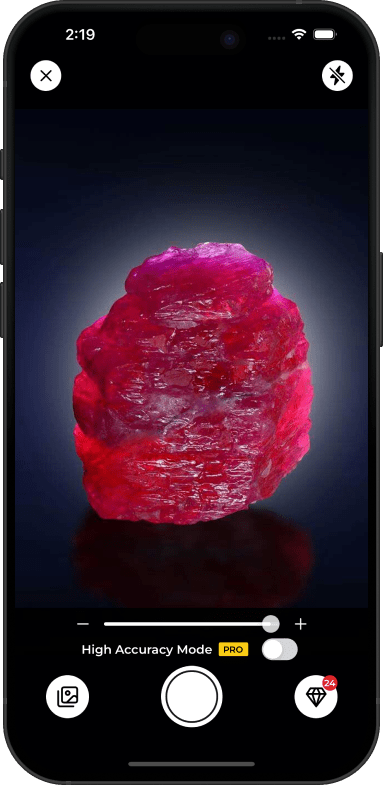
Upload a photo and Ruby Glint's AI compares your stone against thousands of verified tourmaline and lookalike references — free, no login required.
Or try the free online identifier

Real vs Fake Tourmaline: Your Questions
Get answers to common questions about rock identification, rockhounding, and using our platform.
Copper gives Paraíba its neon 'windex' glow, and original Brazilian material is nearly mined out — fine stones exceed $10,000 per carat. Verify hardness (apatite fails a knife test), pleochroism, and then insist on a lab report confirming copper-bearing chemistry; for these prices, paper is part of the product.
That's pleochroism, and it's a sign of authenticity, not a defect. Tourmaline absorbs light differently along different crystal axes — many green stones go nearly black down their length. Glass and CZ imitations never do this.
Yes — pink cores with green rinds form naturally as the crystal's chemistry changes during growth. Natural bicolors show gradual, slightly irregular transitions. Razor-straight color boundaries or glued joins (check under immersion) indicate assembled fakes.
When warmed, yes. Tourmaline is pyroelectric: heating builds an electric charge at opposite ends of the crystal that attracts dust and ash. It's a quirky but genuinely diagnostic home test — no common imitation shares the property.
Keep Going: TourmalineValue & Identification
Tourmaline Price Per Carat
Current 2026 price ranges by carat size and quality tier.
Gemstone Value Calculator
Get an instant market estimate for your tourmaline.
Tourmaline Identification Guide
Full encyclopedia entry: properties, colors, and lookalikes.
Free Gemstone Identifier
Upload a photo and identify any gemstone with AI.
Home tests are screening tools, not certification. For high-value purchases, insurance, or resale, confirm with an accredited gem lab (GIA, AGL, Gübelin, SSEF).