How to Tell if Turquoise Is Real
More than 90% of 'turquoise' in the marketplace is either treated, reconstituted, or not turquoise at all — dyed howlite and magnesite are the workhorses of this fraud. Real turquoise is a dense phosphate mineral that stays cold, resists fingernails, and never bleeds dye. Five minutes of testing protects you.
The 60-Second Turquoise Checklist
Run these quick checks first — most fakes fail at least one before you ever reach for a loupe.
- Cold, dense stone feel — plastic fakes are warm and light
- Acetone on a cotton swab: blue stain = dye
- Natural matrix is irregular; dyed howlite veins look penciled-on
- A fingernail can't scratch real turquoise — it can scratch magnesite
- Robin's-egg perfection at trinket prices = fake
5 At-Home Tests for Real Turquoise
Work through these in order — each one is safe for genuine turquoise unless noted, and together they expose nearly every common fake.
The acetone dye test
Wet a cotton swab with acetone (nail polish remover) and rub an inconspicuous spot for ~10 seconds.
Real turquoise
Natural untreated turquoise sheds no color.
Fake
Dyed howlite, magnesite, and dyed reconstituted material leave blue on the swab — instant verdict.
Scratch test (hidden spot)
Try your fingernail first, then a copper coin, on the back or drill-hole area.
Real turquoise
Turquoise (Mohs 5–6) resists fingernails and copper.
Fake
Howlite and magnesite (Mohs 3.5) scratch with modest pressure; chalky white shows beneath the blue dye layer.
Temperature and heft check
Hold the piece against your cheek, then weigh it in hand.
Real turquoise
Stone-cold at first touch and densely heavy for its size (SG ~2.6–2.9).
Fake
Plastic and resin imitations feel warm within seconds and weigh strangely little; block reconstituted material feels 'okay' — combine with the acetone test.
Matrix pattern inspection
Study the veining at 10× magnification.
Real turquoise
Natural matrix (the host rock web) is irregular — varying thickness, depth, and color, intersecting unpredictably.
Fake
Dyed howlite veins look uniformly gray-penciled and sit flat; fake 'spiderweb' patterns repeat with suspicious regularity.
The hot needle test (last resort)
On a hidden spot of a suspected fake only, touch a heated needle point to the surface for a second.
Real turquoise
Genuine turquoise is unaffected (though oil/wax-treated stones may bead slightly).
Fake
Plastic and resin-stabilized imitations melt, smoke, or smell acrid immediately.
Common Fake Turquoises & How to Spot Them
These are the materials most often sold as turquoise — and the giveaway that exposes each one.
| Imitation | How to spot it | The giveaway |
|---|---|---|
| Dyed howlite / magnesite | Fingernail-soft, penciled veins, blue comes off with acetone, white interior at chips. | The most common turquoise fraud on earth — the acetone swab settles it. |
| Reconstituted / block 'turquoise' | Powdered stone (or none at all) mixed with resin and dye; unnaturally even color; warm plastic feel at the drill holes. | Hot needle melts the resin; price is dollars per strand. |
| Plastic and resin imitations | Warm, featherweight, mold seams, melts under the needle test. | Fails temperature and heft instantly. |
| Dyed chalcedony & 'turquoise' glass | Glassy translucent edges under strong light — real turquoise is opaque; bubbles in glass. | Backlight the edges: turquoise blocks light, imitations glow. |
When to get professional testing
Even genuine turquoise is usually stabilized (resin-hardened) — acceptable and standard at commercial prices, but natural untreated material from named US mines (Lander Blue, Bisbee, Sleeping Beauty) or Iran commands collector premiums of 10–100×. For high-value pieces, mine attribution plus a lab treatment report is the standard of proof.
Photo-Check Your Turquoise in Seconds
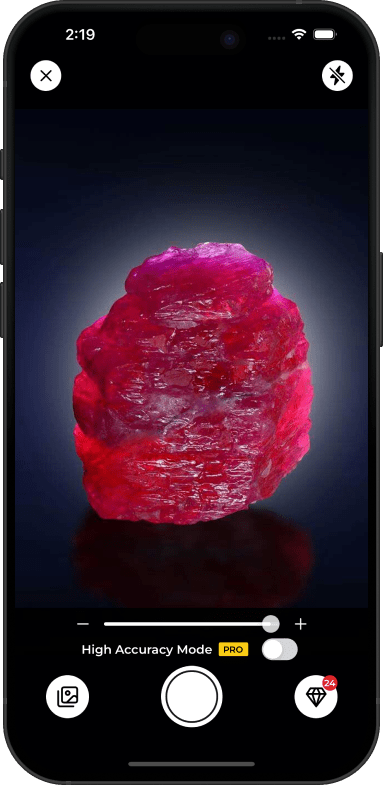
Upload a photo and Ruby Glint's AI compares your stone against thousands of verified turquoise and lookalike references — free, no login required.
Or try the free online identifier

Real vs Fake Turquoise: Your Questions
Get answers to common questions about rock identification, rockhounding, and using our platform.
Dampen a cotton swab with plain acetone nail-polish remover and rub a hidden spot for about ten seconds. Any blue transferring to the swab means dye — typically howlite, magnesite, or dyed reconstituted material. Natural turquoise gives up no color.
Stabilized turquoise is real turquoise vacuum-impregnated with clear resin so soft, chalky material can take a polish and survive wear. It's accepted and ubiquitous (90%+ of the market) but should cost a fraction of natural hard turquoise — the sin is selling it as untreated.
Treatment and provenance. Stabilized commercial material is abundant and cheap; natural untreated stone with tight spiderweb matrix from famous mines (Lander Blue, Number 8, Bisbee) or Iranian 'Persian blue' is genuinely rare and traded almost like art, with named-mine pieces fetching $100–$1,000+ per carat.
Natural untreated turquoise can, slowly — skin oils deepen pale blues toward green over years, which collectors of old 'cabinet' pieces actually prize. Stabilized turquoise stays fixed. A bead bleeding green-blue onto your skin immediately, though, is dye and means fake.
Keep Going: TurquoiseValue & Identification
Turquoise Price Per Carat
Current 2026 price ranges by carat size and quality tier.
Gemstone Value Calculator
Get an instant market estimate for your turquoise.
Turquoise Identification Guide
Full encyclopedia entry: properties, colors, and lookalikes.
Free Gemstone Identifier
Upload a photo and identify any gemstone with AI.
Home tests are screening tools, not certification. For high-value purchases, insurance, or resale, confirm with an accredited gem lab (GIA, AGL, Gübelin, SSEF).