Botryoidal Hematite
Hematite
What is Botryoidal Hematite?
Botryoidal Hematite is a variety of the mineral hematite that exhibits a distinctive rounded, grape-like or kidney-like formation. This form occurs when hematite crystallizes in radiating masses, creating a botryoidal (from the Greek word 'botrys' meaning 'grape') structure. The formation is often found in iron ore deposits and can display a metallic luster. The color is typically a reddish-brown to black, and the surface can be smooth or slightly rough. Botryoidal Hematite is valued for its unique appearance and is sometimes used as an ornamental stone.
Optical Properties
- Birefringence
- 0.26
- Pleochroism
- None
- Optical Character
- Uniaxial negative
Discover Values
Market Value Factors
Pricing varies for every rock and mineral, so use these universal factors to gauge Botryoidal Hematite before comparing listings or appraisals.
Size & Weight
Larger, intact specimens usually command higher prices.
Rarity & Demand
Scarce material or popular varieties sell at a premium.
Condition & Finish
Chips, repairs, and heavy wear lower value; clean prep helps.
Treatment & Provenance
Untreated specimens with documented locality are prized.
Quick Facts
Physical Properties
- Color
- Reddish-brown to black
- Hardness (Mohs)
- 5.5-6.5
- Rock tumbling
- With care
- Density
- 5.26 g/cm³
- Luster
- Metallic
- Crystal System
- Trigonal
Chemical Properties
- Chemical Formula
- Fe₂O₃
- Elements
- Fe, O
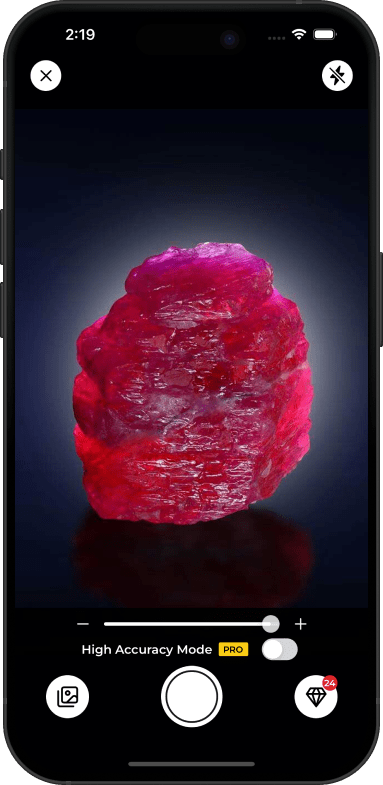
Identify Botryoidal Hematite Instantly
- Snap a photo, get instant results
- 6,700+ rocks, minerals & crystals
- Discover collecting spots near you
Botryoidal Hematite FAQs
How do I identify Botryoidal Hematite?
Botryoidal Hematite can be identified by its hardness of 5.5-6.5 on the Mohs scale, Reddish-brown to black color, Metallic luster, Trigonal crystal system. Look for these key characteristics when examining specimens.
What color is Botryoidal Hematite?
Botryoidal Hematite typically appears in Reddish-brown to black. Color can vary depending on impurities and formation conditions.
How hard is Botryoidal Hematite?
Botryoidal Hematite has a hardness of 5.5-6.5 on the Mohs scale. This gives it moderate hardness.