Carminite
A variety of Carminite Group
What is Carminite?
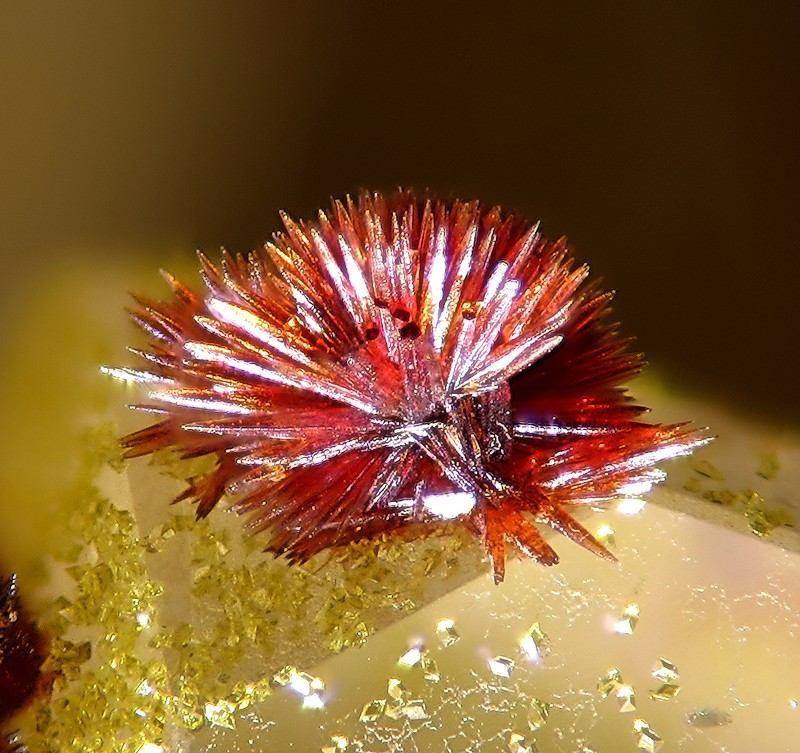
Carminite is a unique mineral recognizable by its red and brown translucent long-needle appearance. The shade of red was first described as carmine, which gives this mineral its name. Carminite is relatively soft but is heavier than it appears due to the presence of lead. This mineral is often physically confused with arsenbrackebuschite and caminite due to spelling.
Uses & Applications
Carminite is used as a minor source of lead in some areas. While lead has been banned from many applications due to its toxicity, it is still used for car batteries, weights, radiation protection, and in stained windows.
Market Value Factors
Pricing varies for every rock and mineral, so use these universal factors to gauge Carminite before comparing listings or appraisals.
Size & Weight
Larger, intact specimens usually command higher prices.
Rarity & Demand
Scarce material or popular varieties sell at a premium.
Condition & Finish
Chips, repairs, and heavy wear lower value; clean prep helps.
Treatment & Provenance
Untreated specimens with documented locality are prized.
Key Characteristics
Characteristics of Carminite
Carminite is fairly soft, with a Mohs hardness of 3 ⁄2, between that of calcite and fluorite. Because of the lead content it is heavy, with specific gravity of 5.03 - 5.18, although specimens from Mapimi are less dense at 4.10. Cleavage is distinct in one direction parallel to the c axis. The mineral is slowly soluble in hydrochloric acid (HCl) with the separation of lead(II) chloride (PbCl2) and totally soluble in nitric acid (HNO3). Carminite is not radioactive and no piezoelectric effect has been detected.
Appearance of Carminite
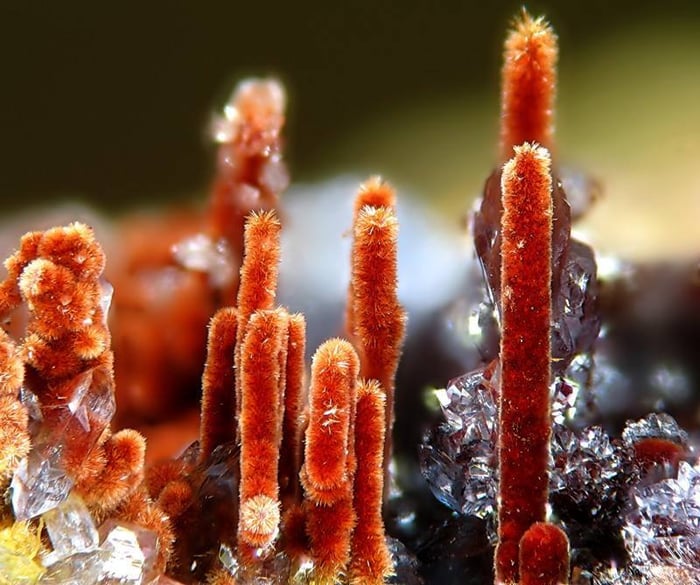
Crystals have been found up to 2 cm long, though most are smaller. They are typically bladed, elongated along the c axis and flattened perpendicular to the b axis. They also occur as acicular crystals, in spherical or tufted aggregates and as fibrous or drusy masses. The crystals are a characteristic carmine red colour, hence the name, and they are also red in transmitted light. They are translucent with a vitreous lustre and a reddish yellow streak.
Formation of Carminite
Carminite is formed as an uncommon alteration product of arsenopyrite (FeAsS) in the oxidized zones of some lead-bearing deposits. Common associates are wulfenite, scorodite, plumbojarosite, mimetite, dussertite, cerussite, beudantite, bayldonite, arseniosiderite and anglesite. The type locality is the Louise Mine, Bürdenbach, Altenkirchen, Wied Iron Spar District, Westerwald, Rhineland-Palatinate, Germany where it is associated with beudantite. At the Hingston Down Consols mine in Cornwall, England, carminite occurs with scorodite, mimetite and pharmacosiderite. The ores of the Ojuela Mine, Mexico, are replacement deposits in limestone and consist of galena, sphalerite, pyrite, and arsenopyrite in a matrix of quartz, dolomite and fluorite. Arsenopyrite is abundant. On a dump near the north shaft blocks of massive scorodite containing seams and pockets of arseniosiderite and small areas of dussertite and carminite have been found. Carminite also occurs as masses mixed with cerussite, anglesite and plumbojarosite. It is almost always intimately associated with arseniosiderite and dussertite.
Composition of Carminite
Carminite belongs to the orthorhombic crystal class (2/m 2/m 2/m) and has space group C ccm or C cc2. The structure consists of linked octahedra of iron surrounded by oxygen and hydroxyl which are aligned parallel to the c axis. They are connected together in the direction of the an axis by arsenate tetrahedra (arsenic surrounded by 4 oxygen). Coordination about the lead atoms is eight-fold. The edges of the unit cell have lengths a = 16.59 Å, b = 7.58 Å and c = 12.295 Å. There are 8 formula units in each unit cell (Z = 8).
Health & Safety Information
- ⚠️Carminite dust is toxic because it contains heavy metals Arsenic, Lead.
- ⚠️Arsenic, Lead
- ⚠️It's advisable to handle carminite carefully to avoid generating dust and wash hands thoroughly afterward. When cutting or polishing carminite, wear a dust mask to prevent inhaling heavy metal particles. Store carminite in a sealed container in a well-ventilated area, away from children and pets. For those involved in crystal healing, never put it in your mouth.
More Images

Quick Facts
Physical Properties
- Color
- Carmine-red, terra cotta-red, reddish brown, red in transmitted light
- Hardness (Mohs)
- 3.5
- Rock tumbling
- Not recommended
- Density
- 5.405 g/cm³
- Streak
- Reddish yellow
- Luster
- Pearly, Vitreous
- Crystal System
- Orthorhombic
Chemical Properties
- Chemical Formula
- PbFe3+2(AsO4)2(OH)2
- Elements
- As, Fe, H, O, Pb
Identify Carminite Instantly
- Snap a photo, get instant results
- 6,700+ rocks, minerals & crystals
- Discover collecting spots near you
Carminite FAQs
How do I identify Carminite?
Carminite can be identified by its hardness of 3.5 on the Mohs scale, Carmine-red color, Pearly, Vitreous luster, Orthorhombic crystal system. Look for these key characteristics when examining specimens.
What color is Carminite?
Carminite typically appears in Carmine-red, terra cotta-red, reddish brown, red in transmitted light. Color can vary depending on impurities and formation conditions.
How hard is Carminite?
Carminite has a hardness of 3.5 on the Mohs scale. This gives it moderate hardness.
What is the characteristics of carminite of Carminite?
Carminite is fairly soft, with a Mohs hardness of 3 ⁄2, between that of calcite and fluorite. Because of the lead content it is heavy, with specific gravity of 5.03 - 5.18, although specimens from Mapimi are less dense at 4.10. Cleavage is distinct in one direction parallel to the c axis. The mineral is slowly soluble in hydrochloric acid (HCl) with the separation of lead(II) chloride (PbCl2) and totally soluble in nitric acid (HNO3). Carminite is not radioactive and no piezoelectric effect has been detected.
What is the appearance of carminite of Carminite?
Crystals have been found up to 2 cm long, though most are smaller. They are typically bladed, elongated along the c axis and flattened perpendicular to the b axis. They also occur as acicular crystals, in spherical or tufted aggregates and as fibrous or drusy masses. The crystals are a characteristic carmine red colour, hence the name, and they are also red in transmitted light. They are translucent with a vitreous lustre and a reddish yellow streak.
What is the formation of carminite of Carminite?
Carminite is formed as an uncommon alteration product of arsenopyrite (FeAsS) in the oxidized zones of some lead-bearing deposits. Common associates are wulfenite, scorodite, plumbojarosite, mimetite, dussertite, cerussite, beudantite, bayldonite, arseniosiderite and anglesite. The type locality is the Louise Mine, Bürdenbach, Altenkirchen, Wied Iron Spar District, Westerwald, Rhineland-Palatinate, Germany where it is associated with beudantite. At the Hingston Down Consols mine in Cornwall, England, carminite occurs with scorodite, mimetite and pharmacosiderite. The ores of the Ojuela Mine, Mexico, are replacement deposits in limestone and consist of galena, sphalerite, pyrite, and arsenopyrite in a matrix of quartz, dolomite and fluorite. Arsenopyrite is abundant. On a dump near the north shaft blocks of massive scorodite containing seams and pockets of arseniosiderite and small areas of dussertite and carminite have been found. Carminite also occurs as masses mixed with cerussite, anglesite and plumbojarosite. It is almost always intimately associated with arseniosiderite and dussertite.