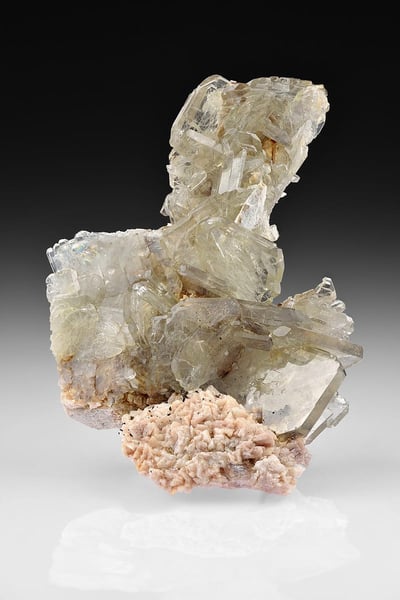
Celestine
A variety of Baryte Group

What is Celestine?
The beautiful clear crystallization of celestine can be found in geode form and is wildly popular with mineral enthusiasts. It is also industrially collected for its content of the element strontium, which is widely used in the manufacture of flares, fireworks, and even television tubes.
Etymology & Origins
Celestine derives its name from the Latin word caelestis meaning celestial, which in turn is derived from the Latin word caelum meaning sky or heaven.
Uses & Applications
Celestine is a very common type of strontium mineral, which is used in a powdered form in fireworks. It also has commercial application in the production/processing of glass, rubber, paint, tiles, and can be added to battery lead. Sometimes it is cut for use in jewelry, but it is not ideal for this purpose as it is very soft.
Healing Properties
Celestine is believed to have a very high frequency that attracts certain individuals. It is said to enhance intuition, allowing the user expanded consciousness. It activates the Crown and Third Eye chakras. Many believe that it has the power to connect with angelic realms and open communication with spiritual guides. It can help anyone feeling lost to understand their higher purpose in life.
Optical Properties
- Refractive Index
- 1.619-1.635
- Birefringence
- 0.004-0.012
- Pleochroism
- Weakly trichroic
- Optical Character
- Biaxial positive
Discover Values
Market Value Factors
Pricing varies for every rock and mineral, so use these universal factors to gauge Celestine before comparing listings or appraisals.
Size & Weight
Larger, intact specimens usually command higher prices.
Rarity & Demand
Scarce material or popular varieties sell at a premium.
Condition & Finish
Chips, repairs, and heavy wear lower value; clean prep helps.
Treatment & Provenance
Untreated specimens with documented locality are prized.
The Meaning
Celestine is a birthstone for those born under the sign of Gemini. From the Latin word for celestial, celestine's light blue color reflects the heavens. According to Greek mythology, it originated from the Pleiades, a network of seven stars also known as the Seven Sisters. The state of Pennsylvania adopted celestine as its official state mineral.
Associated Chakras



Key Characteristics
Formation of Celestine
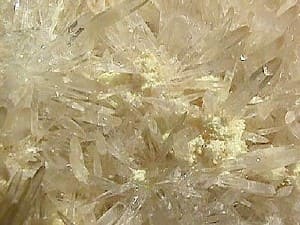
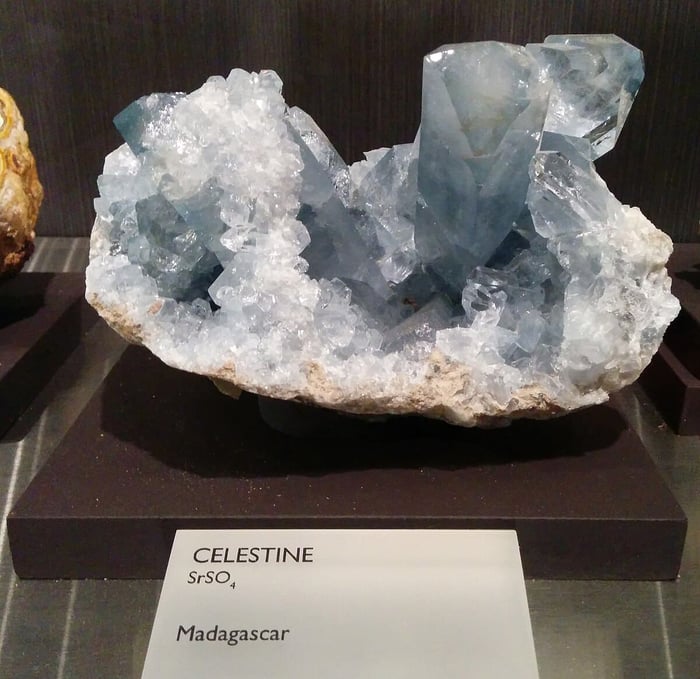
Celestine occurs as crystals, and also in compact massive and fibrous forms. It is mostly found in sedimentary rocks, often associated with the minerals gypsum, anhydrite, and halite. The mineral is found worldwide, usually in small quantities. Pale blue crystal specimens are found in Madagascar. White and orange variants also occurred at Yate, Bristol, UK, where it was extracted for commercial purposes until the mid-20th century. The skeletons of the protozoan Acantharea are made of celestine, unlike those of other radiolarians which are made of silica. In carbonate marine sediments, burial dissolution is a recognised mechanism of celestine precipitation. It is sometimes used as a gemstone.
More Images
Quick Facts
Physical Properties
- Color
- Colourless, blue, white, reddish, greenish, brownish, greyish
- Hardness (Mohs)
- 3 - 3.5
- Rock tumbling
- Not recommended
- Density
- 3.98 g/cm³
- Streak
- White
- Luster
- Pearly, Vitreous
- Crystal System
- Orthorhombic
Chemical Properties
- Chemical Formula
- SrSO4
- Elements
- O, S, Sr
Also Known As
Identify Celestine Instantly
- Snap a photo, get instant results
- 6,700+ rocks, minerals & crystals
- Discover collecting spots near you
Celestine FAQs
How do I identify Celestine?
Celestine can be identified by its hardness of 3 - 3.5 on the Mohs scale, Colourless color, Pearly, Vitreous luster, Orthorhombic crystal system. Look for these key characteristics when examining specimens.
What color is Celestine?
Celestine typically appears in Colourless, blue, white, reddish, greenish, brownish, greyish. Color can vary depending on impurities and formation conditions.
How hard is Celestine?
Celestine has a hardness of 3 - 3.5 on the Mohs scale. This makes it a soft mineral that can be scratched easily.
What is the formation of celestine of Celestine?
Celestine occurs as crystals, and also in compact massive and fibrous forms. It is mostly found in sedimentary rocks, often associated with the minerals gypsum, anhydrite, and halite. The mineral is found worldwide, usually in small quantities. Pale blue crystal specimens are found in Madagascar. White and orange variants also occurred at Yate, Bristol, UK, where it was extracted for commercial purposes until the mid-20th century. The skeletons of the protozoan Acantharea are made of celestine, unlike those of other radiolarians which are made of silica. In carbonate marine sediments, burial dissolution is a recognised mechanism of celestine precipitation. It is sometimes used as a gemstone.