Coquimbite
A variety of Coquimbite Group
What is Coquimbite?
Named after Coquimba Province, Chile, where the material was first discovered, coquimbite is a relatively uncommon mineral. It is found primarily in regions with arid climates and tends to deteriorate in humid environments. It is sometimes used as a collector's gem, particularly the purple variety.
Uses & Applications
Coquimbite is a rare mineral that forms into an attractive mass of purple crystals, which makes it popular with mineralogists for its attractive appearance and scarcity. This mineral is not used commercially or in the gem industry other than as an interesting ornamental stone.
Healing Properties
Coquimbite is believed to do wonders for the root, brow, and crown chakras. When used in meditation, the stone is said to aid communication with higher realms and enable you to gain clarity and insight into your capabilities. Physically, coquimbite supposedly benefits the nervous system, helping to heal its disorders, and providing relief from skin conditions.
Market Value Factors
Pricing varies for every rock and mineral, so use these universal factors to gauge Coquimbite before comparing listings or appraisals.
Size & Weight
Larger, intact specimens usually command higher prices.
Rarity & Demand
Scarce material or popular varieties sell at a premium.
Condition & Finish
Chips, repairs, and heavy wear lower value; clean prep helps.
Treatment & Provenance
Untreated specimens with documented locality are prized.
Associated Chakras


Quick Facts
Physical Properties
- Color
- Light violet to purple, Greenish white, Bluish white, Yellowish white, Brownish white
- Hardness (Mohs)
- 2.5
- Rock tumbling
- Not recommended
- Density
- 2.12 g/cm³
- Streak
- white
- Luster
- Greasy, Resinous, Waxy, Sub-vitreous
- Crystal System
- Trigonal
Chemical Properties
- Chemical Formula
- AlFe3(SO4)6(H2O)12·6H2O
- Elements
- Al, Fe, H, O, S
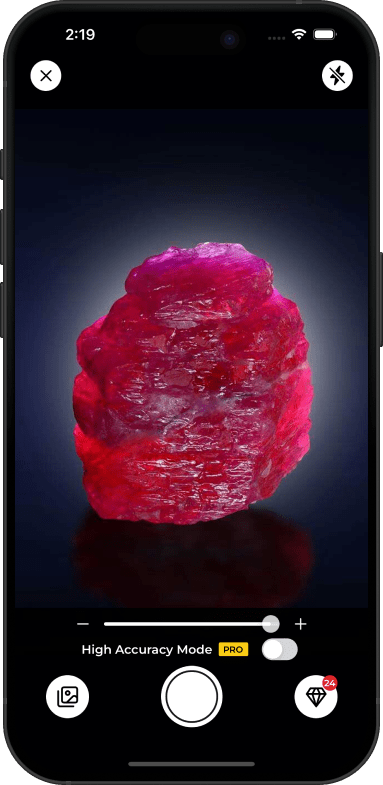
Identify Coquimbite Instantly
- Snap a photo, get instant results
- 6,700+ rocks, minerals & crystals
- Discover collecting spots near you
Coquimbite FAQs
How do I identify Coquimbite?
Coquimbite can be identified by its hardness of 2.5 on the Mohs scale, Light violet to purple color, Greasy, Resinous, Waxy, Sub-vitreous luster, Trigonal crystal system. Look for these key characteristics when examining specimens.
What color is Coquimbite?
Coquimbite typically appears in Light violet to purple, Greenish white, Bluish white, Yellowish white, Brownish white. Color can vary depending on impurities and formation conditions.
How hard is Coquimbite?
Coquimbite has a hardness of 2.5 on the Mohs scale. This makes it a soft mineral that can be scratched easily.