Ericssonite
A variety of Ericssonite Group

What is Ericssonite?
Ericssonite has a general formula of BaMn2FeOSi2O7. It was discovered in 1967 and named after John Ericsson (July 31, 1803 – March 8, 1889), a well known Swedish American inventor, engineer and designer of the iron-clad ship USS Monitor. Ericssonite was discovered in the Jakobsberg Mine in Värmland, Sweden. Ericcsonite is monoclinic; this means it contains three unequal vectors, two of these vector angles are perpendicular while the other is at an angle greater than 90°. Optically ericssonite is anisotropic which means that the mineral has more than one index of refraction, causing light to vary in speed depending on which axis it is traveling through. Since ericssonite is monoclinic, containing three unequal vectors, it has three indices of refraction. Ericssonite is usually a deep reddish-black in color. Ericssonite is only found in the Langban mine in Sweden, associated with a metamorphic manganese orebody. Also it is always inter-grown with orthoericssonite, which is almost identical to ericssonite except it contains extra silicon and oxygen in its chemical formula.
Market Value Factors
Pricing varies for every rock and mineral, so use these universal factors to gauge Ericssonite before comparing listings or appraisals.
Size & Weight
Larger, intact specimens usually command higher prices.
Rarity & Demand
Scarce material or popular varieties sell at a premium.
Condition & Finish
Chips, repairs, and heavy wear lower value; clean prep helps.
Treatment & Provenance
Untreated specimens with documented locality are prized.
Quick Facts
Physical Properties
- Color
- Deep reddish black
- Hardness (Mohs)
- 4.5
- Rock tumbling
- Not recommended
- Density
- 4.38 g/cm³
- Streak
- Rich brown
Chemical Properties
- Chemical Formula
- BaMn2+2Fe3+(Si2O7)O(OH)
- Elements
- Ba, Fe, H, Mn, O, Si
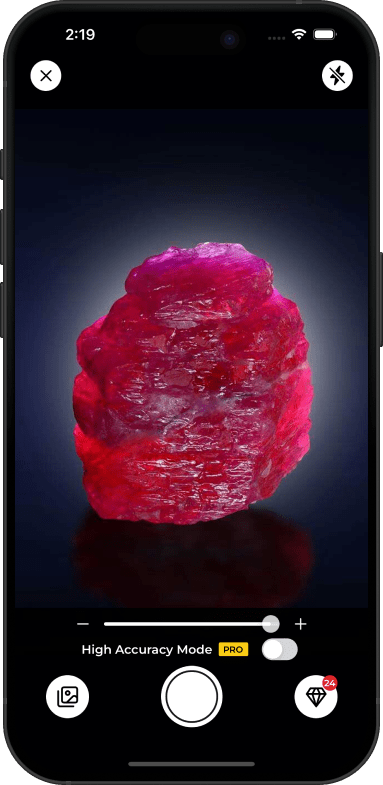
Identify Ericssonite Instantly
- Snap a photo, get instant results
- 6,700+ rocks, minerals & crystals
- Discover collecting spots near you
Ericssonite FAQs
How do I identify Ericssonite?
Ericssonite can be identified by its hardness of 4.5 on the Mohs scale, Deep reddish black color. Look for these key characteristics when examining specimens.
What color is Ericssonite?
Ericssonite typically appears in Deep reddish black. Color can vary depending on impurities and formation conditions.
How hard is Ericssonite?
Ericssonite has a hardness of 4.5 on the Mohs scale. This gives it moderate hardness.