Erionite-k
Erionite-K
A variety of Erionite Group
What is Erionite-k?
Erionite is a naturally occurring fibrous mineral that belongs to a group of minerals called zeolites. It usually is found in volcanic ash that has been altered by weathering and ground water. Erionite forms brittle, wool-like fibrous masses in the hollows of rock formations and has an internal molecular structure similar to chabazite. Some properties of erionite are similar to the properties of asbestos; however, erionite is not currently regulated by the U.S. Environmental Protection Agency and there are no occupational exposure limits for erionite fibers. Erionite was first described by A.S. Eakle in 1898, as white woolly fibrous masses in cavities in rhyolite lava near Durkee, Oregon. It was originally thought to be another relatively rare zeolite named offretite, which is very similar to erionite in appearance and chemical composition.
Market Value Factors
Pricing varies for every rock and mineral, so use these universal factors to gauge Erionite-k before comparing listings or appraisals.
Size & Weight
Larger, intact specimens usually command higher prices.
Rarity & Demand
Scarce material or popular varieties sell at a premium.
Condition & Finish
Chips, repairs, and heavy wear lower value; clean prep helps.
Treatment & Provenance
Untreated specimens with documented locality are prized.
Key Characteristics
Characteristics of Erionite-k
The chemical composition of erionite is approximately represented by the formula (Na2,K2,Ca)2Al4Si14O36•15H2O. It can be differentiated into Erionite-Na, Erionite-K, and Erionite-Ca forms based on the most dominant component. Erionite has a hexagonal, cage-like structure composed of a framework of linked tetrahedra. It consists of white prismatic crystals in radiating groups of crystal fiber. Erionite absorbs up to 20% of its weight in water, has a specific gravity of 2.02 to 2.13, and has gas absorption, ion exchange, and catalytic properties that are highly selective and depend on the molecular size of the absorbed compounds. Zeolites, in general, have good thermal stability, rehydration kinetics, and water vapor adsorption capacity.
Quick Facts
Physical Properties
- Hardness (Mohs)
- 3.5 - 4
- Rock tumbling
- Not recommended
- Streak
- White
Chemical Properties
- Chemical Formula
- (K2,Ca,Na2)2[Al4Si14O36] · 15H2O
- Elements
- Al, H, K, O, Si
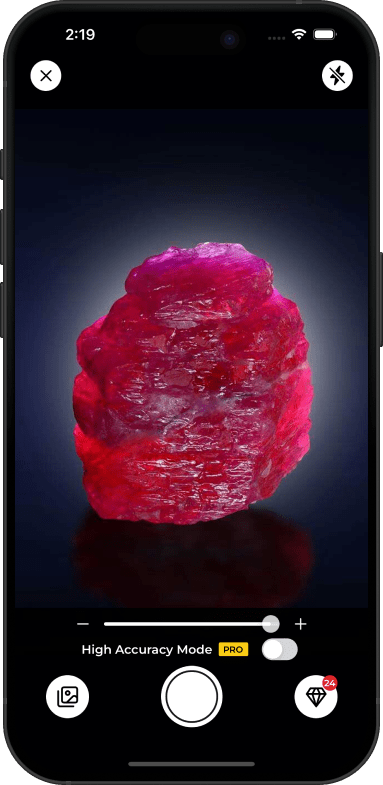
Identify Erionite-k Instantly
- Snap a photo, get instant results
- 6,700+ rocks, minerals & crystals
- Discover collecting spots near you
Erionite-k FAQs
How do I identify Erionite-k?
Erionite-k can be identified by its hardness of 3.5 - 4 on the Mohs scale. Look for these key characteristics when examining specimens.
How hard is Erionite-k?
Erionite-k has a hardness of 3.5 - 4 on the Mohs scale. This gives it moderate hardness.
What is the characteristics of erionite-k of Erionite-k?
The chemical composition of erionite is approximately represented by the formula (Na2,K2,Ca)2Al4Si14O36•15H2O. It can be differentiated into Erionite-Na, Erionite-K, and Erionite-Ca forms based on the most dominant component. Erionite has a hexagonal, cage-like structure composed of a framework of linked tetrahedra. It consists of white prismatic crystals in radiating groups of crystal fiber. Erionite absorbs up to 20% of its weight in water, has a specific gravity of 2.02 to 2.13, and has gas absorption, ion exchange, and catalytic properties that are highly selective and depend on the molecular size of the absorbed compounds. Zeolites, in general, have good thermal stability, rehydration kinetics, and water vapor adsorption capacity.