Fake Ruby
A variety of Ruby
What is Fake Ruby?
Fake Ruby is a synthetic or natural material that is designed to imitate the appearance of a natural Ruby. A popular type of fake Ruby includes glass, synthetic corundum, and cubic zirconia. Unlike the natural ruby, fake Ruby offers consistent color and clarity, enabling jewelers to craft a more uniform and visually appealing piece. Since a genuine ruby is rare, a large specimen is highly valuable and costly. In contrast, fake Ruby can be produced in larger sizes without such constraints, making it significantly more affordable. However, it may not retain its value over time.
Optical Properties
- Refractive Index
- 1.762-1.778
- Birefringence
- 0.008
- Pleochroism
- Strong: purplish-red, orangy-red
- Optical Character
- Uniaxial negative
- Dispersion
- 0.018
Market Value Factors
Pricing varies for every rock and mineral, so use these universal factors to gauge Fake Ruby before comparing listings or appraisals.
Size & Weight
Larger, intact specimens usually command higher prices.
Rarity & Demand
Scarce material or popular varieties sell at a premium.
Condition & Finish
Chips, repairs, and heavy wear lower value; clean prep helps.
Treatment & Provenance
Untreated specimens with documented locality are prized.
Where to Find Fake Ruby
Fake Ruby is a variety of Ruby. RockHoundR, the free-to-download rockhounding map from the Ruby Glint team, shows where collectors find ruby in the US, with land-access notes for BLM land and national forests. Collecting is banned in national parks.
See where to find rubyAlways check the local rules and get the landowner's permission before you collect.
Quick Facts
Physical Properties
- Color
- Pure, vibrant red to purplish red
- Streak
- White
- Luster
- Vitreous, Adamantine
Chemical Properties
- Chemical Formula
- Al2O3
- Elements
- Al, O
Also Known As
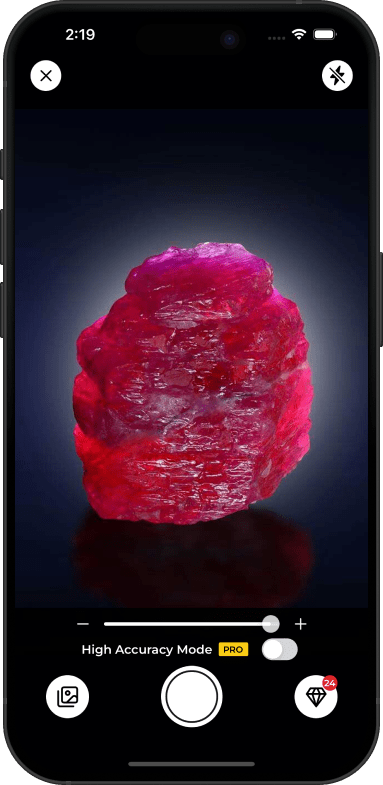
Identify Fake Ruby Instantly
- Snap a photo, get instant results
- 6,700+ rocks, minerals & crystals
- Discover collecting spots near you
Fake Ruby FAQs
How do I identify Fake Ruby?
Fake Ruby can be identified by its Pure color, Vitreous, Adamantine luster. Look for these key characteristics when examining specimens.
What color is Fake Ruby?
Fake Ruby typically appears in Pure, vibrant red to purplish red. Color can vary depending on impurities and formation conditions.