Ferro-glaucophane
A variety of Glaucophane Root Name Group
What is Ferro-glaucophane?
Glaucophane is the name of a mineral and a mineral group belonging to the sodic amphibole supergroup of the double chain inosilicates, with the chemical formula ☐Na2(Mg3Al2)Si8O22(OH)2. Glaucophane crystallizes in the monoclinic system.
Market Value Factors
Pricing varies for every rock and mineral, so use these universal factors to gauge Ferro-glaucophane before comparing listings or appraisals.
Size & Weight
Larger, intact specimens usually command higher prices.
Rarity & Demand
Scarce material or popular varieties sell at a premium.
Condition & Finish
Chips, repairs, and heavy wear lower value; clean prep helps.
Treatment & Provenance
Untreated specimens with documented locality are prized.
Key Characteristics
Characteristics of Ferro-glaucophane
The blue color is very diagnostic for this species. Glaucophane, along with the closely related mineral riebeckite, to which it forms a series with, and their intermediate crossite, are the only well known amphiboles that are commonly blue. Glaucophane forms a solid solution series with ferroglaucophane (Na2(Fe,Mg)3Al2Si8O22(OH)2). Glaucophane is the magnesium-rich endmember and ferroglaucophane is the iron-rich endmember. Ferroglaucophane is similar to glaucophane but is slightly denser and hence increased specific gravity. The two endmembers are indistinguishable in hand specimens and are strongly pleochroic. Glaucophane's hardness is 5–6 and its specific gravity is approximately 3–3.2.
Formation of Ferro-glaucophane
The blueschist metamorphic facies gets its name from abundant blue minerals glaucophane and lawsonite. Glaucophane generally forms in blueschist metamorphic rocks of gabbroic or basaltic composition that are rich in sodium and have experienced low temperature-high pressure metamorphism such as would occur along a subduction zone. This material has undergone intense pressure and moderate heat as it was subducted downward toward the mantle. Glaucophane is also found in eclogites that have undergone retrograde metamorphism. There is also a rare amphibole called holmquistite, chemical formula Li2Mg3Al2Si8O22(OH)2, which occurs only in lithium-rich continental rocks. For many years, holmquistite was mistaken for glaucophane, as the two look identical in thin section.
Quick Facts
Physical Properties
- Color
- Grey to lavender-blue.
- Hardness (Mohs)
- 5 - 6
- Rock tumbling
- With care
- Streak
- Pale grey to bluish-grey.
Chemical Properties
- Chemical Formula
- ◻[Na2][Fe<sup>2+</sup><sub>3</sub>Al<sub>2</sub>]Si8O22(OH)2 Ferro-glaucophane is defined as a member of the glaucophane group with Fe2+ >Mg in the C2+ position and (OH) in the W position.
- Elements
- Al, Fe, H, Na, O, Si
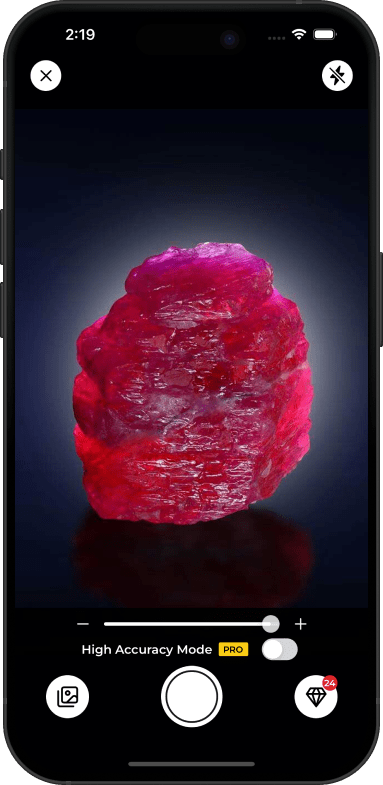
Identify Ferro-glaucophane Instantly
- Snap a photo, get instant results
- 6,700+ rocks, minerals & crystals
- Discover collecting spots near you
Ferro-glaucophane FAQs
How do I identify Ferro-glaucophane?
Ferro-glaucophane can be identified by its hardness of 5 - 6 on the Mohs scale, Grey to lavender-blue. color. Look for these key characteristics when examining specimens.
What color is Ferro-glaucophane?
Ferro-glaucophane typically appears in Grey to lavender-blue.. Color can vary depending on impurities and formation conditions.
How hard is Ferro-glaucophane?
Ferro-glaucophane has a hardness of 5 - 6 on the Mohs scale. This gives it moderate hardness.
What is the characteristics of ferro-glaucophane of Ferro-glaucophane?
The blue color is very diagnostic for this species. Glaucophane, along with the closely related mineral riebeckite, to which it forms a series with, and their intermediate crossite, are the only well known amphiboles that are commonly blue. Glaucophane forms a solid solution series with ferroglaucophane (Na2(Fe,Mg)3Al2Si8O22(OH)2). Glaucophane is the magnesium-rich endmember and ferroglaucophane is the iron-rich endmember. Ferroglaucophane is similar to glaucophane but is slightly denser and hence increased specific gravity. The two endmembers are indistinguishable in hand specimens and are strongly pleochroic. Glaucophane's hardness is 5–6 and its specific gravity is approximately 3–3.2.
What is the formation of ferro-glaucophane of Ferro-glaucophane?
The blueschist metamorphic facies gets its name from abundant blue minerals glaucophane and lawsonite. Glaucophane generally forms in blueschist metamorphic rocks of gabbroic or basaltic composition that are rich in sodium and have experienced low temperature-high pressure metamorphism such as would occur along a subduction zone. This material has undergone intense pressure and moderate heat as it was subducted downward toward the mantle. Glaucophane is also found in eclogites that have undergone retrograde metamorphism. There is also a rare amphibole called holmquistite, chemical formula Li2Mg3Al2Si8O22(OH)2, which occurs only in lithium-rich continental rocks. For many years, holmquistite was mistaken for glaucophane, as the two look identical in thin section.