Jade
A variety of Jewellery

What is Jade?
Jade is a highly valued ornamental stone that has been treasured for over 5,000 years, particularly in East Asian cultures. The term "jade" encompasses two distinct minerals: jadeite and nephrite, both prized for their exceptional toughness and beautiful appearance. Historically used for tools, weapons, and ceremonial objects, jade has been called the "stone of heaven" in Chinese culture. Its remarkable durability, combined with its ability to take a high polish, makes it ideal for intricate carvings and jewelry. The finest jade exhibits a translucent, even color and smooth, waxy luster that has captivated civilizations throughout history.
Uses & Applications
Jade is highly prized for jewelry, decorative objects, and ornamental carvings. It has been used for thousands of years to create tools, weapons, ceremonial objects, and intricate sculptures. In traditional Chinese medicine, jade is used in massage tools and is believed to have cooling properties for the skin. Modern uses include decorative items, jewelry, and spiritual practices.
Healing Properties
Jade is believed to be a powerful healing stone that promotes emotional balance, wisdom, and protection. It is said to attract good luck and friendship while dispelling negative energy. Jade is thought to support the heart and kidneys, promote longevity, and enhance mental clarity. The stone is believed to help with decision-making, encourage self-sufficiency, and provide emotional stability during times of stress.
Optical Properties
- Refractive Index
- 1.640-1.688 (jadeite), 1.600-1.641 (nephrite)
- Pleochroism
- Weak to moderate
- Optical Character
- Biaxial positive (jadeite), Biaxial negative (nephrite)
- Dispersion
- Low
Discover Values
This stone excels in popularity, beauty, cultural value, collection value.
Market Value Factors
Pricing varies for every rock and mineral, so use these universal factors to gauge Jade before comparing listings or appraisals.
Size & Weight
Larger, intact specimens usually command higher prices.
Rarity & Demand
Scarce material or popular varieties sell at a premium.
Condition & Finish
Chips, repairs, and heavy wear lower value; clean prep helps.
Treatment & Provenance
Untreated specimens with documented locality are prized.
Where to Find Jade
RockHoundR, the free-to-download rockhounding map from the Ruby Glint team, shows where collectors find jade in the US, with land-access notes for BLM land and national forests. Collecting is banned in national parks.
See where to find jadeAlways check the local rules and get the landowner's permission before you collect.
The Meaning
Jade is considered the stone of wisdom, balance, and peace in Chinese culture, where it symbolizes purity, serenity, and protection. Ancient Chinese believed jade could preserve the body after death and ensure safe passage to the afterlife. In Mesoamerican cultures, jade was more valuable than gold and represented life, fertility, and power. Jade is often associated with good luck, prosperity, and harmony, and is believed to attract abundance while protecting against negative energy.
Geochemistry
Jade comprises two different silicate minerals: jadeite (NaAlSi2O6) and nephrite, which is an aggregate of either actinolite or tremolite (Ca2(Mg,Fe)5Si8O22(OH)2). Jadeite is a pyroxene mineral that forms under high-pressure metamorphic conditions, while nephrite is an amphibole that forms under lower pressure conditions. Both minerals achieve their characteristic toughness through interlocking crystalline structures. The various colors of jade result from trace elements: chromium and iron create green hues, iron produces yellow and brown tones, manganese creates violet colors, and titanium can produce blue shades. Pure jadeite and nephrite are white.
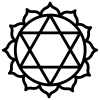
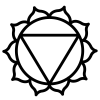
Associated Chakras
More Images


Quick Facts
Physical Properties
- Color
- Green, white, lavender, yellow, orange, red, black, brown
- Hardness (Mohs)
- 6-7
- Rock tumbling
- With care
- Density
- 2.90-3.35 g/cm³
- Streak
- White
- Luster
- Vitreous to greasy
- Crystal System
- Monoclinic (jadeite), Monoclinic (nephrite)
Chemical Properties
- Chemical Formula
- NaAlSi2O6 (jadeite), Ca2(Mg,Fe)5Si8O22(OH)2 (nephrite)
- Elements
- Na, Al, Si, O (jadeite), Ca, Mg, Fe, Si, O, H (nephrite)
Also Known As
Identify Jade Instantly
- Snap a photo, get instant results
- 6,700+ rocks, minerals & crystals
- Discover collecting spots near you
Jade FAQs
How do I identify Jade?
Jade can be identified by its hardness of 6-7 on the Mohs scale, Green color, Vitreous to greasy luster, Monoclinic (jadeite), Monoclinic (nephrite) crystal system. Look for these key characteristics when examining specimens.
What color is Jade?
Jade typically appears in Green, white, lavender, yellow, orange, red, black, brown. Color can vary depending on impurities and formation conditions.
How hard is Jade?
Jade has a hardness of 6-7 on the Mohs scale. This gives it moderate hardness.