Jarosite
A variety of Alunite Group

What is Jarosite?
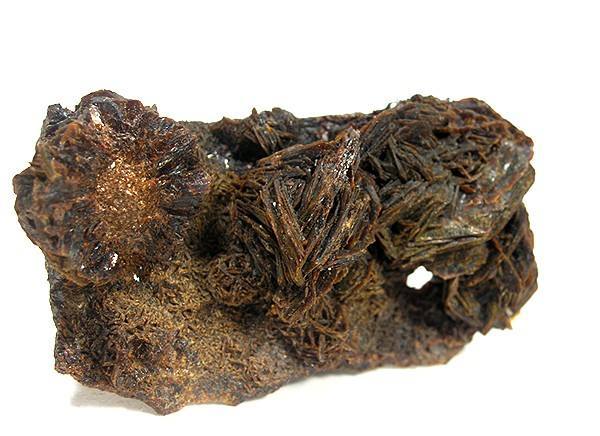
Jarosite is an uncommon sulfate mineral that often forms yellow- or amber-colored crystals. The mineral's name is derived from "Jara", the Spanish name for a flower that often bears a similar color. Jarosite is very brittle and is rarely cut into gemstones, although attractive crystal formations are sought-after by collectors. It also has the distinction of being one of the relatively few minerals to be discovered by rovers on the surface of Mars.
Etymology & Origins
Jarosite was first described in 1852 by August Breithaupt in the Barranco del Jaroso in the Sierra Almagrera (near Los Lobos, Cuevas del Almanzora, Almería, Spain). The name jarosite is also directly derived from Jara, the Spanish name of a yellow flower that belongs to the genus Cistus and grows in this sierra.
Uses & Applications
Jarosite is often used to rid materials of impurities, and it is particularly important to the zinc industry as it can filter out iron and sulfate to result in cleaner and safer zinc. However, it is rare and often only occurs as small crystals, and is used somewhat infrequently in industry.
Market Value Factors
Pricing varies for every rock and mineral, so use these universal factors to gauge Jarosite before comparing listings or appraisals.
Size & Weight
Larger, intact specimens usually command higher prices.
Rarity & Demand
Scarce material or popular varieties sell at a premium.
Condition & Finish
Chips, repairs, and heavy wear lower value; clean prep helps.
Treatment & Provenance
Untreated specimens with documented locality are prized.
Key Characteristics
Characteristics of Jarosite
Jarosite has a trigonal crystal structure and is brittle, with basal cleavage, a hardness of 2.5-3.5, and a specific gravity of 3.15-3.26. It is translucent to opaque with a vitreous to dull luster, and is colored dark yellow to yellowish-brown. It can sometimes be confused with limonite or goethite with which it commonly occurs in the gossan (oxidized cap over an ore body). Jarosite is an iron analogue of the potassium aluminium sulfate, alunite.
More Images

Quick Facts
Physical Properties
- Color
- Amber-yellow, yellow-brown, to brown or light yellow
- Hardness (Mohs)
- 2.5 - 3.5
- Rock tumbling
- Not recommended
- Density
- 3.25 g/cm³
- Streak
- Pale-yellow
- Luster
- Vitreous, Resinous, Sub-adamantine
- Crystal System
- Trigonal
Chemical Properties
- Chemical Formula
- KFe3+3(SO4)2(OH)6
- Elements
- Fe, H, K, O, S
Also Known As
Identify Jarosite Instantly
- Snap a photo, get instant results
- 6,700+ rocks, minerals & crystals
- Discover collecting spots near you
Jarosite FAQs
How do I identify Jarosite?
Jarosite can be identified by its hardness of 2.5 - 3.5 on the Mohs scale, Amber-yellow color, Vitreous, Resinous, Sub-adamantine luster, Trigonal crystal system. Look for these key characteristics when examining specimens.
What color is Jarosite?
Jarosite typically appears in Amber-yellow, yellow-brown, to brown or light yellow. Color can vary depending on impurities and formation conditions.
How hard is Jarosite?
Jarosite has a hardness of 2.5 - 3.5 on the Mohs scale. This makes it a soft mineral that can be scratched easily.
What is the characteristics of jarosite of Jarosite?
Jarosite has a trigonal crystal structure and is brittle, with basal cleavage, a hardness of 2.5-3.5, and a specific gravity of 3.15-3.26. It is translucent to opaque with a vitreous to dull luster, and is colored dark yellow to yellowish-brown. It can sometimes be confused with limonite or goethite with which it commonly occurs in the gossan (oxidized cap over an ore body). Jarosite is an iron analogue of the potassium aluminium sulfate, alunite.