Leifite
A variety of Leifite Group
What is Leifite?
Leifite is a rare tectosilicate. Tectosilicates are built on a framework of tetrahedra with silicon or aluminium at the centre and oxygen at the vertices; they include feldspars and zeolites, but leifite does not belong in either of these categories. It is a member of the leifite group, which includes telyushenkoite (Cs,Na,K)Na6(Be2Al3Si15O39) and eirikite KNa6Be2(Si15Al3)O39F2). Leifite was discovered in 1915, and named after Leif Ericson who was a Norse explorer who lived around 1000 AD, and was probably the first European to land in North America, nearly 500 years before Christopher Columbus. Eirikite was named in 2007 after Eirik Raude, or Erik the Red, (950–1003), who discovered Greenland and who was the father of Leif Ericson. The third mineral in the group, telyushenkoite, was discovered in 2001. It was not named after any of Leif Ericson's family members, but after a professor of geology in Turkmenistan.
Market Value Factors
Pricing varies for every rock and mineral, so use these universal factors to gauge Leifite before comparing listings or appraisals.
Size & Weight
Larger, intact specimens usually command higher prices.
Rarity & Demand
Scarce material or popular varieties sell at a premium.
Condition & Finish
Chips, repairs, and heavy wear lower value; clean prep helps.
Treatment & Provenance
Untreated specimens with documented locality are prized.
Key Characteristics
Characteristics of Leifite
The mineral is hard, with Mohs hardness 6, the same as that of feldspar, and specific gravity 2.6, again like the feldspars. It is brittle, with an uneven to splintery fracture.
Appearance of Leifite
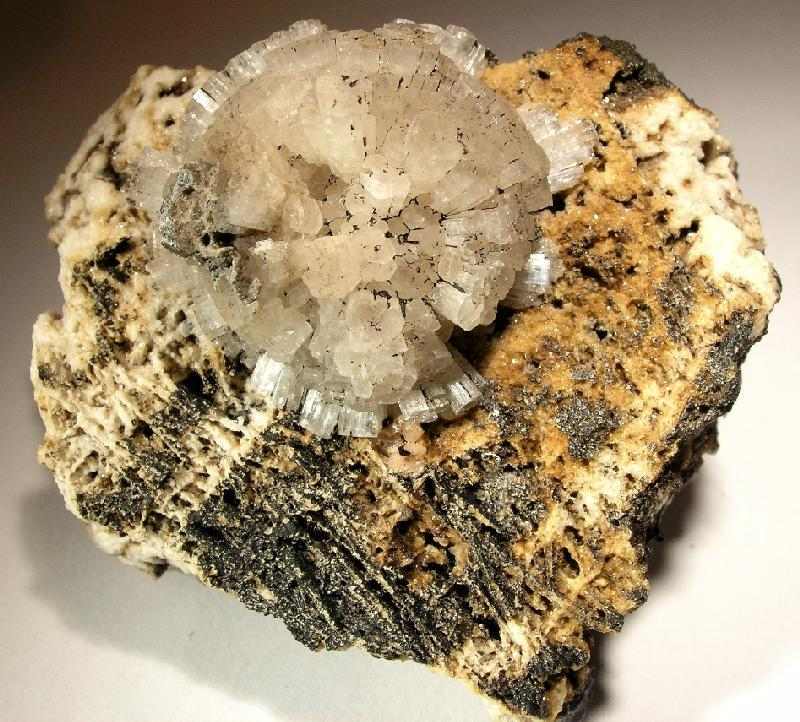
Leifite is generally white or colourless, with a white streak and a silky or vitreous lustre. It occurs as fine needles making up radiating aggregates and rosettes. Individual crystals are deeply striated hexagonal prisms that are transparent to translucent.
Formation of Leifite
The type locality is the Narsaarsuk pegmatite on the Narsaarsuk Plateau, Igaliku, Narsaq, Kujalleq, Greenland and type material is kept at the University of Copenhagen, Denmark, and at the National Museum of Natural History in Washington DC, US. Leifite occurs in cavities in alkali-pegmatite veins. At Mont Saint-Hilaire it occurs as crystals up to 5 cm long and as disk-shaped aggregates and radially fibrous spheres associated with albite, natrolite, serandite and catapleite. In Greenland it occurs in a pegmatite with microcline, calcite, zinnwaldite and acmite. In Russia it occurs in the Lovozero Massif associated with albite and natrolite. In Norway it occurs in a nepheline syenite pegmatite on the south eastern part of the island of Vesle Aroya in the Langesundsfjord District, Oslo Region, as white to colourless fibrous masses and radiating bundles.
Composition of Leifite
Leifite is a trigonal mineral, class 3 2/m, space group P3m1. There are 3 formula units in the unit cell (Z = 3), and cell dimensions are 14.4 Å in the a direction and 4.9 Å in the c direction. It contains OH groups, but no water of crystallization as was previously assumed. Tetrahedrons of silicon or aluminium atoms surrounded by four oxygen atoms link to form six-membered rings stacked along the c direction to form channels, similar to those in zeolites.
Quick Facts
Physical Properties
- Color
- Colorless
- Hardness (Mohs)
- 6
- Rock tumbling
- With care
- Density
- 2.59 g/cm³
Chemical Properties
- Chemical Formula
- (Na,H2O)Na6[Be2Al2(Al,Si)Si15O39]F2
- Elements
- Al, Be, F, H, Na, O, Si
Identify Leifite Instantly
- Snap a photo, get instant results
- 6,700+ rocks, minerals & crystals
- Discover collecting spots near you
Leifite FAQs
How do I identify Leifite?
Leifite can be identified by its hardness of 6 on the Mohs scale, Colorless color. Look for these key characteristics when examining specimens.
What color is Leifite?
Leifite typically appears in Colorless. Color can vary depending on impurities and formation conditions.
How hard is Leifite?
Leifite has a hardness of 6 on the Mohs scale. This gives it moderate hardness.
What is the characteristics of leifite of Leifite?
The mineral is hard, with Mohs hardness 6, the same as that of feldspar, and specific gravity 2.6, again like the feldspars. It is brittle, with an uneven to splintery fracture.
What is the appearance of leifite of Leifite?
Leifite is generally white or colourless, with a white streak and a silky or vitreous lustre. It occurs as fine needles making up radiating aggregates and rosettes. Individual crystals are deeply striated hexagonal prisms that are transparent to translucent.
What is the formation of leifite of Leifite?
The type locality is the Narsaarsuk pegmatite on the Narsaarsuk Plateau, Igaliku, Narsaq, Kujalleq, Greenland and type material is kept at the University of Copenhagen, Denmark, and at the National Museum of Natural History in Washington DC, US. Leifite occurs in cavities in alkali-pegmatite veins. At Mont Saint-Hilaire it occurs as crystals up to 5 cm long and as disk-shaped aggregates and radially fibrous spheres associated with albite, natrolite, serandite and catapleite. In Greenland it occurs in a pegmatite with microcline, calcite, zinnwaldite and acmite. In Russia it occurs in the Lovozero Massif associated with albite and natrolite. In Norway it occurs in a nepheline syenite pegmatite on the south eastern part of the island of Vesle Aroya in the Langesundsfjord District, Oslo Region, as white to colourless fibrous masses and radiating bundles.