Pearl
What is Pearl?
Pearls are unique in that they are the only gem material formed and found within living creatures. Freshwater types are found in mussels and saltwater varieties are found in oysters. Pearls require no polishing or cutting prior to use. They have been cultivated largely for use in jewelry but have also been crushed and used in cosmetics and medicines.
Etymology & Origins
The English word pearl comes from the French perle, originally from the Latin perna meaning leg, after the ham- or mutton leg-shaped bivalve. The scientific name for the family of pearl-bearing oysters, Margaritiferidae comes from the Old Persian word for pearl *margārīta- which is the source of the English name Margaret.
Uses & Applications
Pearl has been used in jewelry for thousands of years. It is formed into beads and sewn onto clothing. The material is also used to create inlay highlights on instruments like guitars and bows. When it is laminated, pearl can be incorporated into mosaics and other decorations.
Healing Properties
The pearl provides a calming effect when used on the Crown and Heart chakras. It is believed to enhance integrity, concentration, and focus. Many believe the stone brings better insight and wisdom, allowing for a greater understanding of one's self and others. It is intended as an emotional healing stone to help remove negativity and allow more positive energy to flow through.
Optical Properties
- Refractive Index
- 1.52-1.66
- Birefringence
- 0.156
- Pleochroism
- None
Discover Values
This stone excels in popularity, beauty, collection value.
Market Value Factors
Pricing varies for every rock and mineral, so use these universal factors to gauge Pearl before comparing listings or appraisals.
Size & Weight
Larger, intact specimens usually command higher prices.
Rarity & Demand
Scarce material or popular varieties sell at a premium.
Condition & Finish
Chips, repairs, and heavy wear lower value; clean prep helps.
Treatment & Provenance
Untreated specimens with documented locality are prized.
The Meaning
Coveted by humans for thousands of years, pearl has been considered a magical and enigmatic gemstone with many folktales and myths about its creation. For example, ancient Chinese associated pearls with dragons, while one legend says that Eve's tears turned to pearls when she was banished from Eden. In ancient Rome, pearl was so valued that the law limited wearing them only to the ruling class.
Associated Chakras



Key Characteristics
Characteristics of Pearl
The unique luster of pearls depends upon the reflection, refraction, and diffraction of light from the translucent layers. The thinner and more numerous the layers in the pearl, the finer the luster. The iridescence that pearls display is caused by the overlapping of successive layers, which breaks up light falling on the surface. In addition, pearls (especially cultured freshwater pearls) can be dyed yellow, green, blue, brown, pink, purple, or black. The very best pearls have a metallic mirror-like luster. Because pearls are made primarily of calcium carbonate, they can be dissolved in vinegar. Calcium carbonate is susceptible to even a weak acid solution because the crystals react with the acetic acid in the vinegar to form calcium acetate and carbon dioxide.
Quick Facts
Physical Properties
- Color
- White, pink, cream, silver, pink, black, gold, green, blue, purple
- Hardness (Mohs)
- 2.5 - 4.5
- Rock tumbling
- Not recommended
- Density
- 2.6 - 2.85 g/cm³
- Streak
- White
- Luster
- Metallic, Pearly
- Crystal System
- Orthorhombic, Trigonal
Chemical Properties
- Chemical Formula
- CaCO3
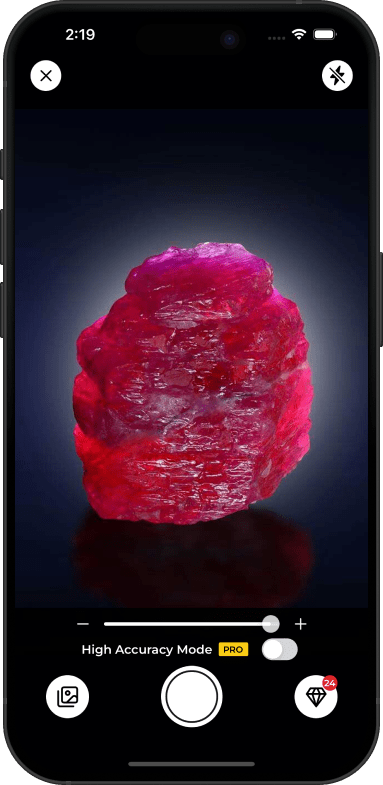
Identify Pearl Instantly
- Snap a photo, get instant results
- 6,700+ rocks, minerals & crystals
- Discover collecting spots near you
Pearl FAQs
How do I identify Pearl?
Pearl can be identified by its hardness of 2.5 - 4.5 on the Mohs scale, White color, Metallic, Pearly luster, Orthorhombic, Trigonal crystal system. Look for these key characteristics when examining specimens.
What color is Pearl?
Pearl typically appears in White, pink, cream, silver, pink, black, gold, green, blue, purple. Color can vary depending on impurities and formation conditions.
How hard is Pearl?
Pearl has a hardness of 2.5 - 4.5 on the Mohs scale. This makes it a soft mineral that can be scratched easily.
What is the characteristics of pearl of Pearl?
The unique luster of pearls depends upon the reflection, refraction, and diffraction of light from the translucent layers. The thinner and more numerous the layers in the pearl, the finer the luster. The iridescence that pearls display is caused by the overlapping of successive layers, which breaks up light falling on the surface. In addition, pearls (especially cultured freshwater pearls) can be dyed yellow, green, blue, brown, pink, purple, or black. The very best pearls have a metallic mirror-like luster. Because pearls are made primarily of calcium carbonate, they can be dissolved in vinegar. Calcium carbonate is susceptible to even a weak acid solution because the crystals react with the acetic acid in the vinegar to form calcium acetate and carbon dioxide.