Plumbogummite
A variety of Plumbogummite Group
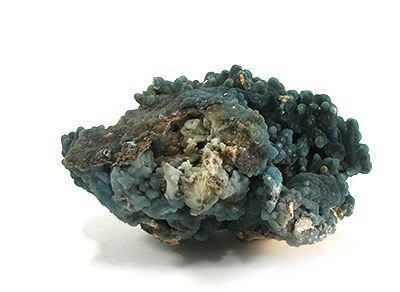
What is Plumbogummite?
Plumbogummite is a secondary mineral usually found in shades of blues, reds, greens, greys, and browns. This mineral is translucent and in the middle of the Mohs scale, which determines the hardness of a mineral. Plumbogummite is typically found alongside lead-bearing deposits in oxidized zones.
Market Value Factors
Pricing varies for every rock and mineral, so use these universal factors to gauge Plumbogummite before comparing listings or appraisals.
Size & Weight
Larger, intact specimens usually command higher prices.
Rarity & Demand
Scarce material or popular varieties sell at a premium.
Condition & Finish
Chips, repairs, and heavy wear lower value; clean prep helps.
Treatment & Provenance
Untreated specimens with documented locality are prized.
Key Characteristics
Formation of Plumbogummite
The type locality is Huelgoat, Finistère, Brittany, France, and the type material is stored in the Natural History Museum, Paris, France. Plumbogummite has been found in the Central Cobar Mines, New South Wales, Australia and the Nifty Copper Mine, Western Australia. Also in the Kintore open cut at Broken Hill, New South Wales, Australia, but it is generally inconspicuous there and only a few specimens have been collected. Material from the Siglio XX Mine, Llallagua, Bolivia, is an unusual pale yellow color, rather than the more common blue or green, forming crusts on quartz and cassiterite, and enclosing crude octahedral jeanbandyite crystals with orange colored shells of plumbogummite.
Composition of Plumbogummite
The basic structural units of plumbogummite are PO4 tetrahedra, with phosphorus atoms (P) at the center and oxygen atoms (O) at the corners, together with AlO6 octahedra, aluminium atoms (Al) at the center and oxygen atoms at the corners. The tetrahedra and octahedra combine by sharing corners, to form composite layers. Lead atoms (Pb) occupy sites between the layers.
Health & Safety Information
- ⚠️Plumbogummite dust is toxic because it contains heavy metals Lead.
- ⚠️Lead
- ⚠️It's advisable to handle plumbogummite carefully to avoid generating dust and wash hands thoroughly afterward. When cutting or polishing plumbogummite, wear a dust mask to prevent inhaling heavy metal particles. Store plumbogummite in a sealed container in a well-ventilated area, away from children and pets. For those involved in crystal healing, never put it in your mouth.
Quick Facts
Physical Properties
- Color
- Light blue, gray-white, yellow-gray, yellow, yellow-brown, red-brown, greenish, bluish, dark blue-gray
- Hardness (Mohs)
- 4 - 5
- Rock tumbling
- Not recommended
- Density
- 4.08 g/cm³
- Streak
- Colourless to white
- Luster
- Resinous, Dull
- Crystal System
- Trigonal
Chemical Properties
- Chemical Formula
- PbAl3(PO4)(PO3OH)(OH)6
- Elements
- Al, H, O, P, Pb
Also Known As
Identify Plumbogummite Instantly
- Snap a photo, get instant results
- 6,700+ rocks, minerals & crystals
- Discover collecting spots near you
Plumbogummite FAQs
How do I identify Plumbogummite?
Plumbogummite can be identified by its hardness of 4 - 5 on the Mohs scale, Light blue color, Resinous, Dull luster, Trigonal crystal system. Look for these key characteristics when examining specimens.
What color is Plumbogummite?
Plumbogummite typically appears in Light blue, gray-white, yellow-gray, yellow, yellow-brown, red-brown, greenish, bluish, dark blue-gray. Color can vary depending on impurities and formation conditions.
How hard is Plumbogummite?
Plumbogummite has a hardness of 4 - 5 on the Mohs scale. This gives it moderate hardness.
What is the formation of plumbogummite of Plumbogummite?
The type locality is Huelgoat, Finistère, Brittany, France, and the type material is stored in the Natural History Museum, Paris, France. Plumbogummite has been found in the Central Cobar Mines, New South Wales, Australia and the Nifty Copper Mine, Western Australia. Also in the Kintore open cut at Broken Hill, New South Wales, Australia, but it is generally inconspicuous there and only a few specimens have been collected. Material from the Siglio XX Mine, Llallagua, Bolivia, is an unusual pale yellow color, rather than the more common blue or green, forming crusts on quartz and cassiterite, and enclosing crude octahedral jeanbandyite crystals with orange colored shells of plumbogummite.
What is the composition of plumbogummite of Plumbogummite?
The basic structural units of plumbogummite are PO4 tetrahedra, with phosphorus atoms (P) at the center and oxygen atoms (O) at the corners, together with AlO6 octahedra, aluminium atoms (Al) at the center and oxygen atoms at the corners. The tetrahedra and octahedra combine by sharing corners, to form composite layers. Lead atoms (Pb) occupy sites between the layers.
