Pyrargyrite
A variety of Proustite Group

What is Pyrargyrite?
Pyrargyrite is a striking, silver-containing mineral sought after by miners and rockhounds alike. The mineral is sometimes referred to as red silver ore or ruby silver because it often takes on a deep red hue; specimens that are both deep red and exhibit some transparency are particularly prized by collectors. Though it is rare, deposits of pyrargyrite can be found around the world.
Etymology & Origins
The color of pyrargyrite is usually greyish-black and the lustre metallic-adamantine; large crystals are opaque, but small ones and thin splinters are deep ruby-red by transmitted light, hence the name, from the Greek pyr and argyros, "fire-silver" in allusion to color and silver content, given by E. F. Glocker in 1831. The streak is purplish-red, thus differing markedly from the scarlet streak of proustite and affording a ready means of distinguishing the two minerals.
Uses & Applications
Pyrargyrite is typically mined as a source of silver, which it often thought of as a precious metal used in jewelry and decorations. However, silver mined from pyrargyrite has many other uses, ranging from metal alloys used in dentistry to batteries. Silver is also used in tips of gloves that are touchscreen-sensitive.
Optical Properties
- Refractive Index
- 2.881-3.084
- Birefringence
- 0.203
- Pleochroism
- Strong
- Optical Character
- Uniaxial negative
Market Value Factors
Pricing varies for every rock and mineral, so use these universal factors to gauge Pyrargyrite before comparing listings or appraisals.
Size & Weight
Larger, intact specimens usually command higher prices.
Rarity & Demand
Scarce material or popular varieties sell at a premium.
Condition & Finish
Chips, repairs, and heavy wear lower value; clean prep helps.
Treatment & Provenance
Untreated specimens with documented locality are prized.
Key Characteristics
Characteristics of Pyrargyrite
The Mohs hardness is 2.75, and the specific gravity 5.85. The refractive indices (nω=3.084 nε=2.881) and birefringence (δ=0.203) are very high. There is no very distinct cleavage and the fracture is conchoidal. The mineral occurs in metalliferous veins with calcite, argentiferous galena, native silver, native arsenic, &c.
Health & Safety Information
- ⚠️Pyrargyrite dust is toxic because it contains heavy metals Antimony, Silver.
- ⚠️It's advisable to handle pyrargyrite carefully to avoid generating dust and wash hands thoroughly afterward. When cutting or polishing pyrargyrite, wear a dust mask to prevent inhaling heavy metal particles. Store pyrargyrite in a sealed container in a well-ventilated area, away from children and pets. For those involved in crystal healing, never put it in your mouth.
More Images

Quick Facts
Physical Properties
- Color
- Deep red, red gray
- Hardness (Mohs)
- 2.5
- Rock tumbling
- Not recommended
- Density
- 5.855 g/cm³
- Streak
- Purplish red
- Luster
- Adamantine
- Crystal System
- Trigonal
Chemical Properties
- Chemical Formula
- Ag3SbS3
- Elements
- Ag, S, Sb
Also Known As
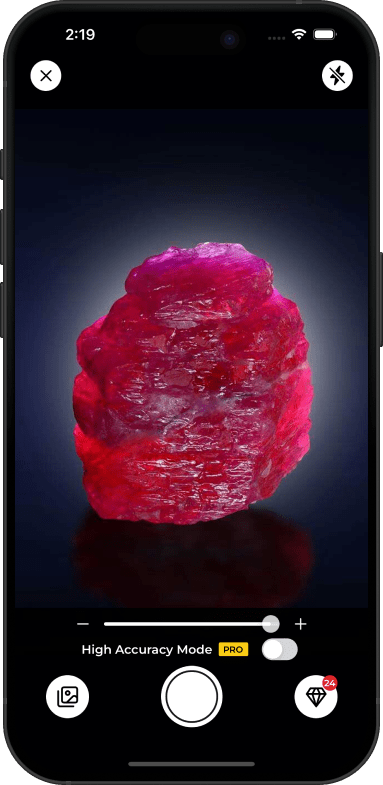
Identify Pyrargyrite Instantly
- Snap a photo, get instant results
- 6,700+ rocks, minerals & crystals
- Discover collecting spots near you
Pyrargyrite FAQs
How do I identify Pyrargyrite?
Pyrargyrite can be identified by its hardness of 2.5 on the Mohs scale, Deep red color, Adamantine luster, Trigonal crystal system. Look for these key characteristics when examining specimens.
What color is Pyrargyrite?
Pyrargyrite typically appears in Deep red, red gray. Color can vary depending on impurities and formation conditions.
How hard is Pyrargyrite?
Pyrargyrite has a hardness of 2.5 on the Mohs scale. This makes it a soft mineral that can be scratched easily.
What is the characteristics of pyrargyrite of Pyrargyrite?
The Mohs hardness is 2.75, and the specific gravity 5.85. The refractive indices (nω=3.084 nε=2.881) and birefringence (δ=0.203) are very high. There is no very distinct cleavage and the fracture is conchoidal. The mineral occurs in metalliferous veins with calcite, argentiferous galena, native silver, native arsenic, &c.
