Rosasite
A variety of Rosasite Group

What is Rosasite?
You may think that rosasite, given its name, is rose-colored. But this sky-blue-hued stone is actually named for the Rosas Mine in Sardinia, Italy, where it was first discovered. This uncommon mineral is mined for its zinc and copper content. The mineral's smooth - almost silky - crystals make it distinctive and attractive to collectors.
Uses & Applications
Rosasite is a source of copper and zinc, though it does not occur abundantly and is not the most popular ore of either of these minerals. Its rarity and bright blue color make it a desired collectors item and popular museum exhibit piece.
Healing Properties
Rosasite is believed to give hope and restore the love and joy in one's aura. It is thought to provide a direct link between the throat and heart chakras, helping a person give voice to their emotions. Many find it useful while repeating affirmations, as it is said to offer strength and determination as well as the positive energy needed for transformation.
Market Value Factors
Pricing varies for every rock and mineral, so use these universal factors to gauge Rosasite before comparing listings or appraisals.
Size & Weight
Larger, intact specimens usually command higher prices.
Rarity & Demand
Scarce material or popular varieties sell at a premium.
Condition & Finish
Chips, repairs, and heavy wear lower value; clean prep helps.
Treatment & Provenance
Untreated specimens with documented locality are prized.
Associated Chakras


Key Characteristics
Characteristics of Rosasite
It is very similar to aurichalcite, but can be distinguished by its superior hardness.
Composition of Rosasite
Rosasite is a carbonate mineral with minor potential for use as a zinc and copper ore. Chemically, it is a copper zinc carbonate hydroxide with a copper to zinc ratio of 3:2, occurring in the secondary oxidation zone of copper-zinc deposits.
Quick Facts
Physical Properties
- Color
- Blue, blue-green to green, sky-blue, colourless to light blue in transmitted light
- Hardness (Mohs)
- 4.5
- Rock tumbling
- Not recommended
- Density
- 4.15 g/cm³
- Streak
- Light blue
- Luster
- Vitreous, Silky
- Crystal System
- Monoclinic
Chemical Properties
- Chemical Formula
- (Cu,Zn)2(CO3)(OH)2
- Elements
- C, Cu, H, O, Zn
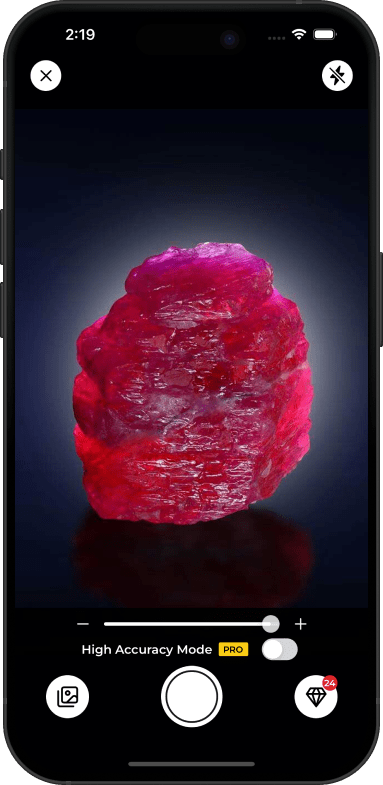
Identify Rosasite Instantly
- Snap a photo, get instant results
- 6,700+ rocks, minerals & crystals
- Discover collecting spots near you
Rosasite FAQs
How do I identify Rosasite?
Rosasite can be identified by its hardness of 4.5 on the Mohs scale, Blue color, Vitreous, Silky luster, Monoclinic crystal system. Look for these key characteristics when examining specimens.
What color is Rosasite?
Rosasite typically appears in Blue, blue-green to green, sky-blue, colourless to light blue in transmitted light. Color can vary depending on impurities and formation conditions.
How hard is Rosasite?
Rosasite has a hardness of 4.5 on the Mohs scale. This gives it moderate hardness.
What is the characteristics of rosasite of Rosasite?
It is very similar to aurichalcite, but can be distinguished by its superior hardness.
What is the composition of rosasite of Rosasite?
Rosasite is a carbonate mineral with minor potential for use as a zinc and copper ore. Chemically, it is a copper zinc carbonate hydroxide with a copper to zinc ratio of 3:2, occurring in the secondary oxidation zone of copper-zinc deposits.