Sphalerite
A variety of Sphalerite Group

What is Sphalerite?
Sphalerite is a zinc sulfide mineral found not only all across the Earth, but also in lunar rocks and meteorites. It's the number one ore of zinc, but it's also a source of cadmium, germanium, gallium, and indium. The yellow, red, orange, and green crystal forms are prized in the gemstone market for their beautiful light dispersion properties, although the stone is too soft for most jewelry purposes.
Uses & Applications
Sphalerite is a widely distributed ore that is the principal source of zinc, an element with many industrial uses, including non-corrosive alloys and protective coatings. Sphalerite is mined by underground or open mining and zinc is separated from the other constituent minerals by grinding the or using selective flotation to separate zinc.
Healing Properties
Sphalerite is considered a grounding stone and may be beneficial to overcome or prevent nervous exhaustion and fatigue. It works on the lower chakras to improve stamina and increase energy. For those working with powerful crystals, this stone is perfect for restoring calm and balance. It can help discern between a person's imagination and reality when they are channeling the higher realm.
Optical Properties
- Refractive Index
- 2.368-2.371
- Pleochroism
- None
- Optical Character
- Isotropic
Market Value Factors
Pricing varies for every rock and mineral, so use these universal factors to gauge Sphalerite before comparing listings or appraisals.
Size & Weight
Larger, intact specimens usually command higher prices.
Rarity & Demand
Scarce material or popular varieties sell at a premium.
Condition & Finish
Chips, repairs, and heavy wear lower value; clean prep helps.
Treatment & Provenance
Untreated specimens with documented locality are prized.
Where to Find Sphalerite
RockHoundR, the free-to-download rockhounding map from the Ruby Glint team, shows where collectors find sphalerite in the US, with land-access notes for BLM land and national forests. Collecting is banned in national parks.
See where to find sphaleriteAlways check the local rules and get the landowner's permission before you collect.
Geochemistry
The mineral crystallizes in the cubic crystal system. Like other minerals with a cubic crystal structure, sphalerite may show a tetrahedral crystal habit. In the crystal structure, zinc and sulfur atoms are tetrahedrally coordinated. The structure is closely related to the structure of diamond. The hexagonal analog is known as the wurtzite structure. The lattice constant for zinc sulfide in the zinc blende crystal structure is 0.541 nm. All natural sphalerites contain concentrations of various impurity elements. These generally substitute for the zinc position in the lattice. The most common are Cd and Mn, but Gallium, Germanium and Indium may also be present in relatively high concentrations (hundreds to thousands of ppm). The abundances of these elements are controlled by the conditions under which the sphalerite formed, most importantly formation temperature and fluid composition.
Associated Chakras



Key Characteristics
Rock Types of Sphalerite
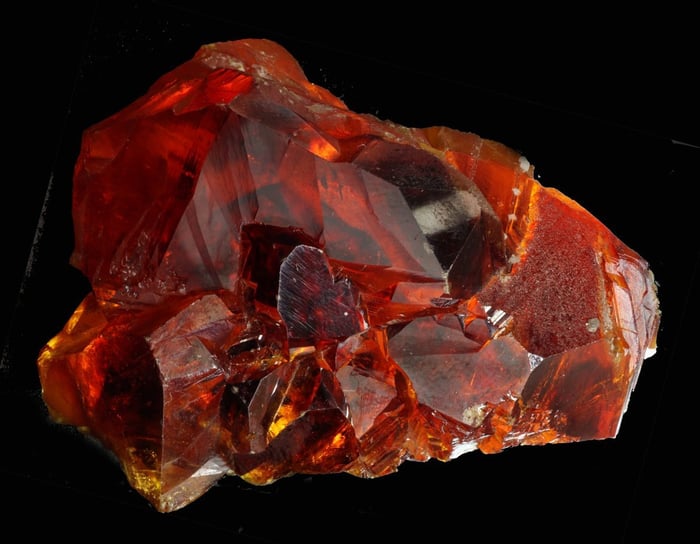
Sphalerite's color is usually yellow, brown, or gray to gray-black, and it may be shiny or dull. Its luster is adamantine, resinous to submetallic for high iron varieties. It has a yellow or light brown streak, a Mohs hardness of 3.5–4, and a specific gravity of 3.9–4.1. Some specimens have a red iridescence within the gray-black crystals; these are called "ruby sphalerite". The pale yellow and red varieties have very little iron and are translucent. The darker, more opaque varieties contain more iron. Some specimens are also fluorescent in ultraviolet light. A striped rock Bands of sphalerite The refractive index of sphalerite (as measured via sodium light, average wavelength 589.3 nm) is 2.37. Sphalerite crystallizes in the isometric crystal system and possesses perfect dodecahedral cleavage. Gemmy, pale specimens from Franklin, New Jersey (see Franklin Furnace), are highly fluorescent orange and/or blue under longwave ultraviolet light and are known as cleiophane, an almost pure ZnS variety.
Formation of Sphalerite
Sphalerite is the major ore of zinc and is found in thousands of locations worldwide. Sources of high quality crystals include:
More Images

Quick Facts
Physical Properties
- Color
- Yellow, light to dark brown, black, red-brown, colourless, light blue, green
- Hardness (Mohs)
- 3.5 - 4
- Rock tumbling
- Not recommended
- Density
- 4.096 g/cm³
- Streak
- Pale yellow to brown
- Luster
- Resinous, Adamantine
- Crystal System
- Isometric
Chemical Properties
- Chemical Formula
- ZnS
- Elements
- S, Zn
Also Known As
Identify Sphalerite Instantly
- Snap a photo, get instant results
- 6,700+ rocks, minerals & crystals
- Discover collecting spots near you
Sphalerite FAQs
How do I identify Sphalerite?
Sphalerite can be identified by its hardness of 3.5 - 4 on the Mohs scale, Yellow color, Resinous, Adamantine luster, Isometric crystal system. Look for these key characteristics when examining specimens.
What color is Sphalerite?
Sphalerite typically appears in Yellow, light to dark brown, black, red-brown, colourless, light blue, green. Color can vary depending on impurities and formation conditions.
How hard is Sphalerite?
Sphalerite has a hardness of 3.5 - 4 on the Mohs scale. This gives it moderate hardness.
What is the rock types of sphalerite of Sphalerite?
Sphalerite's color is usually yellow, brown, or gray to gray-black, and it may be shiny or dull. Its luster is adamantine, resinous to submetallic for high iron varieties. It has a yellow or light brown streak, a Mohs hardness of 3.5–4, and a specific gravity of 3.9–4.1. Some specimens have a red iridescence within the gray-black crystals; these are called "ruby sphalerite". The pale yellow and red varieties have very little iron and are translucent. The darker, more opaque varieties contain more iron. Some specimens are also fluorescent in ultraviolet light. A striped rock Bands of sphalerite The refractive index of sphalerite (as measured via sodium light, average wavelength 589.3 nm) is 2.37. Sphalerite crystallizes in the isometric crystal system and possesses perfect dodecahedral cleavage. Gemmy, pale specimens from Franklin, New Jersey (see Franklin Furnace), are highly fluorescent orange and/or blue under longwave ultraviolet light and are known as cleiophane, an almost pure ZnS variety.
What is the formation of sphalerite of Sphalerite?
Sphalerite is the major ore of zinc and is found in thousands of locations worldwide. Sources of high quality crystals include: