Zorite
A variety of Zorite Group
What is Zorite?
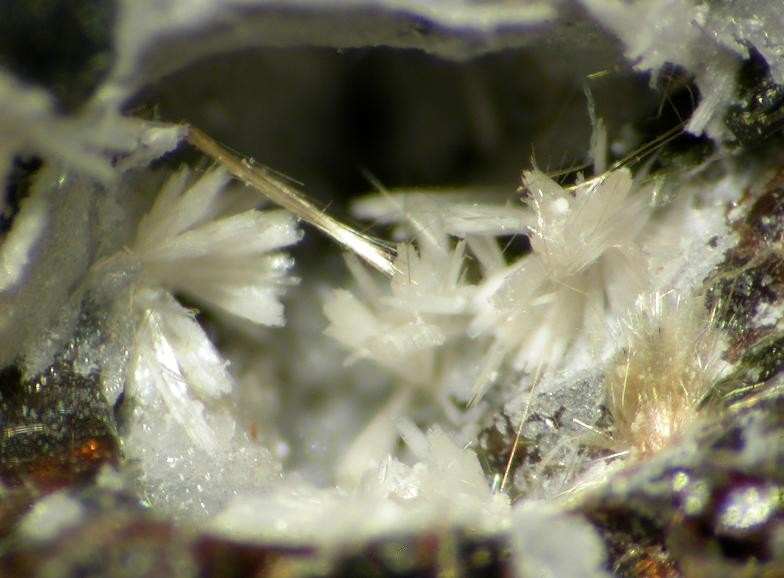
Zorite is a silicate mineral with the chemical formula of Na2Ti(Si,Al)3O9·nH2O. It is named because of its pink color, after the Russian word "zoria" which refers to the rosy hue of the sky at dawn. It is primarily found in Mount Karnasurta, Lovozero Massif, Kola Peninsula, Russia. The Lovozero Massif is an area with an igneous mountain range, home to various types of minerals such as eudialyte, loparite, and natrosilitite. Crystallographically, zorite belongs in the orthorhombic group, which has 3 axes, a, b, and c that are of unequal lengths (a≠b≠c) that form 90° with each other. It also belongs in the point group 2/m2/m2/m. The state of aggregation for zorite is acicular. Zorite has perfect cleavage along the planes {010} and {001}, while having poor cleavage along the plane {110}. Zorite is anisotropic, which means that the velocity of light is not the same in all directions. It belongs in the biaxial group, because it is an orthorhombic mineral. Under plane polarized light, zorite displays different colors depending on the angle that the light hits the mineral. This quality is called pleochroism and zorite is rose along the x-axis, colorless along the y-axis, and bluish along the z-axis. The index of refraction of zorite is 1.59, which is the velocity of light through vacuum over the velocity of light through zorite. Zorite is studied to better understand silicate structures. In 2003, zorite was looked into to analyze the symmetry and topology of a family of three minerals found in Russia, Nenadkevichite, Labuntsovite, and Zorite. Zorite was also studied to comprehend how silicate structures change when an element is replaced, for example when the sodium is replaced with potassium, caesium and phosphorus. Furthermore, because of its rarity, zorite is one of the collectors’ items coveted for its scarcity, as well as it being a valuable source to understanding silicate topology.
Market Value Factors
Pricing varies for every rock and mineral, so use these universal factors to gauge Zorite before comparing listings or appraisals.
Size & Weight
Larger, intact specimens usually command higher prices.
Rarity & Demand
Scarce material or popular varieties sell at a premium.
Condition & Finish
Chips, repairs, and heavy wear lower value; clean prep helps.
Treatment & Provenance
Untreated specimens with documented locality are prized.
Quick Facts
Physical Properties
- Color
- Rose-red, pink, can appear white or colourless in individual crystals.
- Hardness (Mohs)
- 3 - 4
- Rock tumbling
- Not recommended
Chemical Properties
- Chemical Formula
- Na8(Ti,Nb)5(Si6O17)2(OH,O)5 · 14H2O
- Elements
- H, Na, O, Si, Ti
Identify Zorite Instantly
- Snap a photo, get instant results
- 6,700+ rocks, minerals & crystals
- Discover collecting spots near you
Zorite FAQs
How do I identify Zorite?
Zorite can be identified by its hardness of 3 - 4 on the Mohs scale, Rose-red color. Look for these key characteristics when examining specimens.
What color is Zorite?
Zorite typically appears in Rose-red, pink, can appear white or colourless in individual crystals.. Color can vary depending on impurities and formation conditions.
How hard is Zorite?
Zorite has a hardness of 3 - 4 on the Mohs scale. This makes it a soft mineral that can be scratched easily.