How to Tell if an Amethyst Is Real
Amethyst is affordable enough that most fakes aren't glass — they're synthetic amethyst grown in factories, which is chemically identical and very hard to spot. Glass and purple CZ still circulate in jewelry and tumbled stones, though, and those fall to simple tests: zoning, bubbles, and hardness.
The 60-Second Amethyst Checklist
Run these quick checks first — most fakes fail at least one before you ever reach for a loupe.
- Natural amethyst shows uneven, angular color zoning
- Perfectly even, vivid purple in a large flawless gem = suspect
- Bubbles inside = glass
- Real amethyst (Mohs 7) scratches a steel knife blade
- Dirt-cheap 'deep Siberian' parcels are synthetic
5 At-Home Tests for Real Amethyst
Work through these in order — each one is safe for genuine amethyst unless noted, and together they expose nearly every common fake.
Color zoning check
Look through the stone against white paper, rotating it slowly.
Real amethyst
Patchy, angular zones of stronger and weaker purple — natural amethyst color is rarely uniform.
Fake
Glass is perfectly even; many synthetics also look suspiciously uniform edge to edge.
Bubble and swirl inspection
Examine the interior at 10× with strong side light.
Real amethyst
Clean or with natural 'fingerprint' and thumbprint-style inclusions; sometimes tiger-stripe ('zebra') Brazil-law twinning flashes.
Fake
Round gas bubbles and swirl marks are glass, every time.
Hardness test
Try to scratch the stone with a steel knife, then use the stone on a glass bottle.
Real amethyst
Quartz (Mohs 7) shrugs off steel and scratches glass.
Fake
Glass imitations get scratched by the knife and barely mark the bottle; purple fluorite (Mohs 4) is even softer.
Dichroism check
Rotate the stone under daylight and look for a subtle color shift.
Real amethyst
Amethyst shows weak but real dichroism — bluish-purple to reddish-purple as you turn it.
Fake
Glass and CZ show one flat purple from every direction.
Temperature and heft
Touch the stone to your cheek and weigh it in hand against known quartz.
Real amethyst
Cold to the touch, with quartz's familiar heft (2.65 g/cm³).
Fake
Purple CZ feels noticeably heavier for its size; plastic beads feel warm and light.
Common Fake Amethysts & How to Spot Them
These are the materials most often sold as amethyst — and the giveaway that exposes each one.
| Imitation | How to spot it | The giveaway |
|---|---|---|
| Synthetic amethyst | Extreme uniformity, flawless clarity in big stones, bargain prices on 'top Siberian' color. | Often only a lab can confirm (absence of Brazil-law twinning) — buy from sellers who disclose. |
| Purple glass | Gas bubbles, swirls, soft surface that a knife scratches. | Fails the hardness test immediately. |
| Purple cubic zirconia | Far more sparkle and fire than quartz, much heavier per size. | Amethyst never throws rainbow fire. |
| Dyed quartz / fluorite | Dye concentrating in surface cracks; fluorite shows cleavage planes and scratches easily. | Color sitting in fractures instead of the body of the stone. |
When to get professional testing
Because synthetic amethyst is cheap to grow and hard to detect, certification only makes sense for exceptional pieces. For everyday amethyst, buy on color quality and price — deep purple with red flashes ('Siberian' grade) is the top of the market either way.
Photo-Check Your Amethyst in Seconds
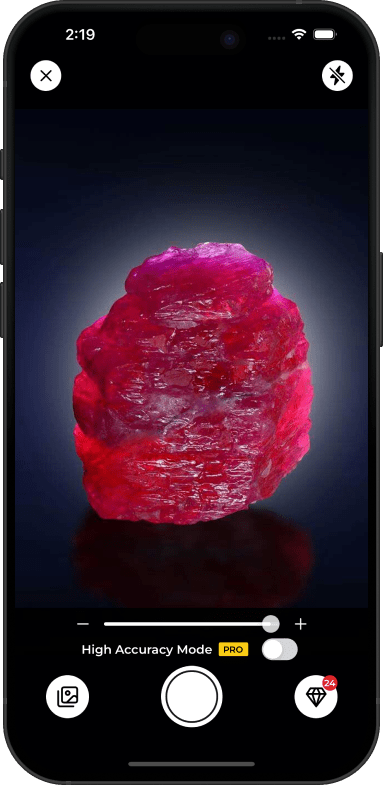
Upload a photo and Ruby Glint's AI compares your stone against thousands of verified amethyst and lookalike references — free, no login required.
Or try the free online identifier

Real vs Fake Amethyst: Your Questions
Get answers to common questions about rock identification, rockhounding, and using our platform.
It's real quartz with real amethyst color, but grown in weeks instead of millennia — and it should cost less and be disclosed. The problem is undisclosed synthetic sold as natural, which is widespread in large flawless stones with perfectly even color.
Yes, slowly. Prolonged direct sun can pale amethyst's purple over months to years — both natural and synthetic. Fading isn't a fake indicator, but it is a reason to store fine amethyst away from windowsills.
Three quick checks: glass contains round bubbles, glass scratches with a steel knife while amethyst doesn't, and glass shows one flat purple while amethyst shifts subtly between bluish and reddish purple as you rotate it.
Green quartz sold as 'green amethyst' is prasiolite — almost always heat-treated or irradiated amethyst. It's genuine quartz, but the name is a marketing term; it should be priced as treated quartz, not as a rare gem.
Keep Going: AmethystValue & Identification
Amethyst Price Per Carat
Current 2026 price ranges by carat size and quality tier.
Gemstone Value Calculator
Get an instant market estimate for your amethyst.
Amethyst Identification Guide
Full encyclopedia entry: properties, colors, and lookalikes.
Free Gemstone Identifier
Upload a photo and identify any gemstone with AI.
Home tests are screening tools, not certification. For high-value purchases, insurance, or resale, confirm with an accredited gem lab (GIA, AGL, Gübelin, SSEF).