How to Tell if an Aquamarine Is Real
The most common 'fake' aquamarine isn't glass — it's irradiated blue topaz, which costs a tenth as much and looks deceptively similar. Real aquamarine is dichroic, lightly colored, and ice-clean. Here's how to separate genuine aqua from topaz, glass, and synthetic spinel.
The 60-Second Aquamarine Checklist
Run these quick checks first — most fakes fail at least one before you ever reach for a loupe.
- Subtle sea-blue or blue-green — electric vivid blue suggests treated topaz
- Dichroism: blue one way, nearly colorless another
- Ice-clear clarity is normal for real aquamarine
- Topaz feels noticeably denser ('heavier') than aqua of the same size
- Bubbles = glass
5 At-Home Tests for Real Aquamarine
Work through these in order — each one is safe for genuine aquamarine unless noted, and together they expose nearly every common fake.
Dichroism test
Rotate the stone slowly against white paper in daylight.
Real aquamarine
Aquamarine shows clear dichroism: stronger blue down one axis, nearly colorless or pale greenish down another.
Fake
Glass and synthetic spinel show one unchanging blue; blue topaz's pleochroism is much weaker.
The heft (density) comparison
Compare weight-for-size against a known stone, or weigh a loose stone and check millimeter charts.
Real aquamarine
Beryl is relatively light (SG ~2.7) — aquamarines look big for their carat weight.
Fake
Blue topaz (SG ~3.5) is about 30% denser: a same-size topaz weighs noticeably more carats.
Color character check
Judge the hue under neutral daylight.
Real aquamarine
Natural aqua runs pale greenish-blue to a refined 'Santa Maria' blue — elegant, never electric.
Fake
Swiss blue and London blue topaz have a saturated, electric quality no natural aquamarine reaches.
Inclusion check at 10×
Look inside with a loupe under side lighting.
Real aquamarine
Typically eye-clean; characteristic inclusions are long hollow tubes parallel to each other ('rain').
Fake
Round bubbles mean glass; perfect emptiness plus electric color means treated topaz or synthetic spinel.
Cold and hardness test
Touch to your cheek; if loose, try it against a steel blade.
Real aquamarine
Cold like crystal, and at Mohs 7.5–8 untouched by steel.
Fake
Glass warms quickly and scratches; plastic imitations feel warm immediately.
Common Fake Aquamarines & How to Spot Them
These are the materials most often sold as aquamarine — and the giveaway that exposes each one.
| Imitation | How to spot it | The giveaway |
|---|---|---|
| Irradiated blue topaz | Electric saturated blue, heavier per size, weaker pleochroism. | The #1 aquamarine substitute — beautiful but worth ~$10–25/carat. |
| Synthetic blue spinel | Singly refractive (no dichroism), often slightly violet-blue, may glow red through a Chelsea filter. | Zero color shift on rotation. |
| Blue glass | Bubbles, swirls, soft scratched facets, warm to the touch quickly. | Fails hardness and inclusion checks at once. |
| Pale synthetic quartz / dyed quartz | Dye lines in fractures; quartz's lower brilliance and different heft. | Color concentrated in cracks rather than the crystal body. |
When to get professional testing
Most aquamarine on the market is gently heated to remove green — that's standard and barely affects value. What matters is natural-vs-topaz and depth of blue. For important pieces, a basic gem-lab ID report is inexpensive and definitive (refractive index separates beryl from topaz instantly).
Photo-Check Your Aquamarine in Seconds
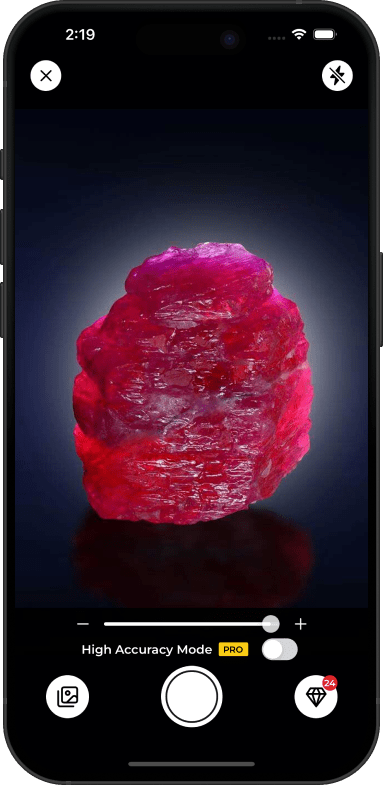
Upload a photo and Ruby Glint's AI compares your stone against thousands of verified aquamarine and lookalike references — free, no login required.
Or try the free online identifier

Real vs Fake Aquamarine: Your Questions
Get answers to common questions about rock identification, rockhounding, and using our platform.
Three ways: aquamarine is visibly dichroic (blue to nearly colorless as you rotate it) while topaz barely shifts; topaz is about 30% denser so it feels heavy for its size; and topaz's treated blues look electric while natural aqua is a softer sea blue. A jeweler's refractometer settles it in seconds.
Fine aquamarine is typically eye-clean — clean clarity alone doesn't mean fake. When inclusions do appear, parallel hollow tubes ('rain') are the classic natural signature. Round bubbles, on the other hand, always mean glass.
Yes — saturation drives price. The deep 'Santa Maria' blue from Brazil (and similar 'Santa Maria Africana' material from Mozambique) commands multiples of pale stones. But genuinely dark natural aqua is rare: most very dark blue stones offered cheaply are treated topaz.
Yes. Gentle heating to remove greenish tints is near-universal, stable, undetectable, and accepted by the trade. It is not considered a fake or even a significant value deduction, unlike the irradiation used to color blue topaz.
Keep Going: AquamarineValue & Identification
Aquamarine Price Per Carat
Current 2026 price ranges by carat size and quality tier.
Gemstone Value Calculator
Get an instant market estimate for your aquamarine.
Aquamarine Identification Guide
Full encyclopedia entry: properties, colors, and lookalikes.
Free Gemstone Identifier
Upload a photo and identify any gemstone with AI.
Home tests are screening tools, not certification. For high-value purchases, insurance, or resale, confirm with an accredited gem lab (GIA, AGL, Gübelin, SSEF).