Aquamarine
A variety of Beryl

What is Aquamarine?
The pastel blue variation of the mineral beryl, aquamarine is of the same family as emeralds (green) and morganite (pink). Some of the best specimens come from the high mountains of Pakistan. Named for the Latin word for seawater, it was once thought to protect sailors at sea. It is the birthstone for March.
Uses & Applications
Aquamarine (window decorator), a software application USS Aquamarine (PYc-7), a patrol vessel of the United States Navy, named for the stone Aqua Marine, a private housing estate in Cheung Sha Wan, Hong Kong
Healing Properties
Aquamarine is believed to detoxify the body from the negative effects caused by excessive stress and mental exhaustion. It is believed that the stone helps to encourage positive energy to flow through the body and also restores vitality and drive. This stone can be used to align the chakras, bringing a sense of balance and contentment to meet the challenges of daily life.
Optical Properties
- Refractive Index
- 1.570-1.592
- Birefringence
- 0.005-0.009
- Pleochroism
- Dichroism: Colorless to greenish bluish, blue to sky blue
- Greenish-blue stones - distinct: yellowish-greenish, blue-green
- Optical Character
- Uniaxial negative
- Dispersion
- 0.014
Discover Values
Market Value Factors
Pricing varies for every rock and mineral, so use these universal factors to gauge Aquamarine before comparing listings or appraisals.
Size & Weight
Larger, intact specimens usually command higher prices.
Rarity & Demand
Scarce material or popular varieties sell at a premium.
Condition & Finish
Chips, repairs, and heavy wear lower value; clean prep helps.
Treatment & Provenance
Untreated specimens with documented locality are prized.
Where to Find Aquamarine
RockHoundR, the free-to-download rockhounding map from the Ruby Glint team, shows where collectors find aquamarine in the US, with land-access notes for BLM land and national forests. Collecting is banned in national parks.
See where to find aquamarineAlways check the local rules and get the landowner's permission before you collect.
The Meaning
Aquamarine has been admired by many cultures since ancient times. It was known as "the sailor's gem" among the Romans and the Greeks because the stone was used by sailors to protect them during their long-distance journeys. According to a legend, aquamarine was a magical stone that could reveal whether something is true or false by changing its color. It is the birthstone of March.
Associated Chakras

Key Characteristics
Rock Types of Aquamarine
Aquamarine occurs at most localities which yield ordinary beryl. The gem-gravel placer deposits of Sri Lanka contain aquamarine. Green-yellow beryl, such as that occurring in Brazil, is sometimes called chrysolite aquamarine. The deep blue version of aquamarine is called maxixe. Maxixe is commonly found in the country of Madagascar.
More Images

Quick Facts
Physical Properties
- Color
- Blue
- Hardness (Mohs)
- 7.5 - 8
- Rock tumbling
- Tumbles well
- Density
- 2.66 - 2.8 g/cm³
- Streak
- White
- Luster
- Vitreous
- Crystal System
- Hexagonal
Chemical Properties
- Chemical Formula
- Be3Al2Si6O18
- Elements
- Al, Be, O, Si
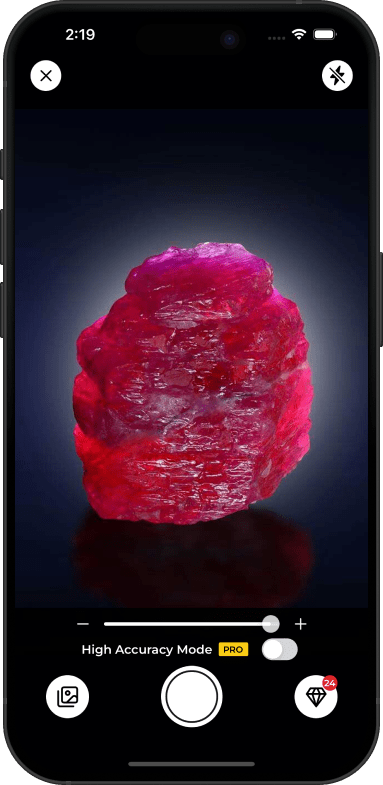
Identify Aquamarine Instantly
- Snap a photo, get instant results
- 6,700+ rocks, minerals & crystals
- Discover collecting spots near you
Aquamarine FAQs
How do I identify Aquamarine?
Aquamarine can be identified by its hardness of 7.5 - 8 on the Mohs scale, Blue color, Vitreous luster, Hexagonal crystal system. Look for these key characteristics when examining specimens.
What color is Aquamarine?
Aquamarine typically appears in Blue. Color can vary depending on impurities and formation conditions.
How hard is Aquamarine?
Aquamarine has a hardness of 7.5 - 8 on the Mohs scale. This makes it a relatively hard mineral suitable for jewelry.
What is the rock types of aquamarine of Aquamarine?
Aquamarine occurs at most localities which yield ordinary beryl. The gem-gravel placer deposits of Sri Lanka contain aquamarine. Green-yellow beryl, such as that occurring in Brazil, is sometimes called chrysolite aquamarine. The deep blue version of aquamarine is called maxixe. Maxixe is commonly found in the country of Madagascar.


