How to Tell if Jade Is Real
Jade is the most faked gem material on earth. The name legitimately covers two minerals — jadeite and nephrite — but the market is awash with dyed quartz, serpentine, glass, and polymer-impregnated 'B jade'. Density, sound, and surface luster expose most fakes; treatment grading (Type A/B/C) protects you from the rest.
The 60-Second Jade Checklist
Run these quick checks first — most fakes fail at least one before you ever reach for a loupe.
- Real jade feels unusually dense and cold — like a heavy river pebble
- Tapped bangles ring with a high musical chime
- Dye concentrating in fracture webs = Type C (dyed)
- Bubbles or swirls = glass
- Imperial green at low prices doesn't exist
5 At-Home Tests for Real Jade
Work through these in order — each one is safe for genuine jade unless noted, and together they expose nearly every common fake.
Heft and temperature test
Hold the piece in your palm and against your cheek; compare with a same-size stone you trust.
Real jade
Jadeite (SG 3.3) and nephrite (SG 3.0) feel surprisingly heavy for their size and stay cold longer than glass.
Fake
Glass, resin, and serpentine feel notably lighter; plastic warms in seconds.
The chime test (bangles and pendants)
Suspend the piece on a thread and tap gently with a coin or another jade piece.
Real jade
Untreated jadeite rings with a clear, high-pitched, almost metallic chime that sustains.
Fake
Polymer-impregnated B jade and glass give a dull, plasticky 'tock'. (Use this as a screen, not a verdict.)
Surface luster at 10×
Examine the polished surface under a loupe in good light.
Real jade
Type A jadeite shows a tight, fine 'orange peel' dimpling with a greasy-to-vitreous luster.
Fake
Acid-bleached, polymer-filled B jade shows a web of fine surface micro-cracks and a waxy plastic shine; glass shows pure glassy luster and maybe bubbles.
Dye check
Backlight the piece with a strong torch and inspect color distribution; check fracture lines.
Real jade
Natural color sits in roots and patches that follow the stone's structure.
Fake
Type C dyed jade shows color pooling in fracture webs like ink in cracked ice; under magnification the dye threads are unmistakable.
Scratch resistance (with care)
On an inconspicuous spot of a suspected fake only, test with a steel point.
Real jade
Jadeite (6.5–7) resists steel; nephrite (6–6.5) barely yields.
Fake
Serpentine ('new jade', Mohs ~3–5) and soapstone scratch easily; glass scratches and may flake conchoidally.
Common Fake Jades & How to Spot Them
These are the materials most often sold as jade — and the giveaway that exposes each one.
| Imitation | How to spot it | The giveaway |
|---|---|---|
| Polymer-treated 'B jade' | Dull chime, surface micro-crack web, waxy luster, UV may show blue-white glow. | Real jadeite, but bleached and plastic-filled — worth a fraction of Type A. |
| Dyed 'C jade' and dyed quartz | Color concentrated in fracture webs under backlight, hues too vivid and even. | Dye fades over years and gives itself away under any magnification. |
| Serpentine ('new jade') and aventurine quartz | Serpentine is light and knife-soft; aventurine shows glittery mica platelets inside. | Wrong density and wrong internal texture. |
| Glass and resin | Bubbles, mold lines, warm feel, light weight, dull tap sound. | Fails heft, temperature, and chime tests simultaneously. |
When to get professional testing
For any jade purchase beyond souvenir money, ask for a lab certificate stating 'jadeite jade, no polymer detected' (Type A) — Hong Kong and GIA labs issue these routinely. Imperial green Type A jadeite trades alongside fine ruby per carat, which is exactly why B and C treatments exist.
Photo-Check Your Jade in Seconds
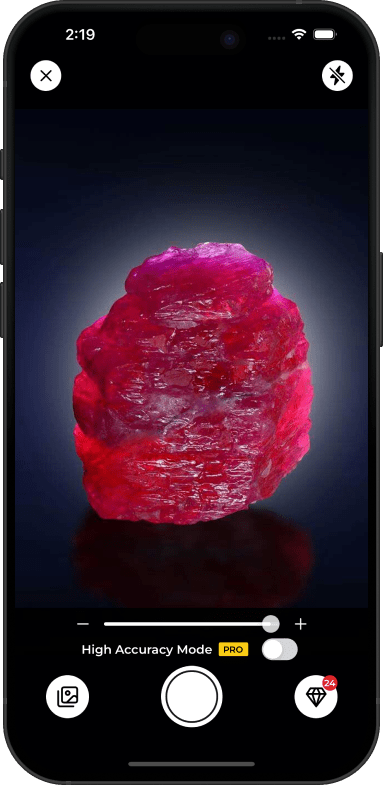
Upload a photo and Ruby Glint's AI compares your stone against thousands of verified jade and lookalike references — free, no login required.
Or try the free online identifier

Real vs Fake Jade: Your Questions
Get answers to common questions about rock identification, rockhounding, and using our platform.
Type A is natural jadeite with only wax surface polish — full value. Type B is acid-bleached and polymer-impregnated to fake higher quality — worth 5–10% of A. Type C adds dye — worth even less and unstable over time. Certificates from reputable labs state the type explicitly.
Yes. Both jadeite and nephrite are true jade — nephrite is the historic jade of China and New Zealand. Jadeite reaches more vivid colors (including imperial green) and higher prices, while fine nephrite, like Siberian 'mutton fat', is a respected collector material in its own right.
Only as a screen, and only on pieces you suspect are fake — you don't want to damage genuine carvings. Steel scratches serpentine and soapstone fakes easily but skates on jadeite. Heft, temperature, chime, and surface luster are safer first checks.
Because 'jade' spans everything from $5 nephrite trinkets to imperial jadeite bangles auctioned above $1M. Color (vivid even green), translucency (semi-transparent 'glassy' material), texture, and Type A treatment status drive the gap. Cheap vivid-green 'jade' is virtually always dyed or isn't jade.
Keep Going: JadeValue & Identification
Jade Price Per Carat
Current 2026 price ranges by carat size and quality tier.
Gemstone Value Calculator
Get an instant market estimate for your jade.
Jade Identification Guide
Full encyclopedia entry: properties, colors, and lookalikes.
Free Gemstone Identifier
Upload a photo and identify any gemstone with AI.
Home tests are screening tools, not certification. For high-value purchases, insurance, or resale, confirm with an accredited gem lab (GIA, AGL, Gübelin, SSEF).