How to Tell if a Morganite Is Real
Morganite's engagement-ring boom brought a wave of pink glass, CZ, and lab-grown beryl into the market. Real morganite is subtle: a soft peachy pink with gentle dichroism and excellent clarity. If the pink looks like bubblegum or the price looks too kind, test before you buy.
The 60-Second Morganite Checklist
Run these quick checks first — most fakes fail at least one before you ever reach for a loupe.
- Soft peach-pink — hot pink or bubblegum tones are suspect
- Subtle dichroism: pale pink to slightly bluish-pink on rotation
- Eye-clean is normal for real morganite
- CZ feels heavy and over-sparkles; glass shows bubbles
- Kunzite lookalikes show much stronger color shifts
5 At-Home Tests for Real Morganite
Work through these in order — each one is safe for genuine morganite unless noted, and together they expose nearly every common fake.
Color character check
Judge the hue in neutral daylight against white paper.
Real morganite
Morganite runs delicate pink, peach, and salmon — elegant pastels, stronger in bigger stones.
Fake
Vivid magenta, hot pink, or candy tones come from glass, CZ, or dyed stones; natural morganite never screams.
Dichroism test
Rotate the stone slowly and watch for a subtle two-tone shift.
Real morganite
Gentle dichroism between pale pink and a slightly bluish or purplish pink.
Fake
Glass and CZ show zero shift; kunzite shows a much stronger violet-pink swing plus perfect cleavage planes inside.
Brilliance and fire check
Compare sparkle character under a point light.
Real morganite
Beryl has moderate brilliance and low fire — refined, not flashy.
Fake
Pink CZ throws intense rainbow fire and looks 'wet'; that disco sparkle is impossible for beryl.
Inclusion check at 10×
Loupe the interior with side lighting.
Real morganite
Typically eye-clean; possible fine hollow tubes parallel to the crystal axis, like its sibling aquamarine.
Fake
Round gas bubbles mean glass; visible color banding or dye in cracks means treated quartz.
Heft comparison
Weigh against a known stone of similar size.
Real morganite
Beryl is light (SG ~2.8) — morganites face up large for their carat weight.
Fake
CZ (SG 5.8) feels like lead in comparison; even glass runs denser than beryl.
Common Fake Morganites & How to Spot Them
These are the materials most often sold as morganite — and the giveaway that exposes each one.
| Imitation | How to spot it | The giveaway |
|---|---|---|
| Pink cubic zirconia | Double the heft, ten times the fire, flat color under rotation. | A 'morganite' that out-sparkles a diamond is CZ. |
| Pink glass | Bubbles and swirls inside, scratches easily, warms quickly in hand. | Fails loupe and hardness checks immediately. |
| Kunzite | Stronger pleochroism, perfect cleavage flashes inside, fades badly in sunlight. | Beautiful but fragile — and not beryl. |
| Lab-grown pink beryl | Suspicious cleanliness + saturation in large sizes at low prices. | Needs a lab to confirm, but pricing usually tells the story. |
When to get professional testing
Most morganite is routinely heated to remove orange and stabilize pink — accepted and undetectable. Certification matters mainly for untreated-color claims and large fine stones; for typical engagement-ring morganite, a basic ID report confirming natural beryl is cheap peace of mind.
Photo-Check Your Morganite in Seconds
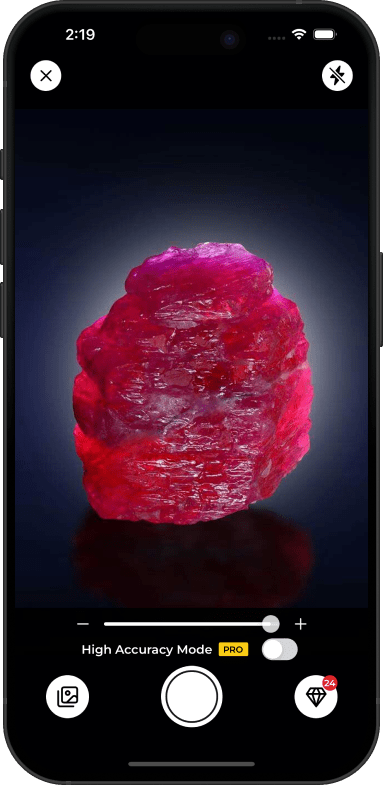
Upload a photo and Ruby Glint's AI compares your stone against thousands of verified morganite and lookalike references — free, no login required.
Or try the free online identifier

Real vs Fake Morganite: Your Questions
Get answers to common questions about rock identification, rockhounding, and using our platform.
Close — both are beryl, like emerald. Manganese colors morganite pink-to-peach while iron colors aquamarine blue. Same durability (Mohs 7.5–8), same glassy elegance, different chromophores and different markets.
Beryl's color saturates with size — under 2 carats, even good morganite reads pastel. Vivid pink small stones should raise suspicion of CZ or glass rather than excitement. Jewelers often set morganite in rose gold specifically to deepen the perceived pink.
Yes — at Mohs 7.5–8 with no problematic cleavage, it handles daily wear better than opal, tanzanite, or emerald. It will accumulate minor scratches over decades and can be repolished. Clean with mild soap; skip harsh ultrasonic cycles if the stone is included.
Heft and fire. CZ is roughly twice as dense — a same-size CZ feels conspicuously heavy — and erupts with rainbow fire under any light, while morganite sparkles politely. Add the rotation test: morganite shifts subtly between pinks, CZ never changes.
Keep Going: MorganiteValue & Identification
Morganite Price Per Carat
Current 2026 price ranges by carat size and quality tier.
Gemstone Value Calculator
Get an instant market estimate for your morganite.
Morganite Identification Guide
Full encyclopedia entry: properties, colors, and lookalikes.
Free Gemstone Identifier
Upload a photo and identify any gemstone with AI.
Home tests are screening tools, not certification. For high-value purchases, insurance, or resale, confirm with an accredited gem lab (GIA, AGL, Gübelin, SSEF).