Morganite
A variety of Beryl

What is Morganite?
Actually a form of beryl (like emeralds and aquamarines), morganite owes its characteristic pink color to traces of manganese within its crystal structure. The color tends to be most intense in the largest specimens, which are usually mined in Brazil. It is named for J.P. Morgan, an American financier and gem collector who donated many specimens to natural history museums.
Etymology & Origins
In December 1910, the New York Academy of Sciences named the pink variety of beryl "morganite" after financier J. P. Morgan.
Uses & Applications
Morganite is an increasingly popular precious stone in the jewelry industry. It is valued for a hardness and clarity which allow it to be cut and used as a faceted gemstone. This gem has few fractures or inclusions, increasing its potential for use in high-end jewelry items like engagement rings.
Healing Properties
Morganite is believed to detoxify the body from the negative effects caused by excessive stress and mental exhaustion. It is believed that the stone helps to encourage positive energy to flow through the body and also restores vitality and drive. This stone can be used to align the chakras, bringing a sense of balance and contentment to meet the challenges of daily life.
Optical Properties
- Refractive Index
- 1.573-1.600
- Birefringence
- 0.005-0.009
- Pleochroism
- Distinct: pale pink, bluish-pink
- Optical Character
- Uniaxial negative
- Dispersion
- 0.014
Discover Values
This stone excels in beauty.
Market Value Factors
Pricing varies for every rock and mineral, so use these universal factors to gauge Morganite before comparing listings or appraisals.
Size & Weight
Larger, intact specimens usually command higher prices.
Rarity & Demand
Scarce material or popular varieties sell at a premium.
Condition & Finish
Chips, repairs, and heavy wear lower value; clean prep helps.
Treatment & Provenance
Untreated specimens with documented locality are prized.
Where to Find Morganite
Morganite is a variety of Beryl. RockHoundR, the free-to-download rockhounding map from the Ruby Glint team, shows where collectors find beryl in the US, with land-access notes for BLM land and national forests. Collecting is banned in national parks.
See where to find berylAlways check the local rules and get the landowner's permission before you collect.
The Meaning
Morganite is an official gemstone of Madagascar.
Associated Chakras

Quick Facts
Physical Properties
- Color
- Various shades of pink
- Hardness (Mohs)
- 7.5 - 8
- Rock tumbling
- Tumbles well
- Density
- 2.71 - 2.9 g/cm³
- Streak
- White
- Luster
- Vitreous, Sub-vitreous, Waxy, Greasy
- Crystal System
- Hexagonal
Chemical Properties
- Chemical Formula
- Be3Al2(Si6O18)
- Elements
- Al, Be, O, Si
Also Known As
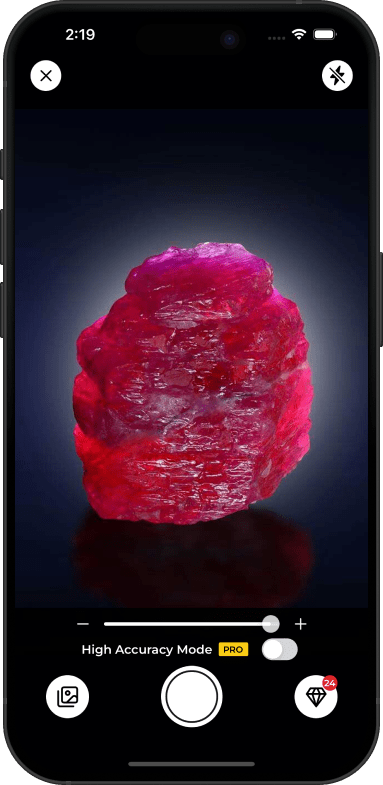
Identify Morganite Instantly
- Snap a photo, get instant results
- 6,700+ rocks, minerals & crystals
- Discover collecting spots near you
Morganite FAQs
How do I identify Morganite?
Morganite can be identified by its hardness of 7.5 - 8 on the Mohs scale, Various shades of pink color, Vitreous, Sub-vitreous, Waxy, Greasy luster, Hexagonal crystal system. Look for these key characteristics when examining specimens.
What color is Morganite?
Morganite typically appears in Various shades of pink. Color can vary depending on impurities and formation conditions.
How hard is Morganite?
Morganite has a hardness of 7.5 - 8 on the Mohs scale. This makes it a relatively hard mineral suitable for jewelry.


