How to Tell if a Sapphire Is Real
Real sapphire is corundum — the same Mohs-9 mineral as ruby — and most fakes are blue glass, synthetic sapphire, or cheaper blue gems like iolite and spinel. Natural stones carry angular color zoning and fine silk; synthetics show curved growth bands. These checks will catch the vast majority of fakes at home.
The 60-Second Sapphire Checklist
Run these quick checks first — most fakes fail at least one before you ever reach for a loupe.
- Scratches glass effortlessly; steel cannot scratch it
- Angular, hexagonal color zoning = natural growth
- Curved color banding under a loupe = flame-fusion synthetic
- Gas bubbles inside = glass imitation
- Big, clean, vividly blue, and cheap = synthetic
5 At-Home Tests for Real Sapphire
Work through these in order — each one is safe for genuine sapphire unless noted, and together they expose nearly every common fake.
Hardness test
Attempt to scratch the stone with a steel blade, then drag a corner of the stone across a glass bottle.
Real sapphire
Nothing in your house short of a diamond scratches sapphire; the sapphire scratches glass with ease.
Fake
Glass imitations scratch, iolite (7–7.5) and blue zircon can be marked by harder materials.
Color zoning inspection
Look through the side of the stone against a white background with a loupe.
Real sapphire
Natural sapphires often show straight, angular bands of lighter and darker blue following hexagonal growth.
Fake
Verneuil synthetics show subtly curved banding, like grooves on a record. Glass shows no zoning at all, only swirls.
Inclusion check at 10×
Light the stone from the side and focus inside.
Real sapphire
Fine rutile silk, fingerprint inclusions, tiny crystals — evidence of natural growth.
Fake
Round gas bubbles mean glass; a flawless interior in a large stone strongly suggests lab growth.
The breath test
Fog the stone with your breath and time the clearing.
Real sapphire
Corundum conducts heat well — fog clears in about two seconds.
Fake
Glass and quartz imitations hold fog noticeably longer.
Tilt test against lookalikes
Rotate the stone under light and watch the color behavior.
Real sapphire
Sapphire is dichroic: blue from one angle shifts slightly violet-blue or greenish-blue from another.
Fake
Glass and spinel are singly refractive and show one flat color from every angle; iolite shifts dramatically to pale yellow-gray (too much change).
Common Fake Sapphires & How to Spot Them
These are the materials most often sold as sapphire — and the giveaway that exposes each one.
| Imitation | How to spot it | The giveaway |
|---|---|---|
| Synthetic (lab-created) sapphire | Curved growth striae, gas bubble clusters, flawless clarity at a bargain price. | Chemically identical to natural — only inclusions and growth patterns separate them. |
| Blue glass / 'spinel doublets' | Bubbles, swirl marks, scratched facets; doublets show a join line at the girdle. | Submerge in water and view from the side — doublet join lines become obvious. |
| Iolite | Extreme pleochroism: vivid blue one way, almost colorless another. | Much softer and lighter than sapphire, with a watery look. |
| Tanzanite & blue spinel | Tanzanite is far softer (6–7) and flashes violet; spinel shows no dichroism. | Neither survives a hardness comparison with corundum. |
When to get professional testing
Heat treatment is standard and accepted, but an unheated certificate from GIA, AGL, or SSEF can multiply a fine sapphire's value 2–5×. For any sapphire over $500, lab confirmation of natural origin is worth the fee.
Photo-Check Your Sapphire in Seconds
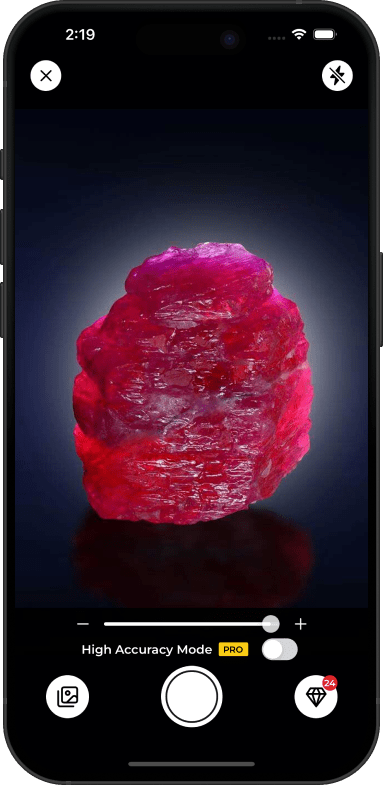
Upload a photo and Ruby Glint's AI compares your stone against thousands of verified sapphire and lookalike references — free, no login required.
Or try the free online identifier

Real vs Fake Sapphire: Your Questions
Get answers to common questions about rock identification, rockhounding, and using our platform.
Look inside with a 10× loupe: natural sapphires show angular zoning and silk-like inclusions, while flame-fusion synthetics show curved growth bands and sometimes tiny gas bubbles. A large, perfectly clean, inexpensive sapphire is almost certainly lab-grown.
Most blue sapphires shift subtly (slightly more violet under incandescent light) because corundum is dichroic. A dramatic blue-to-purple swing suggests color-change sapphire or tanzanite; zero shift from any angle suggests glass or spinel.
Yes, easily. Sapphire is Mohs 9 — only diamond and moissanite are harder. If your stone can't scratch a glass bottle, or a steel knife leaves a mark on it, it isn't sapphire.
Usually. Inky, blackish-blue stones (common from Australia and Thailand) trade at commercial prices, while vivid royal blue and cornflower blue command the premiums. Color is the single biggest value factor — use our sapphire value calculator to see where yours lands.
Keep Going: SapphireValue & Identification
Sapphire Price Per Carat
Current 2026 price ranges by carat size and quality tier.
Sapphire Value Calculator
Get an instant market estimate for your sapphire.
Sapphire Identification Guide
Full encyclopedia entry: properties, colors, and lookalikes.
Free Gemstone Identifier
Upload a photo and identify any gemstone with AI.
Home tests are screening tools, not certification. For high-value purchases, insurance, or resale, confirm with an accredited gem lab (GIA, AGL, Gübelin, SSEF).