Alacránite
A variety of Minerals
What is Alacránite?
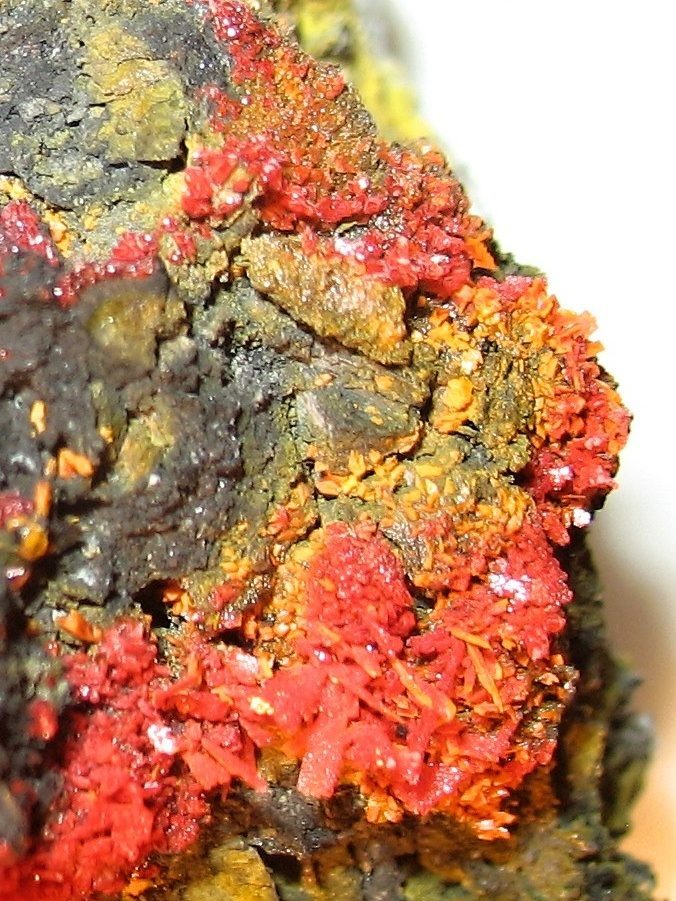
Alacránite (As8S9) is an arsenic sulfide mineral first discovered in the Uzon caldera, Kamchatka, Russia. It was named for its occurrence in the Alacrán silver/arsenic/antimony mine, Pampa Larga, Chile. It is generally more rare than realgar and orpiment. Its origin is hydrothermal. It occurs as subhedral to euhedral tabular orange to pale gray crystals that are transparent to translucent. It has a yellow-orange streak with a hardness of 1.5. It crystallizes in the monoclinic crystal system. It occurs with realgar and uzonite as flattened and prismatic grains up to 0.5 mm across.
Market Value Factors
Pricing varies for every rock and mineral, so use these universal factors to gauge Alacránite before comparing listings or appraisals.
Size & Weight
Larger, intact specimens usually command higher prices.
Rarity & Demand
Scarce material or popular varieties sell at a premium.
Condition & Finish
Chips, repairs, and heavy wear lower value; clean prep helps.
Treatment & Provenance
Untreated specimens with documented locality are prized.
Key Characteristics
Characteristics of Alacránite
Alacranite occurs as cement in sandy gravel and in hydrothermal As-S veins. It occurs with a grain size up to 0.5 mm as flattened and prismatic crystals. Some forms are weak, dull or tarnished. It appears an orange to pale gray crystals with rose-yellow internal reflections with a yellow-orange streak. It has adamantine, vitreous, resinous and greasy luster and it is transparent. The weak chemical bonding in its structure gives the mineral a low Mohs hardness of around 1.5 and weak forms. It has an imperfect cleavage and its fracture is conchoidal and very brittle. Its specific gravity is measured to be around 3.43. When it reacts with 5 molar potassium hydroxide, alacranite changes color to brown. It changes into brown-gray flakes when it is heated, and boiling it should return its color to brown. However, if it is mixed with hydrochloric acid or nitric acid, it does not show any activity.
Composition of Alacránite
When alacranite was first discovered in 1970 by Clark, it was associated with barite and calcite veins in the Alacran silver mine. They also assumed that the mineral was identical to the species occurring in the Ag-As-Sb vein deposit at Alacran due to the similarity of its X-ray diffraction powder pattern. They discovered that alacranite was similar to the high-temperature α polymorph of As4S4 in X-ray characteristics. In addition, alacranite was considered as realgar-like mineral. After that, they reported the composition of alacranite as As8S9 when they noticed another occurrence of Alacranite in Uzon Caldera associated with realgar and uzonite as cement in sandy gravels. They reported the composition of alacranite to be As8S9 regarding to the electron-microprobe analyses. When they analyzed a mineral during seafloor sampling consisting of red and orange arsenic sulfides by X-ray diffraction, a mixture of realgar and alacranite was resulted and it was noticed that the mineral was identical to synthetic β-As4S4 supposed that the original chemical formula of alacranite (As8S9) was incorrect. They argued that it is identical to alacranite because of the similarity of the physical properties and the unit-cell dimensions but further studies argue that it is different with respect to chemical formula and unit-cell volume. The chemistry of the average of four analyses in Uzon caldera, Russia corresponding to alacranite results in 67.35% arsenic and 32.61% sulfur resulting in a total of 99.96%, yielding the formula As7.98S9.02, ideally As8S9.
Quick Facts
Physical Properties
- Color
- Orange to pale gray with rose-yellow internal reflections
- Hardness (Mohs)
- 1.5
- Rock tumbling
- Not recommended
- Density
- 3.43 g/cm³
- Streak
- Yellow-orange
Chemical Properties
- Chemical Formula
- As8S9
- Elements
- As, S
Identify Alacránite Instantly
- Snap a photo, get instant results
- 6,700+ rocks, minerals & crystals
- Discover collecting spots near you
Alacránite FAQs
How do I identify Alacránite?
Alacránite can be identified by its hardness of 1.5 on the Mohs scale, Orange to pale gray with rose-yellow internal reflections color. Look for these key characteristics when examining specimens.
What color is Alacránite?
Alacránite typically appears in Orange to pale gray with rose-yellow internal reflections. Color can vary depending on impurities and formation conditions.
How hard is Alacránite?
Alacránite has a hardness of 1.5 on the Mohs scale. This makes it a soft mineral that can be scratched easily.
What is the characteristics of alacránite of Alacránite?
Alacranite occurs as cement in sandy gravel and in hydrothermal As-S veins. It occurs with a grain size up to 0.5 mm as flattened and prismatic crystals. Some forms are weak, dull or tarnished. It appears an orange to pale gray crystals with rose-yellow internal reflections with a yellow-orange streak. It has adamantine, vitreous, resinous and greasy luster and it is transparent. The weak chemical bonding in its structure gives the mineral a low Mohs hardness of around 1.5 and weak forms. It has an imperfect cleavage and its fracture is conchoidal and very brittle. Its specific gravity is measured to be around 3.43. When it reacts with 5 molar potassium hydroxide, alacranite changes color to brown. It changes into brown-gray flakes when it is heated, and boiling it should return its color to brown. However, if it is mixed with hydrochloric acid or nitric acid, it does not show any activity.
What is the composition of alacránite of Alacránite?
When alacranite was first discovered in 1970 by Clark, it was associated with barite and calcite veins in the Alacran silver mine. They also assumed that the mineral was identical to the species occurring in the Ag-As-Sb vein deposit at Alacran due to the similarity of its X-ray diffraction powder pattern. They discovered that alacranite was similar to the high-temperature α polymorph of As4S4 in X-ray characteristics. In addition, alacranite was considered as realgar-like mineral. After that, they reported the composition of alacranite as As8S9 when they noticed another occurrence of Alacranite in Uzon Caldera associated with realgar and uzonite as cement in sandy gravels. They reported the composition of alacranite to be As8S9 regarding to the electron-microprobe analyses. When they analyzed a mineral during seafloor sampling consisting of red and orange arsenic sulfides by X-ray diffraction, a mixture of realgar and alacranite was resulted and it was noticed that the mineral was identical to synthetic β-As4S4 supposed that the original chemical formula of alacranite (As8S9) was incorrect. They argued that it is identical to alacranite because of the similarity of the physical properties and the unit-cell dimensions but further studies argue that it is different with respect to chemical formula and unit-cell volume. The chemistry of the average of four analyses in Uzon caldera, Russia corresponding to alacranite results in 67.35% arsenic and 32.61% sulfur resulting in a total of 99.96%, yielding the formula As7.98S9.02, ideally As8S9.


%252FAbenakiite-(ce)-01.jpg&size=small)

