Biotite
A variety of Trioctahedral micas Group

What is Biotite?
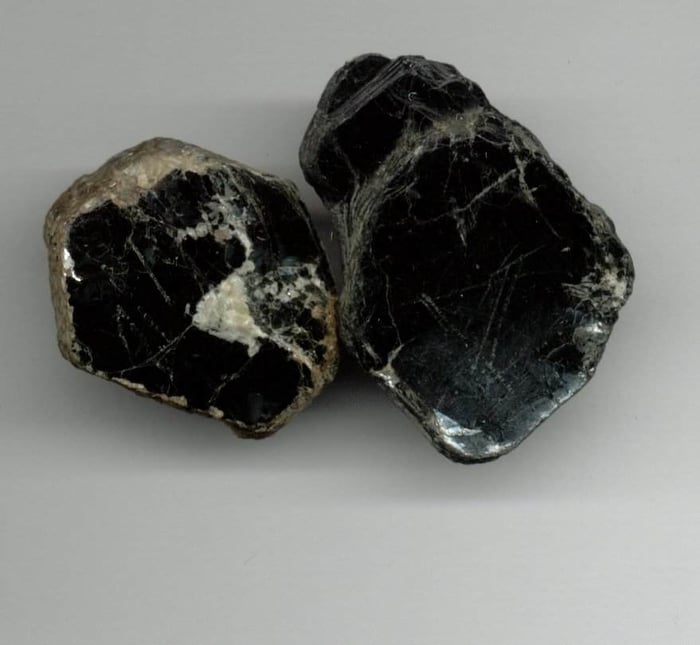
Biotite belongs to the so-called "mica minerals" which can be easily split into thin, but enormously large, flexible sheets. The largest single crystal sheet of biotite measured 23 m squared, found in Norway. This silicate mineral can be found in magmatic and metamorphic rocks and it's commonly used as an isolating material, particularly in heating systems.
Etymology & Origins
The term biotite is still used to describe unanalysed dark micas in the field. Biotite was named by J.F.L. Hausmann in 1847 in honor of the French physicist Jean-Baptiste Biot, who performed early research into the many optical properties of mica.
Uses & Applications
Biotite has some scientific importance because its presence allows geologists and scientists to assess the ages and temperature histories of other nearby rocks during the potassium-argon or argon-argon dating process.
Healing Properties
Biotite works on the Third Eye and Crown chakras to provide clarity of vision and encourage innovative ideas. It allows its user to cut through insignificant details and provides a clearer picture of every issue, so it can be quite beneficial in the office. It enhances visions of the Third Eye chakra and brings better understanding between the physical and spiritual worlds.
Discover Values
Market Value Factors
Pricing varies for every rock and mineral, so use these universal factors to gauge Biotite before comparing listings or appraisals.
Size & Weight
Larger, intact specimens usually command higher prices.
Rarity & Demand
Scarce material or popular varieties sell at a premium.
Condition & Finish
Chips, repairs, and heavy wear lower value; clean prep helps.
Treatment & Provenance
Untreated specimens with documented locality are prized.
Where to Find Biotite
RockHoundR, the free-to-download rockhounding map from the Ruby Glint team, shows where collectors find biotite in the US, with land-access notes for BLM land and national forests. Collecting is banned in national parks.
See where to find biotiteAlways check the local rules and get the landowner's permission before you collect.
Associated Chakras


Key Characteristics
Characteristics of Biotite
Like other mica minerals, biotite has a highly perfect basal cleavage, and consists of flexible sheets, or lamellae, which easily flake off. It has a monoclinic crystal system, with tabular to prismatic crystals with an obvious pinacoid termination. It has four prism faces and two pinacoid faces to form a pseudohexagonal crystal. Although not easily seen because of the cleavage and sheets, fracture is uneven. It appears greenish to brown or black, and even yellow when weathered. It can be transparent to opaque, has a vitreous to pearly luster, and a grey-white streak. When biotite crystals are found in large chunks, they are called "books" because they resemble books with pages of many sheets. The color of biotite is usually black and the mineral has a hardness of 2.5–3 on the Mohs scale of mineral hardness. Biotite dissolves in both acid and alkaline aqueous solutions, with the highest dissolution rates at low pH. However, biotite dissolution is highly anisotropic with crystal edge surfaces (h k0) reacting 45 to 132 times faster than basal surfaces (001).
Formation of Biotite
Members of the biotite group are found in a wide variety of igneous and metamorphic rocks. For instance, biotite occurs in the lava of Mount Vesuvius and in the Monzoni intrusive complex of the western Dolomites. Biotite in granite tends to be poorer in magnesium than the biotite found in its volcanic equivalent, rhyolite. Biotite is an essential phenocryst in some varieties of lamprophyre. Biotite is occasionally found in large cleavable crystals, especially in pegmatite veins, as in New England, Virginia and North Carolina USA. Other notable occurrences include Bancroft and Sudbury, Ontario Canada. It is an essential constituent of many metamorphic schists, and it forms in suitable compositions over a wide range of pressure and temperature. It has been estimated that biotite comprises up to 7% of the exposed continental crust. An igneous rock composed almost entirely of dark mica (biotite or phlogopite) is known as a glimmerite or biotitite. Biotite may be found in association with its common alteration product chlorite. The largest documented single crystals of biotite were approximately 7 m (75 sq ft) sheets found in Iveland, Norway.
More Images

Quick Facts
Physical Properties
- Color
- Dark brown, black, dark green
- Hardness (Mohs)
- 2.5 - 3
- Rock tumbling
- Not recommended
- Density
- 2.8 - 3.4 g/cm³
- Streak
- White
- Luster
- Pearly, Vitreous
- Crystal System
- Monoclinic
Chemical Properties
- Chemical Formula
- K(Mg, Fe)3AlSi3O10(OH)2
- Elements
- H, O, F, Mg, Al, Si, K, Ca, Ti, Mn, Fe, Ba
Also Known As
Identify Biotite Instantly
- Snap a photo, get instant results
- 6,700+ rocks, minerals & crystals
- Discover collecting spots near you
Biotite FAQs
How do I identify Biotite?
Biotite can be identified by its hardness of 2.5 - 3 on the Mohs scale, Dark brown color, Pearly, Vitreous luster, Monoclinic crystal system. Look for these key characteristics when examining specimens.
What color is Biotite?
Biotite typically appears in Dark brown, black, dark green. Color can vary depending on impurities and formation conditions.
How hard is Biotite?
Biotite has a hardness of 2.5 - 3 on the Mohs scale. This makes it a soft mineral that can be scratched easily.
What is the characteristics of biotite of Biotite?
Like other mica minerals, biotite has a highly perfect basal cleavage, and consists of flexible sheets, or lamellae, which easily flake off. It has a monoclinic crystal system, with tabular to prismatic crystals with an obvious pinacoid termination. It has four prism faces and two pinacoid faces to form a pseudohexagonal crystal. Although not easily seen because of the cleavage and sheets, fracture is uneven. It appears greenish to brown or black, and even yellow when weathered. It can be transparent to opaque, has a vitreous to pearly luster, and a grey-white streak. When biotite crystals are found in large chunks, they are called "books" because they resemble books with pages of many sheets. The color of biotite is usually black and the mineral has a hardness of 2.5–3 on the Mohs scale of mineral hardness. Biotite dissolves in both acid and alkaline aqueous solutions, with the highest dissolution rates at low pH. However, biotite dissolution is highly anisotropic with crystal edge surfaces (h k0) reacting 45 to 132 times faster than basal surfaces (001).
What is the formation of biotite of Biotite?
Members of the biotite group are found in a wide variety of igneous and metamorphic rocks. For instance, biotite occurs in the lava of Mount Vesuvius and in the Monzoni intrusive complex of the western Dolomites. Biotite in granite tends to be poorer in magnesium than the biotite found in its volcanic equivalent, rhyolite. Biotite is an essential phenocryst in some varieties of lamprophyre. Biotite is occasionally found in large cleavable crystals, especially in pegmatite veins, as in New England, Virginia and North Carolina USA. Other notable occurrences include Bancroft and Sudbury, Ontario Canada. It is an essential constituent of many metamorphic schists, and it forms in suitable compositions over a wide range of pressure and temperature. It has been estimated that biotite comprises up to 7% of the exposed continental crust. An igneous rock composed almost entirely of dark mica (biotite or phlogopite) is known as a glimmerite or biotitite. Biotite may be found in association with its common alteration product chlorite. The largest documented single crystals of biotite were approximately 7 m (75 sq ft) sheets found in Iveland, Norway.
