Celsian
A variety of Minerals
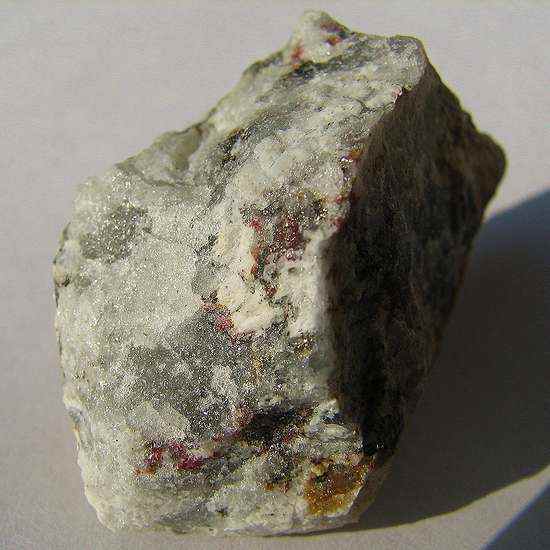
What is Celsian?
Celsian is an uncommon feldspar mineral, barium aluminosilicate, BaAl2Si2O8. The mineral occurs in contact metamorphic rocks with significant barium content. Its crystal system is monoclinic, and it is white, yellow, or transparent in appearance. In pure form, it is transparent. Synthetic barium aluminosilicate is used as a ceramic in dental fillings and other applications. The mineral is named after Anders Celsius (1701–1744).
Uses & Applications
The uses of celsian are mostly related to glass and ceramics. This uses are usually achieved by the preparation of pure synthetic monoclinic celsian. Celsian has very attractive features such as chemical stability and high mechanical resistance, which can be favourably exploited in order to obtain enhanced-performance composites with respect to bulk glass. (Cannillo, Carlier, Manfredini, Montorsi, and Siligardi 2006). Many studies show that by increasing the amount of celsian phases in the glasses results in increased bulk of crystallization (Khater and Idris, 2004).
Market Value Factors
Pricing varies for every rock and mineral, so use these universal factors to gauge Celsian before comparing listings or appraisals.
Size & Weight
Larger, intact specimens usually command higher prices.
Rarity & Demand
Scarce material or popular varieties sell at a premium.
Condition & Finish
Chips, repairs, and heavy wear lower value; clean prep helps.
Treatment & Provenance
Untreated specimens with documented locality are prized.
Key Characteristics
Characteristics of Celsian
Celsian shows a c(001) perfect cleavage and a b(010) good cleavage, which marks the difference with its polymorph paracelsian which has a [110] indistinct cleavage. There are different crystals habits like adularia, larger, stout crystals (Spencer, 1941), and long, slender to acicular. It is usually colorless and transparent with a pearly to non-fluorescent luster. The density is about 3.31 to 3.33 g/cm. This might be the case due to some impurities in the structure of the mineral. It has a hardness of 6 on the Mohs scale, this hardness is due to the short length of the bond in the structure, since relatively short bonds tend to be harder.
Composition of Celsian
Celsian is a barium feldspar with a chemical composition BaAl2Si2O8. It forms part of the feldspar group and belongs to the celsian-hyalophane series and the celsian-orthoclase series. It has some resemblance to anorthite, and it has four distinct polymorphs. The essential elements are silicon, aluminum, oxygen, and barium. Some common impurities in the mineral are iron, titanium, magnesium, potassium, and calcium. Celsian is stable from room temperature up to 1590 °C (Lin and Foster, 1968). The most common trace elements are potassium and calcium, in an analysis of the approximate chemical composition of celsian the following wt% were found: • SiO2—35.1 • Al2O3---26.8 • BaO----35.8 • K2O-----2.3 Total:100.0 (Newham and Megaw, 1960).
Quick Facts
Physical Properties
- Color
- Colourless, white, yellow
- Hardness (Mohs)
- 6 - 6.5
- Rock tumbling
- With care
- Density
- 3.26 g/cm³
- Streak
- White
Chemical Properties
- Chemical Formula
- Ba(Al2Si2O8)
- Elements
- Al, Ba, O, Si
Also Known As
Identify Celsian Instantly
- Snap a photo, get instant results
- 6,700+ rocks, minerals & crystals
- Discover collecting spots near you
Celsian FAQs
How do I identify Celsian?
Celsian can be identified by its hardness of 6 - 6.5 on the Mohs scale, Colourless color. Look for these key characteristics when examining specimens.
What color is Celsian?
Celsian typically appears in Colourless, white, yellow. Color can vary depending on impurities and formation conditions.
How hard is Celsian?
Celsian has a hardness of 6 - 6.5 on the Mohs scale. This gives it moderate hardness.
What is the characteristics of celsian of Celsian?
Celsian shows a c(001) perfect cleavage and a b(010) good cleavage, which marks the difference with its polymorph paracelsian which has a [110] indistinct cleavage. There are different crystals habits like adularia, larger, stout crystals (Spencer, 1941), and long, slender to acicular. It is usually colorless and transparent with a pearly to non-fluorescent luster. The density is about 3.31 to 3.33 g/cm. This might be the case due to some impurities in the structure of the mineral. It has a hardness of 6 on the Mohs scale, this hardness is due to the short length of the bond in the structure, since relatively short bonds tend to be harder.
What is the composition of celsian of Celsian?
Celsian is a barium feldspar with a chemical composition BaAl2Si2O8. It forms part of the feldspar group and belongs to the celsian-hyalophane series and the celsian-orthoclase series. It has some resemblance to anorthite, and it has four distinct polymorphs. The essential elements are silicon, aluminum, oxygen, and barium. Some common impurities in the mineral are iron, titanium, magnesium, potassium, and calcium. Celsian is stable from room temperature up to 1590 °C (Lin and Foster, 1968). The most common trace elements are potassium and calcium, in an analysis of the approximate chemical composition of celsian the following wt% were found: • SiO2—35.1 • Al2O3---26.8 • BaO----35.8 • K2O-----2.3 Total:100.0 (Newham and Megaw, 1960).

%252FAbenakiite-(ce)-01.jpg&size=small)

