Coffinite
A variety of Minerals

What is Coffinite?
Coffinite is a uranium-bearing silicate mineral with formula: U(SiO4)1−x(OH)4x. It occurs as black incrustations, dark to pale-brown in thin section. It has a grayish-black streak. It has a brittle to conchoidal fracture. The hardness of coffinite is between 5 and 6. It was first described in 1954 for an occurrence at the La Sal No. 2 Mine, Beaver Mesa, Mesa County, Colorado, US, and named for American geologist Reuben Clare Coffin (1886–1972). It has widespread global occurrence in Colorado Plateau-type uranium ore deposits of uranium and vanadium. It replaces organic matter in sandstone and in hydrothermal vein type deposits. It occurs in association with uraninite, thorite, pyrite, marcasite, roscoelite, clay minerals and amorphous organic matter.
Market Value Factors
Pricing varies for every rock and mineral, so use these universal factors to gauge Coffinite before comparing listings or appraisals.
Size & Weight
Larger, intact specimens usually command higher prices.
Rarity & Demand
Scarce material or popular varieties sell at a premium.
Condition & Finish
Chips, repairs, and heavy wear lower value; clean prep helps.
Treatment & Provenance
Untreated specimens with documented locality are prized.
Key Characteristics
Characteristics of Coffinite
Initial examination of coffinite by Stieff et al. described the mineral as black in color with an adamantine luster, indistinguishable from uraninite (UO2). Additionally, the discoverers reported that although no cleavage is seen in coffinite, it does exhibit subconchoidal fracturing and is very fine grained. Initial samples showed a brittle texture and a hardness between 5 and 6, with a specific gravity of 5.1. Later samples from Woodrow Mine in New Mexico collected by Moench showed fibrous internal structure and exceptional crystallization. A polished thin section of coffinite has a brown color and shows anisotropic transmission of light. Optical analysis yielded a refractive index of about 1.74.
Composition of Coffinite
Coffinite's chemical formula is U(SiO4)1−x(OH)4x. X-ray powder patterns from samples of coffinite allowed geologists to classify it as a new mineral in 1955. A comparison to the x-ray powder pattern of zircon (ZrSiO4) and thorite (ThSiO4) was the basis for this classification. Preliminary chemical analysis indicated that the uranous silicate exhibited hydroxyl substitution. The results of Sherwood's preliminary chemical analysis were based on samples from three locations. Hydroxyl bonds and silicon-oxygen bonds also proved to exist after infrared absorption spectral analyses were performed. The hydroxyl substitution occurs as (OH)4 for (SiO4). The hydroxyl constituent in coffinite later proved to be nonessential in the formation of a stable synthetic mineral. Recent electron microprobe analysis of the submicroscopic crystals uncovered an abundance of calcium, yttrium, phosphorus, and minimal lead substitutions along with traces of other rare earth elements.
Quick Facts
Physical Properties
- Color
- Black
- Hardness (Mohs)
- 5 - 6
- Rock tumbling
- With care
- Density
- 5.1 g/cm³
Chemical Properties
- Chemical Formula
- U(SiO4) · nH2O Also given as (U4+,Th)(SiO4)1-x(OH)4x
- Elements
- H, O, Si, U
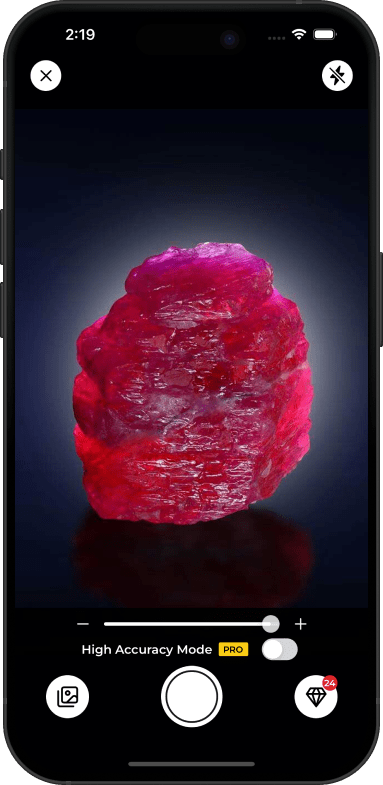
Identify Coffinite Instantly
- Snap a photo, get instant results
- 6,700+ rocks, minerals & crystals
- Discover collecting spots near you
Coffinite FAQs
How do I identify Coffinite?
Coffinite can be identified by its hardness of 5 - 6 on the Mohs scale, Black color. Look for these key characteristics when examining specimens.
What color is Coffinite?
Coffinite typically appears in Black. Color can vary depending on impurities and formation conditions.
How hard is Coffinite?
Coffinite has a hardness of 5 - 6 on the Mohs scale. This gives it moderate hardness.
What is the characteristics of coffinite of Coffinite?
Initial examination of coffinite by Stieff et al. described the mineral as black in color with an adamantine luster, indistinguishable from uraninite (UO2). Additionally, the discoverers reported that although no cleavage is seen in coffinite, it does exhibit subconchoidal fracturing and is very fine grained. Initial samples showed a brittle texture and a hardness between 5 and 6, with a specific gravity of 5.1. Later samples from Woodrow Mine in New Mexico collected by Moench showed fibrous internal structure and exceptional crystallization. A polished thin section of coffinite has a brown color and shows anisotropic transmission of light. Optical analysis yielded a refractive index of about 1.74.
What is the composition of coffinite of Coffinite?
Coffinite's chemical formula is U(SiO4)1−x(OH)4x. X-ray powder patterns from samples of coffinite allowed geologists to classify it as a new mineral in 1955. A comparison to the x-ray powder pattern of zircon (ZrSiO4) and thorite (ThSiO4) was the basis for this classification. Preliminary chemical analysis indicated that the uranous silicate exhibited hydroxyl substitution. The results of Sherwood's preliminary chemical analysis were based on samples from three locations. Hydroxyl bonds and silicon-oxygen bonds also proved to exist after infrared absorption spectral analyses were performed. The hydroxyl substitution occurs as (OH)4 for (SiO4). The hydroxyl constituent in coffinite later proved to be nonessential in the formation of a stable synthetic mineral. Recent electron microprobe analysis of the submicroscopic crystals uncovered an abundance of calcium, yttrium, phosphorus, and minimal lead substitutions along with traces of other rare earth elements.


%252FAbenakiite-(ce)-01.jpg&size=small)

