Pyrophyllite
A variety of Minerals
What is Pyrophyllite?
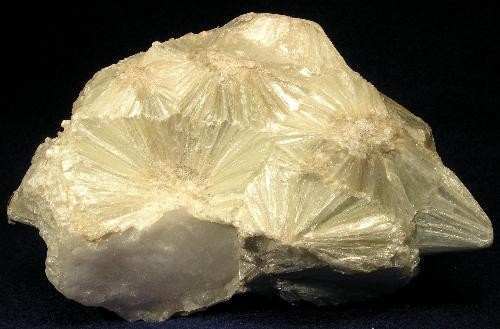
Pyrophyllite is a phyllosilicate mineral composed of aluminium silicate hydroxide: Al2Si4O10(OH)2. It occurs in two forms (habits): crystalline folia and compact masses; distinct crystals are not known. The folia have a pronounced pearly luster, owing to the presence of a perfect cleavage parallel to their surfaces: they are flexible but not elastic, and are usually arranged radially in fan-like or spherical groups. This variety, when heated , exfoliates and swells up to many times its original volume, hence the name pyrophyllite, from the Greek pyro- (πυρο-, the combining form of πῦρ fire) and phyllos (a leaf), given by R. Hermann in 1829. The color of both varieties is white, pale green, greyish or yellowish; they are very soft (hardness of 1.0 to 1.5) and are greasy to the touch. The specific gravity is 2.65 - 2.85. The two varieties are thus very similar to talc.
Uses & Applications
The compact variety of pyrophyllite is used for slate pencils and tailors' chalk (French chalk), and is carved by the Chinese into small images and ornaments of various kinds. Other soft compact minerals (steatite and pinite) used for these Chinese carvings are included with pyrophyllite under the terms agalmatolite and pagodite. Pyrophyllite is easily machineable and has excellent thermal stability, so it is added to clay to reduce thermal expansion when firing, but it has many other industry uses when combined with other compounds, such as in insecticide and for making bricks. Pyrophyllite is also widely used in high-pressure experiments, both as a gasket material and as a pressure-transmitting medium.
Optical Properties
- Refractive Index
- 1.534-1.601
- Birefringence
- 0.05
- Pleochroism
- None
- Optical Character
- Biaxial negative
Market Value Factors
Pricing varies for every rock and mineral, so use these universal factors to gauge Pyrophyllite before comparing listings or appraisals.
Size & Weight
Larger, intact specimens usually command higher prices.
Rarity & Demand
Scarce material or popular varieties sell at a premium.
Condition & Finish
Chips, repairs, and heavy wear lower value; clean prep helps.
Treatment & Provenance
Untreated specimens with documented locality are prized.
Key Characteristics
Formation of Pyrophyllite
Pyrophyllite occurs in phyllite and schistose rocks, often associated with kyanite, of which it is an alteration product. It also occurs as hydrothermal deposits. Typical associated minerals include: kyanite, andalusite, topaz, mica and quartz. Deposits containing well-crystallized material are found in: Manuels, Newfoundland and Labrador, Canada, talc-like bright white appearance, high grade, no impurities; 21 million ton deposit. Currently 2 square miles owned and operated by Trinity Resources Ltd and the surrounding 20 km2 including the Dog Pond and Trout Pond owned by White Fox Silver Resources Inc. Russia - pale green foliated masses, very like talc in appearance, are found at Beresovsk near Yekaterinburg in the Urals. St. Niklas, Zermatt, Valais, Switzerland Vaastana, Kristianstad, Sweden Near Ottrje, Ardennes Mountains, Belgium Ibitiara, Bahia, Brazil Nagano Prefecture, Japan Near Ogilby, Imperial County at Tres Cerritos, Mariposa County, and the Champion mine, White Mountains, Mono County, California, USA Near Quartzsite, La Paz County, Arizona, USA Large deposits at the Deep River region of North Carolina, USA Graves Mountain, Lincoln County, Georgia, USA In South Africa, major deposits of pyrophyllite occur within the Ottosdal region, where it is mined for the production of a variety of manufactured goods, and blocks are quarried and marketed as "Wonderstone" for the carving of sculptures.
Quick Facts
Physical Properties
- Color
- White, gray, pale blue, pale green, pale yellow, brownish green
- Hardness (Mohs)
- 1 - 2
- Rock tumbling
- Not recommended
- Density
- 2.81 g/cm³
- Streak
- White
Chemical Properties
- Chemical Formula
- Al2Si4O10(OH)2
- Elements
- Al, H, O, Si
Also Known As
Identify Pyrophyllite Instantly
- Snap a photo, get instant results
- 6,700+ rocks, minerals & crystals
- Discover collecting spots near you
Pyrophyllite FAQs
How do I identify Pyrophyllite?
Pyrophyllite can be identified by its hardness of 1 - 2 on the Mohs scale, White color. Look for these key characteristics when examining specimens.
What color is Pyrophyllite?
Pyrophyllite typically appears in White, gray, pale blue, pale green, pale yellow, brownish green. Color can vary depending on impurities and formation conditions.
How hard is Pyrophyllite?
Pyrophyllite has a hardness of 1 - 2 on the Mohs scale. This makes it a soft mineral that can be scratched easily.
What is the formation of pyrophyllite of Pyrophyllite?
Pyrophyllite occurs in phyllite and schistose rocks, often associated with kyanite, of which it is an alteration product. It also occurs as hydrothermal deposits. Typical associated minerals include: kyanite, andalusite, topaz, mica and quartz. Deposits containing well-crystallized material are found in: Manuels, Newfoundland and Labrador, Canada, talc-like bright white appearance, high grade, no impurities; 21 million ton deposit. Currently 2 square miles owned and operated by Trinity Resources Ltd and the surrounding 20 km2 including the Dog Pond and Trout Pond owned by White Fox Silver Resources Inc. Russia - pale green foliated masses, very like talc in appearance, are found at Beresovsk near Yekaterinburg in the Urals. St. Niklas, Zermatt, Valais, Switzerland Vaastana, Kristianstad, Sweden Near Ottrje, Ardennes Mountains, Belgium Ibitiara, Bahia, Brazil Nagano Prefecture, Japan Near Ogilby, Imperial County at Tres Cerritos, Mariposa County, and the Champion mine, White Mountains, Mono County, California, USA Near Quartzsite, La Paz County, Arizona, USA Large deposits at the Deep River region of North Carolina, USA Graves Mountain, Lincoln County, Georgia, USA In South Africa, major deposits of pyrophyllite occur within the Ottosdal region, where it is mined for the production of a variety of manufactured goods, and blocks are quarried and marketed as "Wonderstone" for the carving of sculptures.

%252FAbenakiite-(ce)-01.jpg&size=small)

