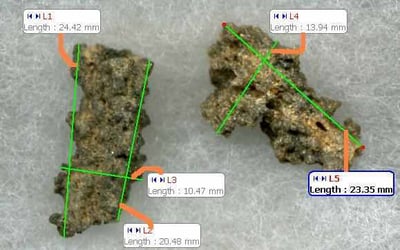
Slate
A variety of Metamorphic
What is Slate?
Slate is a fine-grained, metamorphic rock that is created when shale or mudstone is altered by the heat and pressure of metamorphic action. Most slate is gray in color. Its durability and physical appeal make it a popular material for roofing and flooring. It is also used to build school blackboards and even pool tables.
Etymology & Origins
Before the mid-19th century, the terms slate, shale and schist were not sharply distinguished. In the context of underground coal mining in the United States, the term slate was commonly used to refer to shale well into the 20th century. For example, roof slate referred to shale above a coal seam, and draw slate referred to shale that fell from the mine roof as the coal was removed.
Uses & Applications
Slate has been used for centuries in construction, particularly as roofing tiles due to the flat nature of its fracture pattern and its durability. Slate has also been used in the creation of chalkboards, and it is an excellent insulator, making a popular material for electric panels. Smaller pieces can be used to make turkey calls.
Market Value Factors
Pricing varies for every rock and mineral, so use these universal factors to gauge Slate before comparing listings or appraisals.
Size & Weight
Larger, intact specimens usually command higher prices.
Rarity & Demand
Scarce material or popular varieties sell at a premium.
Condition & Finish
Chips, repairs, and heavy wear lower value; clean prep helps.
Treatment & Provenance
Untreated specimens with documented locality are prized.
Key Characteristics
Characteristics of Slate
Because slate was formed in low heat and pressure, compared to a number of other metamorphic rocks, some fossils can be found in slate; sometimes even microscopic remains of delicate organisms can be found in slate.
Composition of Slate
Slate is mainly composed of the minerals quartz and muscovite or illite, often along with biotite, chlorite, hematite, and pyrite and, less frequently apatite, graphite, kaolinite, magnetite, tourmaline, or zircon as well as feldspar. Occasionally, as in the purple slates of North Wales, ferrous reduction spheres form around iron nuclei, leaving a light green spotted texture. These spheres are sometimes deformed by a subsequent applied stress field to ovoids, which appear as ellipses when viewed on a cleavage plane of the specimen.
Quick Facts
Physical Properties
- Color
- Gray to black, sometimes green, yellow, brown, red
- Hardness (Mohs)
- 2.5 - 4
- Rock tumbling
- Not recommended
- Density
- 2.6 - 2.8 g/cm³
Chemical Properties
Also Known As
Identify Slate Instantly
- Snap a photo, get instant results
- 6,700+ rocks, minerals & crystals
- Discover collecting spots near you
Slate FAQs
How do I identify Slate?
Slate can be identified by its hardness of 2.5 - 4 on the Mohs scale, Gray to black color. Look for these key characteristics when examining specimens.
What color is Slate?
Slate typically appears in Gray to black, sometimes green, yellow, brown, red. Color can vary depending on impurities and formation conditions.
How hard is Slate?
Slate has a hardness of 2.5 - 4 on the Mohs scale. This makes it a soft mineral that can be scratched easily.
What is the characteristics of slate of Slate?
Because slate was formed in low heat and pressure, compared to a number of other metamorphic rocks, some fossils can be found in slate; sometimes even microscopic remains of delicate organisms can be found in slate.
What is the composition of slate of Slate?
Slate is mainly composed of the minerals quartz and muscovite or illite, often along with biotite, chlorite, hematite, and pyrite and, less frequently apatite, graphite, kaolinite, magnetite, tourmaline, or zircon as well as feldspar. Occasionally, as in the purple slates of North Wales, ferrous reduction spheres form around iron nuclei, leaving a light green spotted texture. These spheres are sometimes deformed by a subsequent applied stress field to ovoids, which appear as ellipses when viewed on a cleavage plane of the specimen.