Thorite
A variety of Minerals

What is Thorite?
Thorite, (Th,U)SiO4, is a rare nesosilicate of thorium that crystallizes in the tetragonal system and is isomorphous with zircon and hafnon. It is the most common mineral of thorium and is nearly always strongly radioactive. It was named in 1829 to reflect its thorium content. Thorite was discovered in 1828 on the island of Løvøya, Norway, by the vicar and mineralogist, Hans Morten Thrane Esmark, who sent the first specimens of this black mineral to his father, Jens Esmark, who was a professor of mineralogy and geology.
Market Value Factors
Pricing varies for every rock and mineral, so use these universal factors to gauge Thorite before comparing listings or appraisals.
Size & Weight
Larger, intact specimens usually command higher prices.
Rarity & Demand
Scarce material or popular varieties sell at a premium.
Condition & Finish
Chips, repairs, and heavy wear lower value; clean prep helps.
Treatment & Provenance
Untreated specimens with documented locality are prized.
Key Characteristics
Characteristics of Thorite
Thorite is commonly metamict and hydrated, making it optically isotropic and amorphous. Owing to differences in composition, the specific gravity varies from 4.4 to 6.6 g/cm. Hardness is 4.5 and the luster is vitreous or resinous. The color is normally black, but also brownish black, orange, yellowish-orange and dark green. Because thorite is highly radioactive, specimens are often metamict. This is a condition found in radioactive minerals that results from the destructive effects of its own radiation on its crystal lattice. The effect can destroy a crystal lattice completely while leaving the outward appearance unchanged.
Formation of Thorite
Specimens of thorite generally come from igneous pegmatites and volcanic extrusive rocks, hydrothermal veins and contact metamorphic rocks. It is also known to occur as small grains in detrital sands. Crystals are rare, but when found can produce nicely shaped short prismatic crystals with pyramidal terminations. It is commonly associated with zircon, monazite, gadolinite, fergusonite, uraninite, yttrialite and pyrochlore. Thorite is currently an important ore of uranium. A variety of thorite, often called "uranothorite", is particularly rich in uranium and has been a viable uranium ore at Bancroft in Ontario, Canada. Other varieties of thorite include "orangite", an orange variety, and "calciothorite", an impure variety with trace amounts of calcium.
More Images


Quick Facts
Physical Properties
- Color
- Yellow, yellow-brown, red-brown, green, orange to black
- Hardness (Mohs)
- 4.5
- Rock tumbling
- Not recommended
Chemical Properties
- Chemical Formula
- Th(SiO4) Often contains U replacing Th.
- Elements
- O, Si, Th
Also Known As
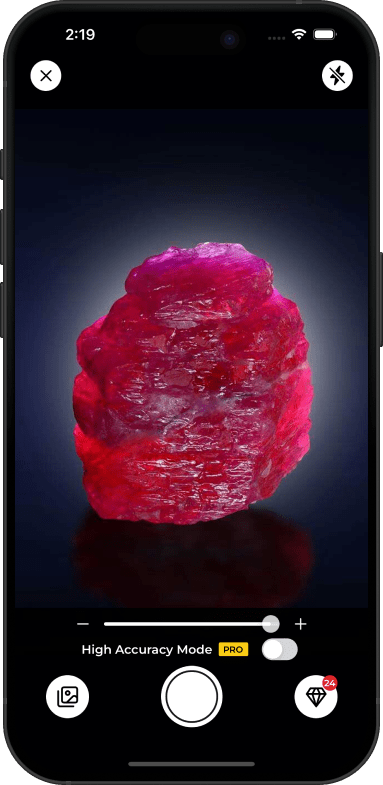
Identify Thorite Instantly
- Snap a photo, get instant results
- 6,700+ rocks, minerals & crystals
- Discover collecting spots near you
Thorite FAQs
How do I identify Thorite?
Thorite can be identified by its hardness of 4.5 on the Mohs scale, Yellow color. Look for these key characteristics when examining specimens.
What color is Thorite?
Thorite typically appears in Yellow, yellow-brown, red-brown, green, orange to black. Color can vary depending on impurities and formation conditions.
How hard is Thorite?
Thorite has a hardness of 4.5 on the Mohs scale. This gives it moderate hardness.
What is the characteristics of thorite of Thorite?
Thorite is commonly metamict and hydrated, making it optically isotropic and amorphous. Owing to differences in composition, the specific gravity varies from 4.4 to 6.6 g/cm. Hardness is 4.5 and the luster is vitreous or resinous. The color is normally black, but also brownish black, orange, yellowish-orange and dark green. Because thorite is highly radioactive, specimens are often metamict. This is a condition found in radioactive minerals that results from the destructive effects of its own radiation on its crystal lattice. The effect can destroy a crystal lattice completely while leaving the outward appearance unchanged.
What is the formation of thorite of Thorite?
Specimens of thorite generally come from igneous pegmatites and volcanic extrusive rocks, hydrothermal veins and contact metamorphic rocks. It is also known to occur as small grains in detrital sands. Crystals are rare, but when found can produce nicely shaped short prismatic crystals with pyramidal terminations. It is commonly associated with zircon, monazite, gadolinite, fergusonite, uraninite, yttrialite and pyrochlore. Thorite is currently an important ore of uranium. A variety of thorite, often called "uranothorite", is particularly rich in uranium and has been a viable uranium ore at Bancroft in Ontario, Canada. Other varieties of thorite include "orangite", an orange variety, and "calciothorite", an impure variety with trace amounts of calcium.


%252FAbenakiite-(ce)-01.jpg&size=small)

