Topaz
A variety of Minerals

What is Topaz?
Topaz is a common household name and readily available in almost any jewelry store globally. It is a tough gem, ranking in the top-five hardest known to man. It is nearly chameleon in nature and can range from crisp and clear to murky purple and all colors in between!
Etymology & Origins
The name "topaz" is usually derived (via Old French: Topace and Latin: Topazus) from the Greek Τοπάζιος (Τοpáziοs) or Τοπάζιον (Τοpáziοn), from Τοπαζος, the ancient name of St. John's Island in the Red Sea which was difficult to find and from which a yellow stone (now believed to be chrysolite: yellowish olivine) was mined in ancient times; topaz itself (rather than topazios) was not really known before the classical era. Ancient Sri Lanka (Tamraparni) exported native oriental topazes to Greece and ancient Egypt, which led to the etymologically related names of the island by Alexander Polyhistor (Topazius) and the early Egyptians (Topapwene) – "land of the Topaz." Pliny said that Topazos is a legendary island in the Red Sea and the mineral "topaz" was first mined there. Alternatively, the word topaz may be related to the Sanskrit word तपस् "tapas," meaning "heat" or "fire."
Uses & Applications
Topaz is one of the world’s most popular gemstones, commonly found in jewelry and in mineral collections. It is the standard mineral for number 8 on Moh’s Hardness Scale and is still used today when determining the hardness of other minerals. Topaz is occasionally used in making refractory materials, molds for casting glass and metal, and in the production of fluorine compounds.
Healing Properties
Topaz often described as the stone of passion and love, promoting forgiveness and encouraging truth. It is believed to enhance self-confidence, helping to remove the negative forces of doubt and replacing them with the positive energy needed to pursue one's dreams. Keep this stone in a room to promote joy and discourage negative energy. Wear it for protection and empowerment.
Optical Properties
- Refractive Index
- 1.606-1.644
- Birefringence
- 0.008-0.011
- Pleochroism
- Pink topaz - distinct: colorless, pale pink, pink
- Red topaz - distinct: dark red, yellow, pinkish-red
- Orange/brown topaz - distinct: yellow-brown, brown
- Yellow topaz - weak: pale yellow, honey-yellow, yellow
- Violet/purple topaz - distinct: colorless, pale pink, purple
- Blue topaz - weak: colorless, pinkish, bluish
- Green topaz - weak: colorless, light green, blue-green
- Optical Character
- Biaxial positive
- Dispersion
- 0.014
Discover Values
Market Value Factors
Pricing varies for every rock and mineral, so use these universal factors to gauge Topaz before comparing listings or appraisals.
Size & Weight
Larger, intact specimens usually command higher prices.
Rarity & Demand
Scarce material or popular varieties sell at a premium.
Condition & Finish
Chips, repairs, and heavy wear lower value; clean prep helps.
Treatment & Provenance
Untreated specimens with documented locality are prized.
Where to Find Topaz
RockHoundR, the free-to-download rockhounding map from the Ruby Glint team, shows where collectors find topaz in the US, with land-access notes for BLM land and national forests. Collecting is banned in national parks.
See where to find topazAlways check the local rules and get the landowner's permission before you collect.
The Meaning
Topaz, one of the November birthstones and state emblem of Utah, was believed to be a gemstone representing peace and healing in mythology. The Romans, the stone's founders, stated that if worn, it would protect from enemies and restore alliances. The old Egyptians asserted that topaz was given mystical powers by Ra, the sun god, while South American tribes claimed that, on the night of a full moon, the gemstone could alleviate illness.
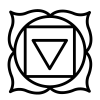
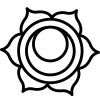
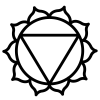
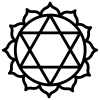
Associated Chakras

Key Characteristics
Characteristics of Topaz
Topaz in its natural state is a golden brown to yellow – a characteristic which means it is sometimes confused with citrine, a less valuable gemstone. A variety of impurities and treatments may make topaz wine red, pale gray, reddish-orange, pale green, or pink (rare), and opaque to translucent/transparent. The pink and red varieties come from chromium replacing aluminium in its crystalline structure. Imperial topaz is yellow, pink (rare, if natural) or pink-orange. Brazilian imperial topaz can often have a bright yellow to deep golden brown hue, sometimes even violet. Many brown or pale topazes are treated to make them bright yellow, gold, pink, or violet colored. Some imperial topaz stones can fade on exposure to sunlight for an extended period of time. Naturally occurring blue topaz is quite rare. Typically, colorless, gray, or pale yellow and blue material is heat treated and irradiated to produce a more desired darker blue. Mystic topaz is colorless topaz which has been artificially coated via a vapor deposition process giving it a rainbow effect on its surface. Although very hard, topaz must be treated with greater care than some other minerals of similar hardness (such as corundum) because of a weakness of atomic bonding of the stone's molecules along one or another axial plane (whereas diamonds, for example, are composed of carbon atoms bonded to each other with equal strength along all of its planes). This gives topaz a tendency to break along such a cleavage plane if struck with sufficient force. Topaz has a relatively low index of refraction for a gemstone, and so stones with large facets or tables do not sparkle as readily as stones cut from minerals with higher refractive indices, though quality colorless topaz sparkles and shows more "life" than similarly cut quartz. When given a typical "brilliant" cut, topaz may either show a sparkling table facet surrounded by dead-looking crown facets or a ring of sparkling crown facets with a dull well-like table.
Formation of Topaz
Topaz is commonly associated with silicic igneous rocks of the granite and rhyolite type. It typically crystallizes in granitic pegmatites or in vapor cavities in rhyolite lava flows including those at Topaz Mountain in western Utah and Chivinar in South America. It can be found with fluorite and cassiterite in various areas including the Ural and Ilmensky Mountains of Russia, in Afghanistan, Sri Lanka, Czech Republic, Germany, Norway, Pakistan, Italy, Sweden, Japan, Brazil, Mexico; Flinders Island, Australia; Nigeria and the United States. Brazil is one of the largest producers of topaz, some clear topaz crystals from Brazilian pegmatites can reach boulder size and weigh hundreds of pounds. The Topaz of Aurangzeb, observed by Jean Baptiste Tavernier weighed 157.75 carats. The American Golden Topaz, a more recent gem, weighed a massive 22,892.5 carats. Large, vivid blue topaz specimens from the St. Anns mine in Zimbabwe were found in the late 1980s. Colorless and light-blue varieties of topaz are found in Precambrian granite in Mason County, Texas within the Llano Uplift. There is no commercial mining of topaz in that area. It is possible to synthesize topaz.
More Images

Quick Facts
Physical Properties
- Color
- Colourless, white, pale blue, light green, yellow, yellowish brown, red
- Hardness (Mohs)
- 8
- Rock tumbling
- Not recommended
- Density
- 3.4 - 3.6 g/cm³
- Streak
- White
- Luster
- Vitreous
- Crystal System
- Orthorhombic
Chemical Properties
- Chemical Formula
- Al2(SiO4)(F,OH)2
- Elements
- Al, F, H, O, Si
Also Known As
Identify Topaz Instantly
- Snap a photo, get instant results
- 6,700+ rocks, minerals & crystals
- Discover collecting spots near you
Topaz FAQs
How do I identify Topaz?
Topaz can be identified by its hardness of 8 on the Mohs scale, Colourless color, Vitreous luster, Orthorhombic crystal system. Look for these key characteristics when examining specimens.
What color is Topaz?
Topaz typically appears in Colourless, white, pale blue, light green, yellow, yellowish brown, red. Color can vary depending on impurities and formation conditions.
How hard is Topaz?
Topaz has a hardness of 8 on the Mohs scale. This makes it a relatively hard mineral suitable for jewelry.
What is the characteristics of topaz of Topaz?
Topaz in its natural state is a golden brown to yellow – a characteristic which means it is sometimes confused with citrine, a less valuable gemstone. A variety of impurities and treatments may make topaz wine red, pale gray, reddish-orange, pale green, or pink (rare), and opaque to translucent/transparent. The pink and red varieties come from chromium replacing aluminium in its crystalline structure. Imperial topaz is yellow, pink (rare, if natural) or pink-orange. Brazilian imperial topaz can often have a bright yellow to deep golden brown hue, sometimes even violet. Many brown or pale topazes are treated to make them bright yellow, gold, pink, or violet colored. Some imperial topaz stones can fade on exposure to sunlight for an extended period of time. Naturally occurring blue topaz is quite rare. Typically, colorless, gray, or pale yellow and blue material is heat treated and irradiated to produce a more desired darker blue. Mystic topaz is colorless topaz which has been artificially coated via a vapor deposition process giving it a rainbow effect on its surface. Although very hard, topaz must be treated with greater care than some other minerals of similar hardness (such as corundum) because of a weakness of atomic bonding of the stone's molecules along one or another axial plane (whereas diamonds, for example, are composed of carbon atoms bonded to each other with equal strength along all of its planes). This gives topaz a tendency to break along such a cleavage plane if struck with sufficient force. Topaz has a relatively low index of refraction for a gemstone, and so stones with large facets or tables do not sparkle as readily as stones cut from minerals with higher refractive indices, though quality colorless topaz sparkles and shows more "life" than similarly cut quartz. When given a typical "brilliant" cut, topaz may either show a sparkling table facet surrounded by dead-looking crown facets or a ring of sparkling crown facets with a dull well-like table.
What is the formation of topaz of Topaz?
Topaz is commonly associated with silicic igneous rocks of the granite and rhyolite type. It typically crystallizes in granitic pegmatites or in vapor cavities in rhyolite lava flows including those at Topaz Mountain in western Utah and Chivinar in South America. It can be found with fluorite and cassiterite in various areas including the Ural and Ilmensky Mountains of Russia, in Afghanistan, Sri Lanka, Czech Republic, Germany, Norway, Pakistan, Italy, Sweden, Japan, Brazil, Mexico; Flinders Island, Australia; Nigeria and the United States. Brazil is one of the largest producers of topaz, some clear topaz crystals from Brazilian pegmatites can reach boulder size and weigh hundreds of pounds. The Topaz of Aurangzeb, observed by Jean Baptiste Tavernier weighed 157.75 carats. The American Golden Topaz, a more recent gem, weighed a massive 22,892.5 carats. Large, vivid blue topaz specimens from the St. Anns mine in Zimbabwe were found in the late 1980s. Colorless and light-blue varieties of topaz are found in Precambrian granite in Mason County, Texas within the Llano Uplift. There is no commercial mining of topaz in that area. It is possible to synthesize topaz.

%252FAbenakiite-(ce)-01.jpg&size=small)

