Wadsleyite
A variety of Minerals

What is Wadsleyite?
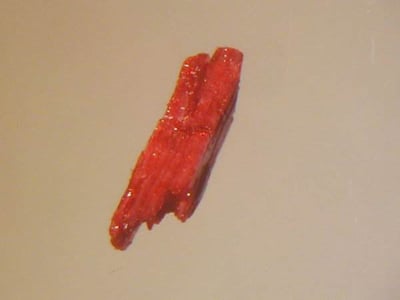
Wadsleyite, a high-pressure phase of olivine, is an orthorhombic mineral with the formula β-(Mg,Fe)2SiO4. It was first found in nature in the Peace River meteorite from Alberta, Canada. It is formed by a phase transformation from olivine (α-(Mg,Fe)2SiO4) under increasing pressure and eventually transforms into spinel-structured ringwoodite (γ-(Mg,Fe)2SiO4) as pressure increases further. The structure can take up a limited amount of other bivalent cations instead of magnesium, but contrary to the α and γ structures, a β structure with the sum formula Fe2SiO4 is not thermodynamically stable. Its cell parameters are approximately a = 5.7 Å, b = 11.71 Å and c = 8.24 Å. Wadsleyite is found to be stable in the upper part of the Transition Zone of the Earth's mantle between 410–520 kilometres (250–320 mi) in depth. Because of oxygens not bound to silicon in the Si2O7 groups of wadsleyite, it leaves some oxygen atoms underbonded, and as a result, these oxygens are hydrated easily, allowing for high concentrations of hydrogen atoms in the mineral. Hydrous wadsleyite is considered a potential site for water storage in the Earth's mantle due to the low electrostatic potential of the underbonded oxygen atoms. Although wadsleyite does not contain H in its chemical formula, it may contain more than 3 percent by weight H2O, and may coexist with a hydrous melt at transition zone pressure-temperature conditions. The solubility of water and the density of wadsleyite depend on the temperature and pressure in the Earth. Even though their maximum water storage capabilities might be reduced to about 0.5-1 wt% along the normal geotherm, the Transition Zone which holds up to 60 vol% wadsleyite could still be a major water reservoir in the Earth’s interior. Furthermore, the transformation resulting in wadsleyite is thought to occur also in the shock event when a meteorite impacts the Earth or another planet at very high velocity. Wadsleyite was first identified by Ringwood and Major in 1966 and was confirmed to be a stable phase by Akimoto and Sato in 1968. The phase was originally known as β-Mg2SiO4 or “beta-phase”. Wadsleyite was named for mineralogist Arthur David Wadsley (1918–1969).
Market Value Factors
Pricing varies for every rock and mineral, so use these universal factors to gauge Wadsleyite before comparing listings or appraisals.
Size & Weight
Larger, intact specimens usually command higher prices.
Rarity & Demand
Scarce material or popular varieties sell at a premium.
Condition & Finish
Chips, repairs, and heavy wear lower value; clean prep helps.
Treatment & Provenance
Untreated specimens with documented locality are prized.
Key Characteristics
Composition of Wadsleyite
In values of weight percent oxide, the pure magnesian variety of wadsleyite would be 42.7% SiO2 and 57.3% MgO by mass. An analysis of trace elements in wadsleyite suggests that there are a number of elements included in it. Results demonstrate traces of rubidium (Rb), strontium (Sr), barium (Ba), titanium (Ti), zirconium (Zr), niobium (Nb), hafnium (Hf), tantalum (Ta), thorium (Th), and uranium (U) in wadsleyite and suggest that the concentrations of these elements could be larger than what has been supposed in the transition zone of Earth's upper mantle. Moreover, these results help in understanding chemical differentiation and magmatism inside the Earth. Although nominally anhydrous, wadsleyite can incorporate more than 3 percent by weight H2O, which means that it is capable of incorporating more water than Earth's oceans and may be a significant reservoir for H (or water) in the Earth's interior.
Quick Facts
Physical Properties
- Color
- Light grayish brown
- Density
- 3.84 g/cm³
Chemical Properties
- Chemical Formula
- Mg4O(Si2O7) although the formula is typically written as β-Mg2SiO4 to emphasize its polymorphic relationship to forsterite, wadsleyite is actually a sorosilicate and not a member of the olivine group. This formula format also better illustrates where hydration of the bridging O occurs in "hydrous wadsleyite".
- Elements
- Mg, O, Si

Identify Wadsleyite Instantly
- Snap a photo, get instant results
- 6,700+ rocks, minerals & crystals
- Discover collecting spots near you
Wadsleyite FAQs
How do I identify Wadsleyite?
Wadsleyite can be identified by its Light grayish brown color. Look for these key characteristics when examining specimens.
What color is Wadsleyite?
Wadsleyite typically appears in Light grayish brown. Color can vary depending on impurities and formation conditions.
What is the composition of wadsleyite of Wadsleyite?
In values of weight percent oxide, the pure magnesian variety of wadsleyite would be 42.7% SiO2 and 57.3% MgO by mass. An analysis of trace elements in wadsleyite suggests that there are a number of elements included in it. Results demonstrate traces of rubidium (Rb), strontium (Sr), barium (Ba), titanium (Ti), zirconium (Zr), niobium (Nb), hafnium (Hf), tantalum (Ta), thorium (Th), and uranium (U) in wadsleyite and suggest that the concentrations of these elements could be larger than what has been supposed in the transition zone of Earth's upper mantle. Moreover, these results help in understanding chemical differentiation and magmatism inside the Earth. Although nominally anhydrous, wadsleyite can incorporate more than 3 percent by weight H2O, which means that it is capable of incorporating more water than Earth's oceans and may be a significant reservoir for H (or water) in the Earth's interior.

%252FAbenakiite-(ce)-01.jpg&size=small)

