How to Tell if an Opal Is Real
Real opal fakes come in three flavors: synthetic opal grown in a lab, assembled doublets and triplets that use only a paper-thin slice of real opal, and outright imitations like opalite glass. Each one is detectable at home — the play-of-color pattern, the side profile, and a few drops of water tell you most of what you need to know.
The 60-Second Opal Checklist
Run these quick checks first — most fakes fail at least one before you ever reach for a loupe.
- Natural play-of-color is irregular and random — not uniform
- 'Lizard skin' or columnar honeycomb pattern = synthetic
- Check the side: visible layers mean doublet or triplet
- Opalite glass glows milky blue but has NO true color flashes
- A domed clear top is the cap of a triplet
5 At-Home Tests for Real Opal
Work through these in order — each one is safe for genuine opal unless noted, and together they expose nearly every common fake.
Play-of-color pattern check
Examine the color flashes face-up under a single light, then at 10×.
Real opal
Random, irregular patches of color that roll and shift unevenly as you rotate the stone.
Fake
Gilson-type synthetics show ordered 'lizard skin' or chicken-wire patterns, and columnar color zones visible from the side, like tiny vertical pipes.
Side-profile (layer) inspection
Look at the stone edge-on with a loupe, ideally unset or with light behind it.
Real opal
Solid opal shows continuous material from top to bottom, often with natural potch banding.
Fake
Doublets show a razor-straight black glue line under the opal layer; triplets add a clear quartz or glass dome on top — three visible layers.
The water test (for hydrophane)
Place a drop of water on the surface, or briefly submerge a loose stone.
Real opal
Ethiopian hydrophane opal absorbs water and may turn temporarily translucent; Australian opal barely changes. Both behave 'mineral'.
Fake
Plastic imitations feel warm and light and never absorb; assembled stones can be ruined by soaking (glue clouding) — submerge only if you suspect solid opal.
Opalite glass check
Hold the stone against dark and light backgrounds.
Real opal
Genuine opal shows discrete spectral color patches regardless of background.
Fake
Opalite glows a hazy blue on dark backgrounds and orangey on light ones — an even milky sheen with zero distinct color play. It's marketing glass, not opal.
Heft and temperature
Hold the stone against your lip or cheek for a moment.
Real opal
Stone-cold initially; opal has a density around 2.0 g/cm³ and feels like rock.
Fake
Plastic imitations (Slocum-style) feel warm and unnaturally light, and show scratches from normal handling.
Common Fake Opals & How to Spot Them
These are the materials most often sold as opal — and the giveaway that exposes each one.
| Imitation | How to spot it | The giveaway |
|---|---|---|
| Opal doublet / triplet | Straight glue line at the side; triplets have a clear cap; backs are black plastic or potch. | Worth 5–10% of solid opal — always check the profile before paying solid-opal prices. |
| Synthetic (Gilson-type) opal | Ordered lizard-skin pattern face-up, columnar structure from the side, often too vivid. | Perfection and regularity — natural play-of-color is chaotic. |
| Opalite (glass) | Even milky-blue adularescence, no color patches, bubbles inside at 10×. | No true play-of-color whatsoever. |
| Plastic imitation | Warm to the touch, ultra-light, scratches with a fingernail file. | Density roughly half of real opal — it floats high in heavy liquids and feels like a toy. |
When to get professional testing
Solid natural opal — especially black opal — varies in price by orders of magnitude based on body tone, brightness, and pattern. Before selling or insuring, get an opal-specialist appraisal; standard diamond-focused jewelers routinely misgrade opal.
Photo-Check Your Opal in Seconds
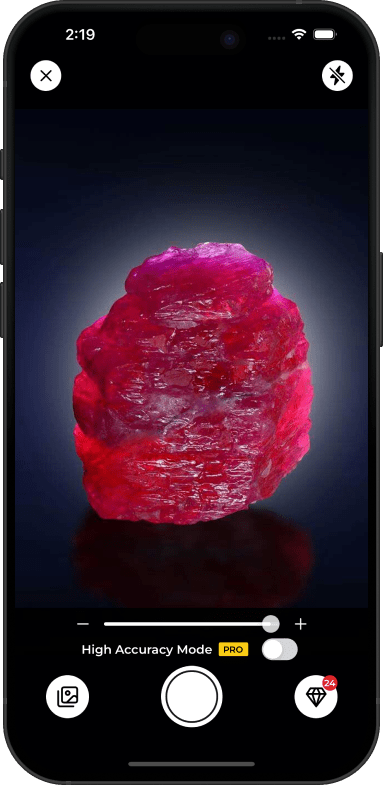
Upload a photo and Ruby Glint's AI compares your stone against thousands of verified opal and lookalike references — free, no login required.
Or try the free online identifier

Real vs Fake Opal: Your Questions
Get answers to common questions about rock identification, rockhounding, and using our platform.
A doublet is a thin slice of real opal glued onto a dark backing to mimic black opal; a triplet adds a clear protective dome on top. Both show flat glue lines from the side and are worth a small fraction of solid opal of the same face-up look.
No. Opalite is man-made glass with a milky blue glow. It contains no opal at all and shows none of the distinct shifting color patches that define genuine play-of-color.
Solid natural opal is safe in plain water. Avoid soaking doublets and triplets — water can penetrate the glue line and permanently cloud them — and avoid oils, ultrasonic cleaners, and rapid temperature swings for all opals.
Be suspicious. Lab-created opal shows tidy, repeating 'lizard skin' patterns and columnar color zones from the side. Natural opal's beauty is irregular — uniformity is the synthetic's fingerprint.
Keep Going: OpalValue & Identification
Opal Price Per Carat
Current 2026 price ranges by carat size and quality tier.
Opal Value Calculator
Get an instant market estimate for your opal.
Opal Identification Guide
Full encyclopedia entry: properties, colors, and lookalikes.
Free Gemstone Identifier
Upload a photo and identify any gemstone with AI.
Home tests are screening tools, not certification. For high-value purchases, insurance, or resale, confirm with an accredited gem lab (GIA, AGL, Gübelin, SSEF).