How to Tell if a Topaz Is Real
Topaz fraud runs in two directions: cheap stones (citrine, glass) sold as precious topaz, and treated topaz sold as rarer gems. Real topaz is very hard (Mohs 8), noticeably dense, and has a slippery-glassy feel that quartz can't match. These tests sort topaz from its impostors in minutes.
The 60-Second Topaz Checklist
Run these quick checks first — most fakes fail at least one before you ever reach for a loupe.
- Real topaz feels heavy for its size and cold to the touch
- Topaz scratches quartz — citrine 'topaz' cannot
- 'Golden topaz' at quartz prices is citrine
- Almost all blue topaz is treated — natural blue is extremely pale
- Bubbles = glass
5 At-Home Tests for Real Topaz
Work through these in order — each one is safe for genuine topaz unless noted, and together they expose nearly every common fake.
Hardness test against quartz
Drag a corner of the stone across a quartz crystal or amethyst point (test loose stones, inconspicuous spots).
Real topaz
Topaz (Mohs 8) cuts a visible scratch into quartz (Mohs 7).
Fake
Citrine masquerading as 'golden topaz' cannot scratch other quartz; glass can't either.
Density (heft) check
Weigh the stone in your palm against a similar-size quartz or beryl gem.
Real topaz
Topaz's SG of ~3.53 makes it feel distinctly heavy for its size — denser than quartz (2.65) and beryl (2.7).
Fake
Citrine and glass feel light by comparison; this heft difference is surprisingly easy to feel with loose stones.
The slippery-surface feel
Run a fingertip across a polished face.
Real topaz
Topaz takes an exceptional polish and feels notably slick, almost soapy-glassy.
Fake
Quartz and glass feel ordinary; worn glass feels scuffed.
Inclusion and clarity check at 10×
Loupe the interior with side light.
Real topaz
Often very clean; may show two-phase (liquid + gas) inclusions in natural stones.
Fake
Round gas bubbles and swirls indicate glass; visible color concentrated near facets can indicate coated topaz ('mystic' coatings scratch off at edges).
Coating inspection (for rainbow/'mystic' stones)
Examine facet edges and the culet at 10× for color wearing thin.
Real topaz
Natural-color topaz is colored throughout the body.
Fake
Mystic/azotic rainbow topaz is a surface coating — look for scratched-through patches showing colorless topaz beneath.
Common Fake Topazs & How to Spot Them
These are the materials most often sold as topaz — and the giveaway that exposes each one.
| Imitation | How to spot it | The giveaway |
|---|---|---|
| Citrine sold as 'golden/Madeira topaz' | Lower heft, can't scratch quartz, usually warmer orange-brown tone. | Centuries-old naming scam — real imperial topaz costs 50–100× more. |
| Glass | Bubbles, light heft, scratches easily, warm to touch. | Fails every physical test topaz passes. |
| Coated ('mystic') topaz sold as rare | Rainbow iridescence from a thin film; coating chips at facet edges. | It IS topaz, but worth only commercial blue-topaz money. |
| Synthetic spinel / CZ | CZ over-sparkles and is heavier still; spinel shows no pleochroism where topaz has some. | Wrong optics under rotation, wrong fire under light. |
When to get professional testing
True imperial topaz (natural orange-pink from Ouro Preto, Brazil) and untreated pink topaz are rare collector gems — for those, insist on a lab report stating natural color. For blue topaz, treatment is assumed and prices are modest; certification rarely pays for itself.
Photo-Check Your Topaz in Seconds
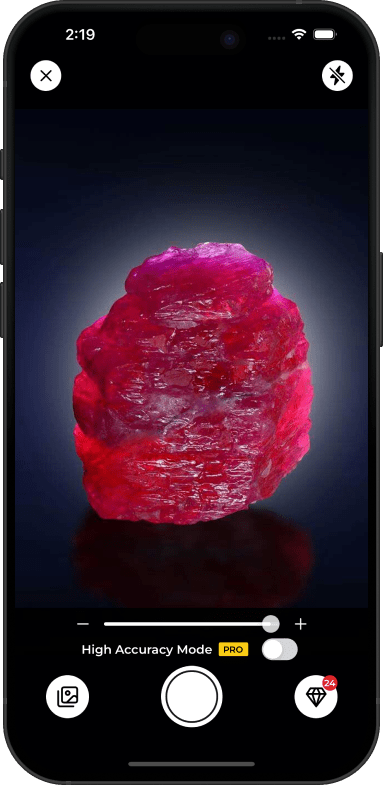
Upload a photo and Ruby Glint's AI compares your stone against thousands of verified topaz and lookalike references — free, no login required.
Or try the free online identifier

Real vs Fake Topaz: Your Questions
Get answers to common questions about rock identification, rockhounding, and using our platform.
The color almost never is. Natural blue topaz is extremely pale and rare; the saturated sky, Swiss, and London blues on the market start as colorless topaz that is irradiated and heated. The stone is real topaz — but the color is man-made, which is why blue topaz stays affordable.
They're different minerals entirely. Topaz is harder (8 vs 7), about 30% denser, and far rarer in fine golden-orange colors. 'Golden topaz', 'Madeira topaz', and 'topaz quartz' are historic trade names for citrine — if the price looks like quartz, it is quartz.
Imperial topaz is the natural orange-to-pink material, classically from Ouro Preto, Brazil, running $200–$3,500+ per carat. Verify the heft and quartz-scratching hardness at home, then get a lab origin/color report for anything sold at imperial prices — citrine and treated stones are common substitutes.
Yes. Topaz has perfect basal cleavage — a sharp knock can split it cleanly despite its Mohs 8 hardness. That's also a subtle authenticity hint: lapidaries orient topaz carefully, and visible cleavage flats inside a stone point toward genuine topaz.
Keep Going: TopazValue & Identification
Topaz Price Per Carat
Current 2026 price ranges by carat size and quality tier.
Gemstone Value Calculator
Get an instant market estimate for your topaz.
Topaz Identification Guide
Full encyclopedia entry: properties, colors, and lookalikes.
Free Gemstone Identifier
Upload a photo and identify any gemstone with AI.
Home tests are screening tools, not certification. For high-value purchases, insurance, or resale, confirm with an accredited gem lab (GIA, AGL, Gübelin, SSEF).