Free calculator
Garnet value calculator
Find out what your garnet is worth in seconds. Use this garnet price calculator to estimate value by type, color, clarity, and carat weight.
Garnet Value Calculator
Question 1 of 4
Which garnet is it?
One free valuation on the web. Unlimited in the app.
Garnet is a family of gems, not one stone. A green tsavorite or demantoid sells for many times the price of a red pyrope or almandine of the same size, so the first question is which garnet you have.
- 4.6on the App Store
- Free - no account needed
- Instant results
- Market-based ranges
- Updated
Garnet price per carat: 2026 market reference
What collectors pay for a loose, natural garnet, as of October 2026: the garnet value per carat for each type, from a commercial stone to a fine one. Use the calculator above for an estimate for your own stone.
Garnet by type, 1 ct, per carat
| Type | Commercial | Good | Top |
|---|---|---|---|
| Tsavorite | $280–$550 | $550–$1,100 | $1,100–$2,100 |
| Merelani Mint | $130–$250 | $250–$480 | $480–$920 |
| Demantoid, Russia (lab report) | $1,300–$2,300 | $2,300–$3,900 | $3,900–$6,700 |
| Demantoid, any origin | $350–$790 | $790–$1,800 | $1,800–$4,000 |
| Spessartite | $40–$110 | $110–$310 | $310–$870 |
| Rhodolite | $20–$56 | $56–$160 | $160–$440 |
| Malaya garnet | $30–$84 | $84–$240 | $240–$670 |
| Color change garnet | $92–$240 | $240–$610 | $610–$1,600 |
| Red garnet | $8–$21 | $21–$57 | $57–$150 |
Not sure what the stone is?
Upload a garnet photo to our gemstone identifier for an AI-powered estimate that looks at the stone itself.What determines how much a garnet is worth?
The type of garnet comes first in garnet value, then color, size and clarity. Here is how each factor works.
The Type of Garnet
Garnets share a crystal structure but differ in chemistry, and the trade sells them under different names. Pyrope and almandine are the common red garnets. Rhodolite is a purplish-red mix of the two. Spessartine is orange, and its brightest stones are sold as Mandarin garnet. Tsavorite and Merelani mint are green grossular, hessonite is orange-brown grossular, and demantoid is green andradite. Malaya is a pinkish-orange mix of pyrope and spessartine.
Prices follow rarity. At 1 ct, red garnet sells for $8–$150 per carat, rhodolite for $20–$440, Malaya for $30–$670, spessartine for $40–$870, Merelani mint for $130–$920, tsavorite for $280–$2,100 and demantoid for $350–$4,000.
Color Within a Type
Within each type, pure and saturated color sells highest: a vivid green in tsavorite and demantoid, a bright orange in spessartine, and pink to raspberry in rhodolite and Malaya. Brownish, very dark or pale stones sell for much less. For tsavorite at 1 ct, a top-color, eye-clean stone sells for $1,100–$2,100 per carat and a commercial one for $280–$550.
The calculator asks whether the color is vivid, medium or light and places the stone in its range from your answer.
Carat Weight
Size matters most for the rare types. Fine tsavorite and demantoid over 2 ct are scarce, so their price per carat climbs steeply: a fine tsavorite tops out at $2,100 per carat at 1 ct, $4,200 at 2 ct and $9,400 at 5 ct.
Common red garnet barely rises with size. It tops out at $150 per carat at 1 ct and $260 at 5 ct.
Clarity
Rhodolite, Malaya and tsavorite are normally eye-clean, so visible inclusions lower the price. Mandarin spessartine and demantoid are often included and buyers accept more in them. In demantoid from Russia's Ural Mountains, a fine “horsetail” inclusion can add value.
Origin Matters for Demantoid
For most garnets, origin does not change the price. Demantoid is the exception: at 1 ct, a Russian stone with a lab report sells for $1,300–$6,700 per carat, against $350–$4,000 for demantoid of any origin.
The calculator does not ask for origin or a lab report, so it prices every demantoid at any-origin prices. If you have a report naming Russia, use the Russian row in the table above.
Treatment and Imitations
Nearly all garnets are untreated, which makes pricing simpler than for most colored stones. Some demantoid is gently heated to remove a brownish tint. Filled, dyed or coated stones are worth very little, $2–$20 per carat.
Natural garnet types are not grown as gems in any volume. Stones sold as lab or synthetic garnet are usually glass, cubic zirconia or man-made materials such as YAG, and sell for $1–$40 per carat.
Garnet prices by type and origin
Where a garnet is from matters for demantoid. For every other type, the type itself sets the price.
Russian Demantoid (Ural Mountains)
Demantoid was first found in Russia's Ural Mountains in the 19th century, and Ural stones are still the most wanted. They often show horsetail inclusions, and stones over 2 ct are rare. Russian origin counts only with a lab report.
At 1 ct, with a lab report: $1,300–$6,700 per carat.
Demantoid From Namibia, Madagascar and Elsewhere
Demantoid is also mined in Namibia, Madagascar, Iran and Italy. African stones usually lack the horsetail inclusions of Ural stones and are often a more yellowish green. The calculator prices all demantoid at these any-origin prices.
At 1 ct, any origin: $350–$4,000 per carat.
Tsavorite and Merelani Mint (East Africa)
Tsavorite is green grossular from Kenya, Tanzania and Madagascar, named after Kenya's Tsavo region. Merelani mint is a paler mint-green grossular from Merelani in Tanzania. Fine, clean tsavorite over 2 ct is rare.
At 1 ct: $280–$2,100 per carat for tsavorite, $130–$920 for Merelani mint.
Spessartine, Rhodolite and Red Garnet
Orange spessartine comes from Namibia, Nigeria, Tanzania, Madagascar and Sri Lanka, and a pure bright Mandarin orange sits at the top of its range. Rhodolite and the common red garnets are mined in East Africa, Sri Lanka, Brazil and many other places, and no origin carries a premium.
At 1 ct: $40–$870 per carat for spessartine, $20–$440 for rhodolite, $8–$150 for pyrope and almandine.
How to use our garnet value calculator
Four steps to a garnet price estimate
Step 01
Pick the garnet type
Choose which garnet it is: tsavorite, demantoid, Mandarin, spessartine, rhodolite, Malaya, hessonite, Merelani mint, color change, pyrope or almandine.
Step 02
Describe the color
Say whether the color is vivid, medium or light. Vivid stones sit at the top of the price range for their type.
Step 03
Rate clarity, enter the exact weight
Say whether inclusions are visible and type the carat weight. Prices per carat rise with size, so the exact weight matters.
Step 04
View your estimate
See an estimated value and price range from the same price tables as the Ruby Glint app.
Frequently asked questions about garnet value
How much is garnet worth per carat?
It depends on the type. At 1 ct, red pyrope and almandine garnet sells for $8–$150 per carat, rhodolite for $20–$440, spessartine for $40–$870, tsavorite for $280–$2,100 and demantoid for $350–$4,000. Each range runs from a commercial stone to a fine one.
What is the most valuable type of garnet?
Demantoid and tsavorite, the two green garnets. At 1 ct, a fine demantoid reaches $4,000 per carat, or $6,700 for a Russian stone with a lab report, and a fine tsavorite reaches $2,100. Tsavorite climbs faster with size: a fine 5 ct stone reaches $9,400 per carat.
Is a red garnet worth anything?
A little. Red pyrope and almandine garnet is plentiful, so a 1 ct stone sells for $8–$150 per carat and prices stay modest even in large sizes: $14–$260 per carat at 5 ct. Purplish-red rhodolite sells for more, $20–$440 per carat at 1 ct.
How do I know which type of garnet I have?
Color narrows it down. Deep red to brownish red is usually pyrope or almandine, purplish red to raspberry is rhodolite, orange is spessartine or hessonite, and green is tsavorite or demantoid. Color alone cannot settle it, because the types overlap. A gemologist can tell them apart with standard instruments, and for a green garnet a lab report is worth the cost.
What is a horsetail inclusion in demantoid?
A horsetail is a spray of fine, curved, golden fibers inside a demantoid. It is typical of stones from Russia's Ural Mountains, and it is one of the few inclusions that can add value to a gem, because collectors look for it. A Russian demantoid with a lab report sells for $1,300–$6,700 per carat at 1 ct.
Are garnets treated?
Nearly all garnets are untreated. The main exception is demantoid, some of which is gently heated to remove a brownish tint. Filled, dyed or coated garnets are worth very little, $2–$20 per carat.
How much is color change garnet worth?
Color change garnet sells for $92–$1,600 per carat at 1 ct. Stones with a strong change, from blue-green in daylight to purple or purplish red under warm light, sell at the top of that range. A weak change sells near the bottom.
Has garnet gone up in value?
By our estimate, a fine 1 ct tsavorite moved +31% over the last five years, demantoid +17% and red garnet +16%. These are estimates from dated sales and market reports, not a forecast.
More gem tools
Other free tools on this site.
Spinel value calculator
Price red, pink, cobalt blue, and lavender spinel by color, clarity, and origin.
Value spinel
Tourmaline value calculator
Price Paraíba, rubellite, indicolite, chrome, and bi-color tourmaline.
Value tourmaline
Tanzanite value calculator
Estimate tanzanite worth by color saturation, clarity, and carat weight.
Value tanzanite
Ruby value calculator
Compare with ruby: estimate ruby worth by carat, color, clarity, origin, and treatment.
Value rubies
Gemstone value calculator
Pick any gem we price and estimate its value by carat, color and treatment.
Value another gem
Ruby Glint app
Track garnet prices and your collection
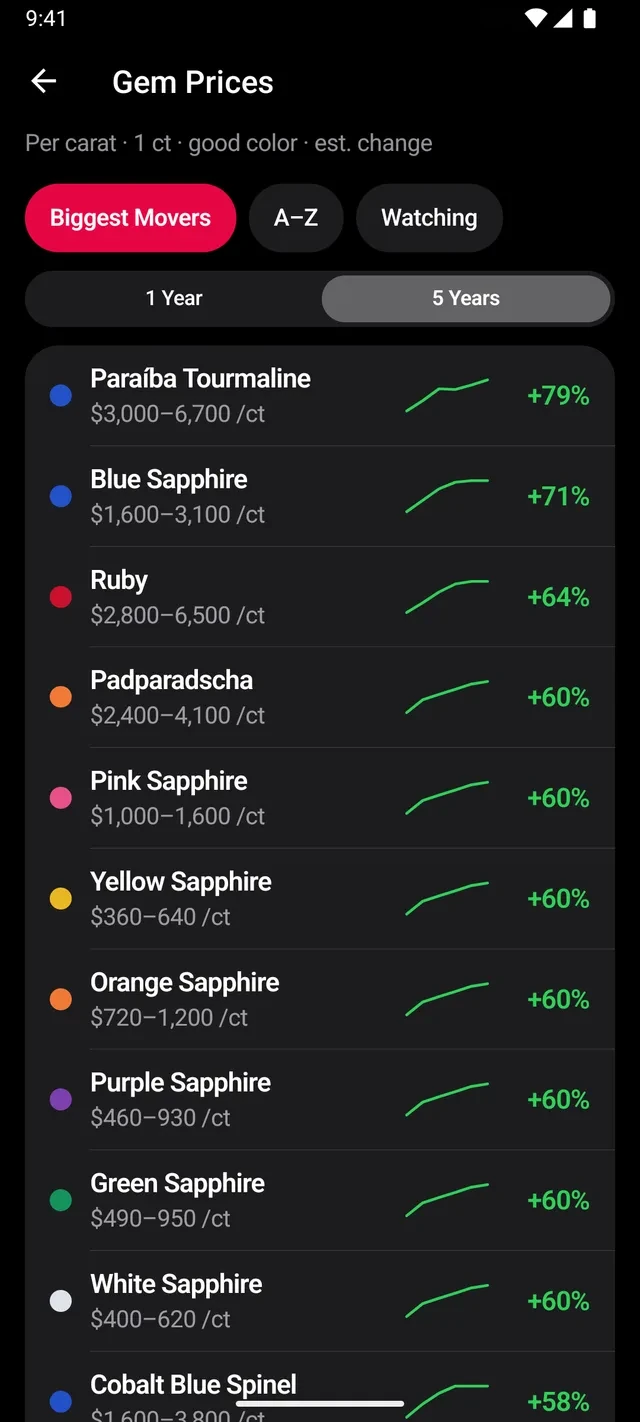
Ruby Glint logs every stone you own, shows what your collection is worth and follows garnet prices over 1, 3, 5 and 10 years. Free to download. Pro includes a 7-day free trial.
- Log your garnets with weight, type and color
- See an estimated value for each stone and the whole collection
- Follow tsavorite, demantoid and other garnet price trends over time